Europe’s Silent Killer: Air Pollution and the Push for Cleaner Air
- David Lowenbrand
- Jul 22, 2025
- 3 min read

Breathing polluted air has become an everyday reality for millions of Europeans, prompting health experts to label air pollution a “silent killer.” In fact, it is the continent’s largest environmental health risk, linked to roughly 300,000 premature deaths across the EU each year.
The Cost of Polluted Air in Europe
Air pollution is a mix of harmful gases and microscopic particles that often goes unnoticed until its effects accumulate. According to the World Health Organization (WHO), nine out of ten people globally breathe polluted air, contributing to about 7 million deaths annually. In Europe, despite decades of progress, the toll remains alarmingly high. Fine particulate matter (PM₂.₅) alone was linked to 238,000 early deaths in EU countries in 2020, with an additional 49,000 deaths attributed to nitrogen dioxide (NO₂) exposure. 96% of urban residents in the EU are still exposed to pollution levels that exceed WHO’s guidelines. This health burden falls heaviest on vulnerable groups – children, the elderly, and lower-income communities suffer the most from dirty air. Such facts underscore why clean air is not just an environmental or scientific issue, but also a matter of public health justice and equity.
The Call for Cleaner Air
Recognising the urgency, European leaders have initiated stronger policies to combat air pollution. In late 2024, the EU revised its Ambient Air Quality Directive (Directive (EU) 2024/2881) as part of the European Green Deal, setting stricter limits on pollutants and aligning closer with WHO recommendations. For example, the annual PM₂.₅ limit will be cut roughly in half (though still higher than the WHO’s ideal target). Beyond tightening standards, the new directive also emphasizes enhanced air quality monitoring and planning at the local level. Authorities are now required to strengthen their monitoring networks and air quality action plans, and citizens will even have the right to seek compensation if their health is damaged by illegal pollution levels. This comprehensive approach – combining regulation, enforcement, and public accountability – marks a significant step in the fight for cleaner air. However, laws and limits alone cannot clean the air; data and technology are critical to translate these goals into reality.
Sensorbee: Monitoring Solutions for Cleaner Air
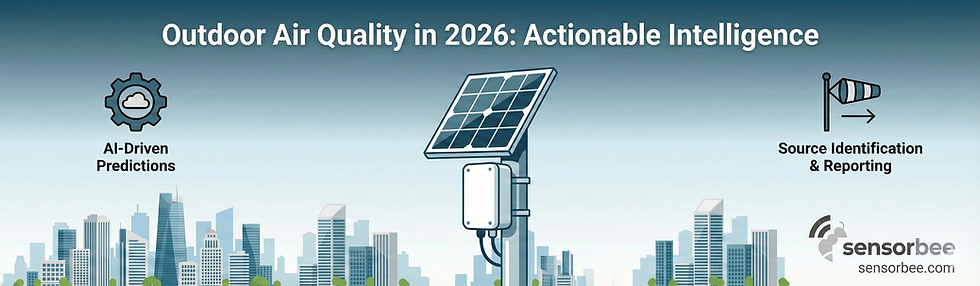
Achieving cleaner air starts with knowing when and where pollution is worst. This is where advanced air quality monitoring systems like Sensorbee come into play. Sensorbee’s environmental monitoring stations can track a wide range of pollutants in real time – including fine dust particles (PM₁, PM₂.₅, PM₁₀) as well as harmful gases such as NO₂, O₃, SO₂, CO and even volatile organic compounds (VOCs). The Sensorbee Pro 2 multi-sensor station, for instance, delivers high-accuracy measurements of these pollutants and buffers the data onboard to prevent any loss during network outages. Weighing under 2 kg, this compact device is easy to deploy on street poles, buildings or industrial sites. It is designed with low-energy, solar-powered operation in mind, and can transmit data continuously via modern IoT networks like NB-IoT or LTE-M for reliable, long-range connectivity. Installation is straightforward and user-friendly, so communities and businesses can start monitoring within minutes of setup.
Key features of Sensorbee’s air quality solution include:
Comprehensive Monitoring: Simultaneously measure particulate levels (PM₁/PM₂.₅/PM₁₀) and multiple gases (e.g. NO₂, O₃, CO, VOCs) to get a full picture of air quality.
Real-Time Data & Alerts: Sensorbee devices stream data to a cloud platform, providing instant insights for informed decision-making. Users can receive alerts when pollution spikes, enabling swift responses.
Easy Deployment, Anywhere: Compact and weather-resistant units with solar power options allow flexible placement – from busy city centers to remote industrial fences – without cumbersome infrastructure. The wireless connectivity ensures data keeps flowing 24/7.
Reliable & Expandable: Built-in data buffering safeguards against connection losses, and an expansion port supports additional sensors (for example, adding a noise module) to broaden environmental monitoring as needed.
By deploying Sensorbee’s network of smart sensors, city officials, industries, and even communities gain hyper-local insight into their air quality conditions. Instead of relying on sparse official stations, they can pinpoint pollution “hotspots” – such as a traffic-clogged intersection or a factory perimeter – and track improvements or new problems in real time. As European cities ramp up efforts to provide more breathable air for their citizens, these granular data insights are proving invaluable. They inform more effective mitigation measures – for example, adjusting traffic flows on high-smog days or verifying that emission control policies are working – and help target interventions where they are needed most.
In summary, air pollution may be Europe’s silent killer, but with modern monitoring technology we can finally give it a voice. Sensorbee’s innovative hardware and cloud-based analytics bridge the gap between policy aspirations and on-the-ground action, empowering authorities and communities alike to respond to pollution in real time. By harnessing accurate data and raising awareness, we move one step closer to truly cleaner air for all – transforming the vision of cleaner European skies into a measurable reality.