
Posted by Oscar Sjöberg on · 4 min read
Spring is back in Stockholm — and so is a familiar air quality problem. As temperatures climb above zero and roads dry out after winter, the sand spread to prevent icy conditions gets pulverised by traffic into fine dust particles. These particles build up in the air of busy streets, reaching levels that pose real health risks, especially for people with asthma, heart conditions, or other respiratory issues.
A recent Aftonbladet report shone a spotlight on this every-year pattern, confirming what air quality researchers have documented for years: road sand, not factory smoke or diesel fumes, is the main driver of Stockholm's worst pollution episodes in late winter and early spring.
The Numbers Tell the Story
According to SLB-analys data from 2024, WHO health guidelines for PM10 were exceeded at every street-level monitoring station in Stockholm — even though the less strict legal EU limit was technically met. The national "Clean Air" environmental target was also missed. And under the EU's new air quality directive (2024/2881), stricter PM10 limits must be achieved by 1 January 2030.
What Is Actually Happening?
Every autumn, Swedish municipalities sand roads and pavements to prevent accidents on ice. That makes perfect sense in winter. The problem comes in spring, when roads dry out and traffic grinds all that accumulated sand into fine airborne dust.
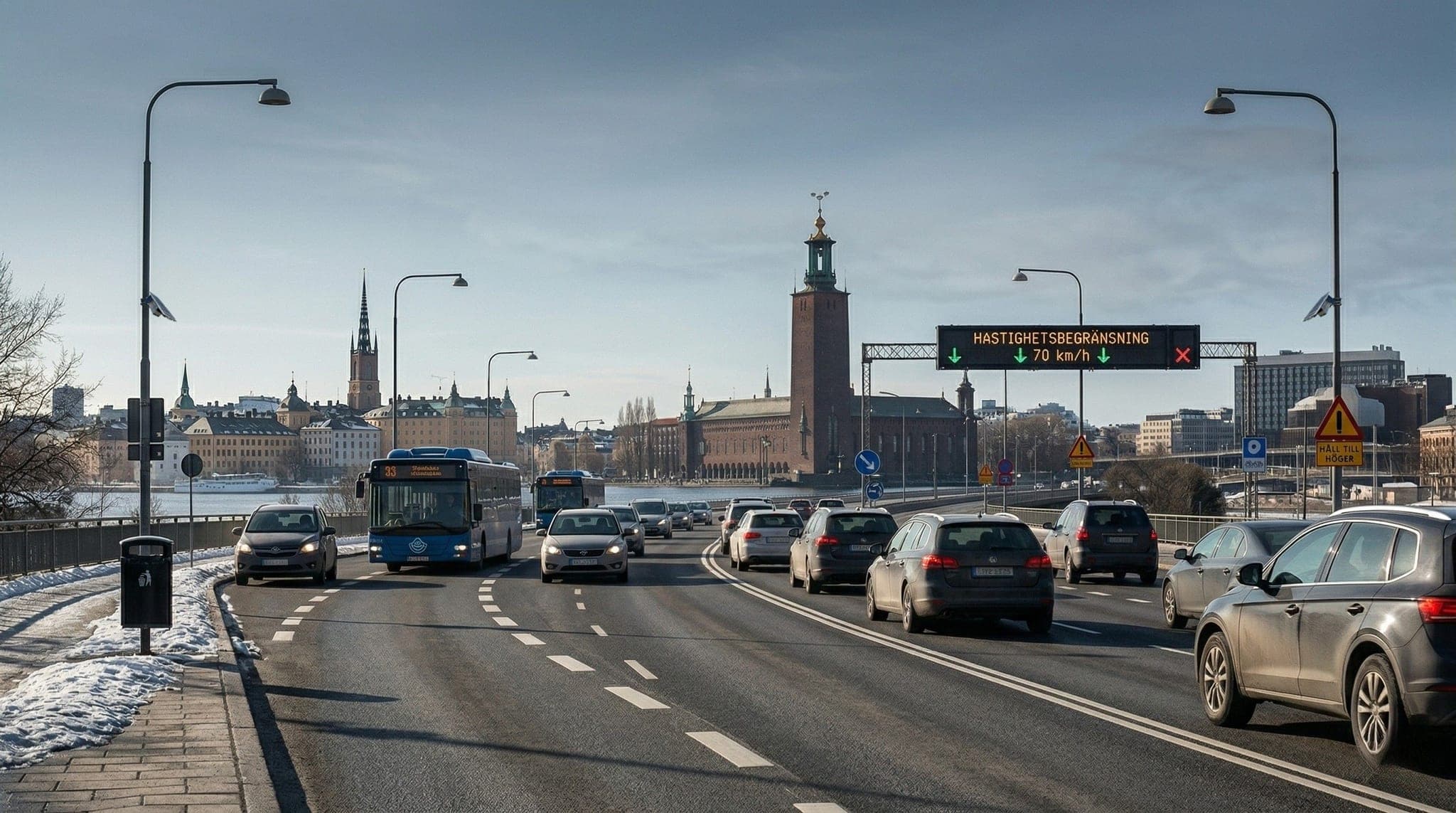
Studded winter tyres make things significantly worse — they not only pulverise the sand but also wear down the asphalt surface itself. The resulting particles, known as PM10 (under 10 micrometres) and PM2.5 (under 2.5 µm), become airborne and build up on streets with tall buildings on both sides, where there is little wind to carry them away. Hornsgatan and the E4/E20 Essingeleden are historically the worst-affected streets in the city.
Road dust from studded tyres and sand ground down by traffic is the largest single source of PM10 particles in Stockholm. — SLB-analys, Luften i Stockholm 2024
Why Existing Monitoring Is Not Enough
Stockholm already runs a solid air quality monitoring network through SLB-analys, with fixed stations on streets like Hornsgatan and S:t Eriksgatan. These stations do important work — but they only measure air quality at the exact spots where they sit. They cannot tell a city manager which block is spiking right now, which street urgently needs dust-binding treatment, or whether the air near a school 400 metres away is safe for children to go outside.
This is not a flaw unique to Stockholm — it is the inherent limitation of any monitoring network with a small number of fixed points. The result is that cities tend to respond after an exceedance has already been recorded, rather than preventing it in the first place.
How Real-Time Sensor Networks Change the Game
Instead of a few expensive reference stations, cities can deploy a dense network of fixed sensors that cover entire neighbourhoods — giving operations teams a real-time picture of air quality, street by street.
Fixed sensor stations — pole-mounted sensors attach to any lamp post and go live in under 10 minutes. They monitor PM10, PM2.5, NO₂ and SO₂ continuously across residential streets, school zones, and busy arterial roads.
Solar-powered, no infrastructure needed — the Sensorbee Air Pro 2 runs entirely on solar power and transmits data over mobile networks. Deploy anywhere, from park paths to highway bridges, without any electrical installation.
Real-time operational dashboards — live air quality data goes straight to city operations teams, so dust-binding treatments and sand removal can be dispatched exactly where and when they are needed, not based on guesswork.
From Reacting to Preventing
Stockholm already uses dust-binding agents and early sand removal — and these measures have brought real improvements over the years. But without detailed location data, operations are still largely reactive: teams respond after a spike has been detected at a fixed station, not before it happens.
A dense monitoring network changes that. By tracking particle levels across many street-level points at once, city teams can see where conditions are deteriorating and get treatment crews to the right streets before air quality turns unhealthy. That is better for residents — and a smarter use of limited operations budgets.
Why Act Now
This problem is not unique to Stockholm. It repeats every spring in cities across Scandinavia and anywhere winter road maintenance relies on sand or grit. And the pressure to improve is growing: the EU's new air quality directive (2024/2881) introduces tighter PM10 limits that must be met by 2030. Cities that build proper monitoring capacity now will be far better placed to meet those requirements — and protect their residents in the meantime.
The data needed to manage this better already exists. The question is whether cities are collecting it in the right places.
Sources and Further Reading
- ·SLB-analys, Luften i Stockholm 2024
- ·Naturvårdsverket, Partiklar PM10 i gaturum — årsmedelvärden
- ·Region Stockholm / CAMM, Miljöhälsorapport 2025: Luftföroreningar utomhus
- ·Sveriges miljömål, Partikelutsläpp PM2.5 — Stockholms län
- ·Aftonbladet, Ohälsosam luft i Stockholm — sand på vägarna är boven

Oscar Sjöberg
Partner & Embedded Software Engineering Manager