Posted by Oscar Sjöberg on · 10 min read
The air quality monitoring industry runs on proprietary protocols that lock customers into vendor platforms. LwM2M — an open OMA standard — changes the equation. Here is why it matters.
If you have purchased an air quality monitor in the last five years, chances are your data flows through a proprietary cloud platform you cannot replace. The sensor hardware connects to the vendor's servers using undisclosed protocols. Your measurements — the data you paid to collect — are accessible only through that vendor's dashboard, API, or subscription service. Want to switch providers? Start again from scratch. Want to integrate directly with your own systems at the protocol level? Not supported.
This is the reality of outdoor air quality monitoring in 2026. Most manufacturers treat connectivity as a way to capture customers, not as infrastructure that should serve them. At Sensorbee, we believe this approach is fundamentally wrong — and we have built our entire platform on an open standard called LwM2M to prove it.
What Is LwM2M?
LwM2M stands for Lightweight Machine-to-Machine. It is an application-layer protocol developed by OMA SpecWorks — the same standards body behind SMS and MMS — specifically for managing resource-constrained IoT devices over cellular networks. Development began in 2012, and the protocol has matured through multiple releases, with version 1.2 finalised in 2020 and version 2.0 expected in early 2026.
Unlike general-purpose messaging protocols such as MQTT or HTTP, LwM2M was purpose-built for the exact challenges outdoor environmental monitoring presents:
- ·Device management and telemetry in one protocol. LwM2M does not just send data — it provides standardised mechanisms for firmware updates, remote configuration, diagnostics, and device lifecycle management. With MQTT, every one of these capabilities must be custom-built per project.
- ·Extreme efficiency on cellular networks. LwM2M operates over CoAP/UDP, producing data packets that are dramatically smaller than MQTT over TCP. Independent testing by Adeunis shows that a sensor reporting once every ten minutes and transmitting hourly uses approximately 430 KB per month with LwM2M, compared to 5,250 KB with MQTT — a 12-fold reduction. That translates directly into lower cellular data costs and longer battery life.
- ·Standardised data models. Every LwM2M device exposes its capabilities through a registered object model. A temperature reading is always Object 3303. A concentration measurement is always Object 3325. And crucially for our industry, the uCIFI Air Quality Object (3428) defines a complete data model covering PM10, PM2.5, PM1, CO, SO2, O3, NO2, CO2, NO, H2S, and VOC — including both instantaneous values and time-averaged concentrations aligned with Air Quality Index calculations.
This means a properly implemented LwM2M air quality sensor from one manufacturer can be managed by a server from a completely different vendor, with both sides understanding the data structure without custom integration work. That is not a theoretical promise — it is how the protocol is designed to operate.
The Vendor Lock-In Problem in Air Quality Monitoring
To understand why protocol choice matters commercially, consider how most air quality monitoring platforms work today.
The typical model looks like this: you purchase or lease a sensor. It connects via cellular to the manufacturer's cloud. You access your data through their dashboard. If you need programmatic access, some vendors offer a REST API. A few support FTP export. But the device itself communicates using a proprietary or undisclosed protocol that only works with that vendor's infrastructure.
The consequences compound over time:
- ·No portability. If you deploy 50 monitors across a construction programme or urban network, switching to a different cloud platform means replacing the hardware or accepting that you cannot manage the devices independently.
- ·Subscription dependency. Several manufacturers require ongoing cloud subscriptions for the hardware to function at all. One major competitor states plainly in their FAQ: "Can I bypass the cloud subscription? No. All devices require a cloud subscription to function properly. Can devices operate offline? No." If the subscription lapses or the vendor raises prices, your monitoring network is compromised.
- ·Integration limitations. Even vendors that offer APIs typically provide application-layer access only — you can pull data out, but you cannot manage the devices through your own systems. The protocol-level communication remains proprietary.
- ·Long-term risk. Environmental monitoring deployments often span 5-10 years. If the vendor changes their platform, is acquired, or discontinues a product line, customers using proprietary protocols have no migration path. With an open standard, the device can be pointed to a new server without firmware replacement.
This is not a niche concern. Environmental consultancies managing monitoring networks for multiple clients, municipalities operating smart city sensor fleets, and construction companies running long-duration site monitoring all face real commercial exposure from protocol lock-in.
How Sensorbee Uses LwM2M

Every cellular Sensorbee monitoring station — including the Air Pro 2 and Air Lite Cellular — communicates using LwM2M version 1.1 or later over NB-IoT or LTE-M cellular networks.
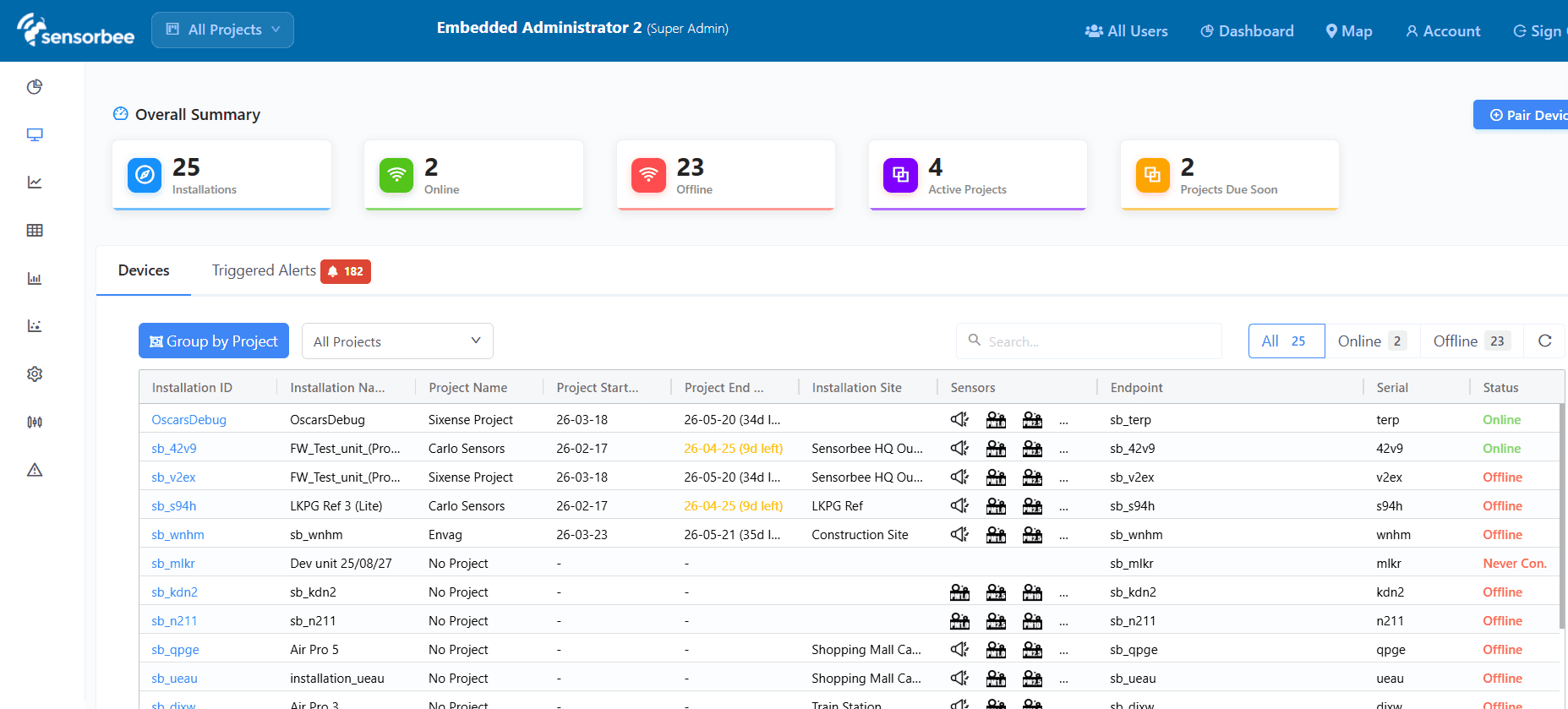
The Sensorbee Cloud platform acts as the LwM2M server, providing real-time dashboards, historical data analysis, automated threshold alerts, push API and REST API access, and data export in CSV and Excel formats.
But here is what makes our approach different: you do not have to use our cloud.
Sensorbee hardware is built on an open protocol. If your organisation operates its own LwM2M server — whether that is AVSystem Coiote, Eclipse Leshan, ThingsBoard, or any other compliant implementation — you can point your Sensorbee devices directly at it. You get complete independence over fleet management, firmware updates, and data ownership, with no dependency on our infrastructure.
This gives customers three distinct integration pathways:
- Sensorbee Cloud — our managed platform, ideal for customers who want a turnkey solution with dashboards, alerts, and API access out of the box.
- Direct LwM2M integration — the device communicates directly with your own LwM2M server, giving you complete control over data routing, storage, and processing.
- Physical integration — for existing monitoring stations or data loggers, the Air Pro 2 supports Modbus RTU via its M12 8-pin connector, allowing direct cabling to third-party systems.
We offer all three because we believe the right architecture depends on the customer's situation, not the vendor's business model. A small consultancy running five monitors may want the simplicity of our cloud. A municipality deploying 200 sensors across a city may want to integrate with their existing IoT platform. Both should be possible with the same hardware.
Why Most Competitors Do Not Offer This
The honest answer is commercial incentive. A proprietary protocol creates a captive customer base. Once your hardware is deployed and communicating over a vendor-specific protocol, switching costs are enormous. The recurring revenue from cloud subscriptions becomes highly predictable.
Looking across the outdoor air quality monitoring market, the pattern is clear:
- ·Fully locked ecosystems — some manufacturers require an active cloud subscription for devices to function. Hardware without the subscription is non-operational. No offline capability, no alternative data paths.
- ·Cloud-centric with limited exports — several established brands offer their own cloud platform with API or FTP data export, but the device-to-cloud communication remains proprietary. You can get data out, but you cannot manage the devices independently.
- ·Open-source but not professional-grade — a few consumer-oriented manufacturers offer open-source firmware and open APIs, which is commendable for transparency. But these products lack MCERTS certification, regulatory-grade accuracy, and the robustness needed for construction sites or long-term environmental compliance monitoring.
To our knowledge, no other MCERTS-certified air quality monitoring manufacturer in the UK market uses LwM2M as their device protocol, or offers customers the option to bypass the vendor cloud entirely at the protocol level.
LwM2M vs MQTT: A Practical Comparison for Environmental Monitoring
MQTT is the most widely used IoT messaging protocol, and for good reason — it is mature, well-supported, and effective for high-throughput telemetry in environments with reliable power and connectivity. But it was designed for a different set of constraints than outdoor environmental monitoring typically presents.
Here is how the two protocols compare in practice:
| Capability | LwM2M | MQTT |
|---|---|---|
| Primary purpose | Device management + telemetry | Messaging and telemetry |
| Transport | CoAP/UDP (primary), TCP, SMS, NB-IoT non-IP | TCP/IP |
| Built-in device management | Yes — firmware OTA, remote config, diagnostics, device lifecycle | No — must be custom-built |
| Standardised data model | Yes — OMA object registry (3,000+ registered objects) | No — payload structure is vendor-specific |
| Power efficiency | Queue Mode, PSM, eDRX support for multi-year battery life | Always-on TCP connection drains batteries |
| Cellular data usage | ~430 KB/month (1 reading/10 min, 1 transmission/hour) | ~5,250 KB/month (same reporting interval) |
| Initial connection overhead | 72% less data than MQTT | Full TCP + TLS handshake required |
| Security | DTLS + OSCORE (end-to-end application-layer encryption) | TLS (transport-layer only) |
| Interoperability | Any compliant server works with any compliant client | Server must understand vendor's custom payload format |
The efficiency differences are not marginal. At scale, they drive significant cost savings. Analysis by Telit estimates that 25,000 devices consuming 2 MB per month via MQTT could save over $720,000 in cellular data costs over 36 months by switching to LwM2M.
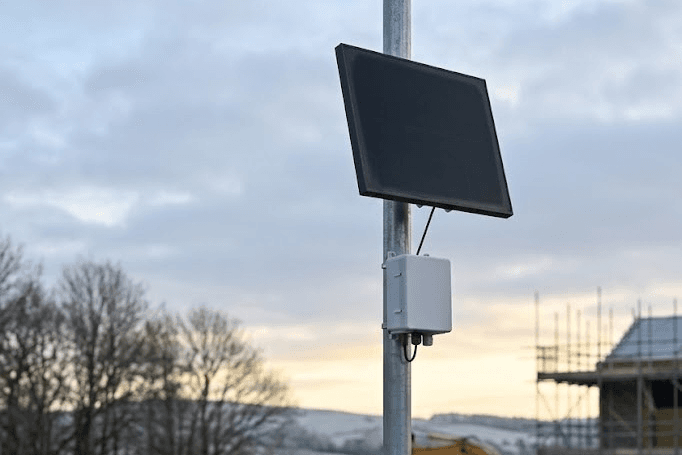
For outdoor monitoring stations running on solar power or batteries in remote locations — exactly the deployment scenario environmental consultants and construction operators face routinely — these efficiency gains are the difference between quarterly site visits to change batteries and multi-year autonomous operation.
LwM2M 2.0 and the Future of Environmental Monitoring Networks
The next major version of LwM2M, targeted for release in 2026, introduces capabilities directly relevant to large-scale environmental monitoring:
- ·Edge computing proxies — processing data closer to the device, reducing cloud dependency and enabling local decision-making (such as triggering alerts when PM2.5 or PM10 thresholds are exceeded, without waiting for a cloud round-trip).
- ·Delta firmware updates — transmitting only the changed portions of firmware, dramatically reducing the data and time required for over-the-air updates across large sensor fleets.
- ·Enhanced eSIM remote provisioning — simplifying the management of cellular connectivity across international deployments.
- ·CBOR/SenML payloads — a compact binary encoding that reduces payload sizes by a further 30-40% compared to JSON-based alternatives, as documented by OMA SpecWorks.
These capabilities matter because the direction of environmental monitoring is toward denser, more distributed networks. Urban air quality programmes require hundreds of sensors. Construction site monitoring under BS 5228 demands continuous, multi-parameter coverage. Dust monitoring for industrial operations generates large volumes of particulate data.
Managing these networks efficiently, securely, and without vendor lock-in requires a protocol designed for exactly this purpose. LwM2M is that protocol.
What This Means for Environmental Consultants and Site Operators
If you are specifying or purchasing air quality monitoring equipment, protocol choice has direct commercial implications:
For environmental consultancies managing monitoring networks across multiple client sites: LwM2M-based hardware gives you the flexibility to run devices through the manufacturer's cloud for straightforward projects, or integrate directly with your own data infrastructure for clients with specific IT requirements. You are not locked into a single vendor's ecosystem, and you can mix hardware from different manufacturers on the same management platform.
For construction companies running long-duration site monitoring programmes: the efficiency of LwM2M over NB-IoT means lower cellular data costs, longer battery autonomy between charges, and standardised remote firmware updates that do not require site visits. When a project spans multiple years, the ability to update and maintain devices remotely without proprietary tools pays for itself.
For municipalities and public bodies deploying urban monitoring networks: open standards are not just a technical preference — they are a procurement safeguard. Specifying LwM2M-compatible hardware in tender documents ensures that you can integrate sensors from multiple suppliers, switch cloud platforms without replacing hardware, and avoid being locked into a single vendor for the lifetime of the deployment.
At Sensorbee, our commitment to LwM2M is not a marketing position — it is an engineering decision that runs through every product we build. We believe environmental monitoring data is too important to be trapped behind proprietary protocols, and we are working to help standardise the way our industry communicates.
If you want to see how this works in practice, download our product catalogue or get in touch to discuss your monitoring requirements.
Frequently Asked Questions
What is LwM2M and how does it relate to air quality monitoring?
LwM2M (Lightweight Machine-to-Machine) is an open IoT protocol developed by OMA SpecWorks for managing connected devices over cellular networks. It combines data telemetry with standardised device management — including remote firmware updates, configuration changes, and diagnostics — in a single, efficient protocol. For air quality monitoring, LwM2M provides standardised data objects (including the uCIFI Air Quality Object 3428) that define how pollutant measurements like PM2.5, PM10, NO2, and O3 are structured and transmitted, enabling interoperability between devices and platforms from different manufacturers.
Can I use Sensorbee hardware without the Sensorbee Cloud?
Yes. All cellular Sensorbee monitoring stations use the LwM2M protocol, which is an open standard. You can connect your devices to any compliant LwM2M server — including open-source options like Eclipse Leshan or commercial platforms like AVSystem Coiote and ThingsBoard. This gives you complete control over your data infrastructure without any dependency on Sensorbee's cloud services.
How does LwM2M compare to MQTT for outdoor environmental monitoring?
LwM2M uses approximately 12 times less cellular data than MQTT for the same reporting interval, extends battery life significantly through power-saving modes (Queue Mode, PSM, eDRX), and includes built-in device management that MQTT lacks entirely. For battery-powered or solar-powered outdoor monitoring stations on cellular networks — the typical deployment scenario for construction and environmental monitoring — LwM2M is purpose-built for the task, while MQTT requires substantial custom engineering to achieve similar functionality.
Does LwM2M work with NB-IoT and LTE-M networks?
Yes. LwM2M was designed specifically for LPWAN cellular networks including NB-IoT and LTE-M. Since version 1.1, it supports non-IP data delivery over 3GPP CIoT, allowing devices to communicate even without a full IP stack. All Sensorbee cellular products use LwM2M over NB-IoT or LTE-M, combining the wide-area coverage and deep indoor penetration of these networks with the efficiency and standardisation of the LwM2M protocol.
What does vendor lock-in mean in air quality monitoring?
Vendor lock-in occurs when your monitoring hardware can only communicate with the manufacturer's own cloud platform using proprietary protocols. If the vendor raises prices, changes terms, discontinues the platform, or is acquired, you have no alternative — your hardware is dependent on their infrastructure to function. With LwM2M-based devices, you can redirect your monitoring stations to any compliant server, giving you genuine data portability and long-term flexibility.
Is Sensorbee the only air quality monitor using LwM2M?
To our knowledge, Sensorbee is the only MCERTS-certified outdoor air quality monitoring manufacturer in the UK market that uses LwM2M as its device protocol and offers customers the option to bypass the vendor cloud entirely. While LwM2M is widely adopted in smart metering, logistics, and industrial IoT, the outdoor air quality sector has been slower to adopt open standards — a gap we are actively working to close.

Oscar Sjöberg
Partner & Embedded Software Engineering Manager