
Posted by David Löwenbrand on · 9 min read
Learn why MCERTS certification protects construction projects from compliance disputes and costly work stoppages. Download our monitoring guide.
Construction site managers face constant pressure to demonstrate environmental compliance. Local authorities demand proof that dust emissions remain within permitted limits. Neighbours file complaints questioning monitoring accuracy. Project delays cost thousands daily while disputes over data quality stall resolution.
The fundamental question is not whether you are monitoring dust — it is whether regulators and stakeholders trust your monitoring data.
This is where MCERTS certification transforms construction site compliance from defensive documentation into confident evidence. When the UK Environment Agency independently validates that your dust monitoring equipment meets rigorous performance standards, compliance disputes shift from "Is your data accurate?" to "What does your certified data show?"
For construction projects operating under environmental permits, facing scrutiny from local authorities, or managing sensitive neighbour relations, MCERTS certification is not just a technical specification — it is the difference between questioned data and trusted evidence.
What MCERTS certification actually means
Independent performance verification
MCERTS is administered by the CSA Group (formerly Sira Certification Service) on behalf of the Environment Agency. The scheme applies performance requirements aligned with EN 15267 (Air quality — Certification of automated measuring systems), the European umbrella standard for type-approval of air monitoring instruments. Equipment must demonstrate equivalence to the reference methods defined in EN 12341:2014 for PM10 and PM2.5 gravimetric measurement.
The certification process includes:
- ·Laboratory testing: Controlled environment validation of sensor accuracy and precision across defined concentration ranges
- ·Field collocation studies: Real-world testing against reference-grade instruments at approved monitoring stations over 12+ weeks, covering seasonal and meteorological variation
- ·Environmental exposure: Performance verification across temperature (-10 °C to 40 °C typical), humidity (20–95% RH), and atmospheric conditions
- ·Manufacturing oversight: Quality management system audits ensuring consistent production standards across all units shipped
What "indicative" actually means
Construction projects often encounter confusion about indicative versus reference monitoring. Here is the practical distinction:
Reference monitoring:
- ·Laboratory-grade equipment costing EUR 24,000–47,000+
- ·Gravimetric samplers meeting EN 12341:2014 for PM10 and PM2.5
- ·Requires climate-controlled enclosures and mains electrical power
- ·Demanding maintenance (filter changes, flow calibration, regular servicing)
- ·Used by government agencies for legal compliance networks (e.g. the UK's Automatic Urban and Rural Network)
Indicative monitoring (MCERTS certified):
- ·Professional-grade equipment tested to EN 15267 performance requirements
- ·Suitable for regulatory reporting and permit compliance
- ·Dramatically lower cost (EUR 3,500–7,000)
- ·Practical deployment without infrastructure requirements
For construction sites, indicative monitoring provides the data quality authorities require without the impractical demands of reference equipment. MCERTS certification confirms this quality through independent validation.
Why construction projects need certified monitoring
Regulatory acceptance without question
When environmental officers review your dust monitoring data during inspections or complaint investigations, the first question they ask is whether they can trust the measurements. MCERTS certification answers this question before it is asked.
Regulatory confidence benefits:
- ·Permit compliance: Data meets quality requirements specified in environmental permits
- ·Enforcement defence: Certified measurements provide credible evidence during violation investigations
- ·Complaint resolution: Authorities accept certified data when adjudicating neighbour disputes
- ·Prosecution evidence: If violations occur, certified data accurately documents conditions without credibility challenges
Construction projects operating without certified monitoring face constant exposure to data quality challenges. "Your sensors aren't accurate" becomes the default response to any unfavourable reading. MCERTS certification eliminates this attack vector.
Protecting against compliance disputes
Consider the typical construction dust complaint scenario:
Without MCERTS certification:
- Neighbour complains about dust levels
- You present monitoring data showing compliance
- Authority questions sensor accuracy and calibration
- Additional reference monitoring required (EUR 5,900–12,000)
- Work stops pending validation (EUR 12,000–59,000 daily losses)
- Dispute resolution takes weeks or months
With MCERTS certification:
- Neighbour complains about dust levels
- You present certified monitoring data showing compliance
- Authority accepts data quality based on MCERTS validation
- Work continues while any investigation proceeds
- Dispute resolves based on trusted evidence
The cost of certification pays for itself the first time it prevents an expensive work stoppage.
Insurance and liability protection
Environmental insurance providers and liability assessors increasingly recognise monitoring data quality. MCERTS certification provides documentation that your environmental management systems meet professional standards.
Insurance benefits:
- ·Claims defence: Certified data supports position during environmental liability claims
- ·Premium consideration: Some insurers recognise comprehensive certified monitoring in risk assessment
- ·Third-party protection: Demonstrates due diligence if neighbouring properties claim damage from dust emissions
- ·Corporate liability: Shields management from negligence allegations by proving professional monitoring standards
When project leaders can demonstrate they implemented independently certified monitoring systems, liability exposure decreases substantially.
The business case: cost vs. risk
Quantifying compliance risk
Construction site dust violations carry substantial costs:
Direct violation costs:
- ·Environmental enforcement fines: EUR 5,900–59,000+ per incident
- ·Remediation requirements: EUR 12,000–118,000 depending on severity
- ·Legal defence costs: EUR 24,000–118,000 if disputed
Indirect violation impacts:
- ·Project delays: EUR 12,000–59,000 daily during work stoppages
- ·Reputation damage: Future permit applications face increased scrutiny
- ·Insurance implications: Environmental violations trigger premium increases
- ·Contract penalties: Many agreements include environmental compliance clauses
A single serious dust violation often exceeds EUR 118,000 in total project impact.
Certification cost analysis
MCERTS-certified monitoring investment:
- ·Sensorbee Air Pro 2 with certification: approximately EUR 4,100–5,900
- ·Installation (10-minute setup): EUR 60–120
- ·Annual operation (solar-powered): EUR 120–240
- ·Three-year total cost: approximately EUR 4,650–6,600
Risk mitigation value:
- ·Prevents single violation scenario: EUR 118,000+
- ·Enables rapid dispute resolution: saves weeks of delays
- ·Supports permit compliance: avoids enforcement scrutiny
- ·Protects project timeline: maintains schedule confidence
The cost-benefit ratio makes MCERTS certification one of the most economically justified project risk management investments.
Practical deployment economics
MCERTS certification does not require sacrificing deployment flexibility:
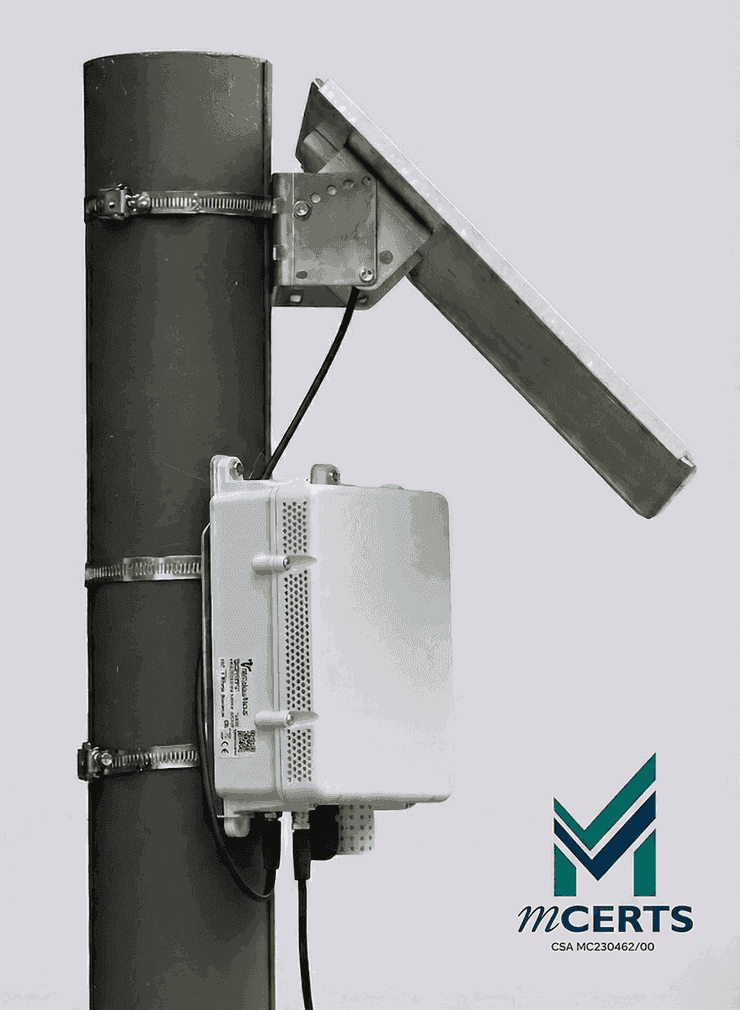
The Sensorbee Air Pro 2 maintains full MCERTS certification while operating on solar power with cellular connectivity. This means you deploy certified monitoring in 10 minutes anywhere on your site without electrical infrastructure — combining regulatory confidence with practical deployment.
Deployment cost comparison:
Traditional certified equipment:
- ·Equipment: EUR 18,000–35,000
- ·Electrical installation: EUR 2,400–5,900
- ·Climate-controlled housing: EUR 3,500–9,500
- ·Total: EUR 24,000–51,000 per location
Solar-powered MCERTS (Air Pro 2):
- ·Equipment with certification: approximately EUR 4,100–5,900
- ·Installation: EUR 60–120
- ·No infrastructure required: EUR 0
- ·Total: approximately EUR 4,200–6,000 per location
Savings: approximately EUR 19,800–45,000 per monitoring point while maintaining regulatory-grade data quality.
Real-world applications: when certification matters most
High-risk project scenarios
Certain construction scenarios make MCERTS certification essential rather than optional:
1. Sensitive neighbour environments
- ·Residential areas with active community engagement
- ·Schools, hospitals, or care facilities nearby
- ·Historic districts with preservation requirements
- ·Areas with previous environmental complaints
2. Strict environmental permits
- ·Projects requiring Environmental Impact Assessments
- ·Sites with specific particulate emission limits
- ·Locations under enforcement monitoring
- ·Brownfield redevelopment with contamination history
3. High-value contracts
- ·Government and municipal infrastructure projects
- ·Commercial developments with strict completion requirements
- ·Projects with liquidated damages clauses
- ·Multi-phase developments requiring ongoing permits
4. Challenging site conditions
- ·Large excavation or earthmoving operations
- ·Demolition of contaminated structures
- ·Extended project timelines (12+ months)
- ·Sites with prevailing winds toward sensitive receptors
If your project matches any of these scenarios, certified monitoring is not a luxury — it is essential risk management.
Permit compliance documentation
Many environmental permits now explicitly require monitoring equipment meeting defined performance standards. MCERTS certification provides clear documentation of compliance with these requirements.
Permit language often includes:
- ·"Monitoring equipment shall meet relevant performance standards"
- ·"Particulate monitoring must provide data suitable for regulatory reporting"
- ·"Equipment accuracy shall be independently verified"
- ·"Quality assurance procedures shall ensure data integrity"
MCERTS certification directly satisfies these requirements without interpretation or debate. When permit renewals or variations occur, certified monitoring systems face minimal scrutiny compared to uncertified alternatives.
Beyond compliance: strategic advantages
Stakeholder communication
MCERTS certification transforms how you communicate environmental performance:
To local authorities: "Our monitoring uses Environment Agency certified equipment meeting MCERTS performance standards — the same quality assurance used in government monitoring networks."
To neighbours: "We've invested in independently certified monitoring providing regulatory-grade accuracy. Our data undergoes the same validation process the government uses for official air quality monitoring."
To project owners: "Environmental compliance monitoring meets MCERTS certification standards, providing documented protection against data quality challenges that could delay the project."
This communication framework shifts conversations from defensive explanations to confident transparency.
Corporate environmental commitments
Organisations with ESG (Environmental, Social, Governance) reporting requirements benefit from demonstrated commitment to environmental monitoring quality:
- ·Documented standards: MCERTS certification provides third-party validation of monitoring quality
- ·Best practice demonstration: Shows environmental management exceeds basic compliance
- ·Data credibility: ESG reporting relies on trusted environmental data
- ·Stakeholder confidence: Certification demonstrates a serious approach to environmental responsibility
When corporate sustainability reports include environmental monitoring data, MCERTS certification adds credibility that self-monitored data cannot match.
Making the certification decision
When to choose MCERTS
Certified monitoring makes sense when:
- ·Environmental permits require defined monitoring standards
- ·The project operates in sensitive or scrutinised locations
- ·Dust compliance affects critical timeline milestones
- ·Liability exposure justifies risk management investment
- ·Corporate environmental standards require validated data quality
- ·Contract requirements specify environmental monitoring quality
Basic monitoring may suffice when:
- ·The project is in a remote location with no sensitive receptors
- ·Permits do not specify monitoring quality requirements
- ·Dust generation is minimal and temporary
- ·Internal tracking rather than regulatory compliance is the goal
Most construction projects facing any neighbour scrutiny, permit requirements, or compliance risk benefit substantially from certified monitoring.
Implementation approach
Phase 1: Critical coverage
Deploy MCERTS-certified monitors at highest-risk locations:
- ·Perimeter boundaries nearest neighbours
- ·Downwind locations during prevailing wind conditions
- ·Specific locations identified in environmental permits
Phase 2: Comprehensive network
Expand coverage to complete site monitoring:
- ·Additional perimeter locations
- ·High-dust work areas (excavation, demolition, material handling)
- ·Access routes and loading zones
Phase 3: Project lifecycle
Maintain monitoring throughout the project:
- ·Reposition as work areas change
- ·Adjust for seasonal wind pattern changes
- ·Document compliance through project completion
Conclusion
Construction site dust monitoring faces a fundamental credibility question: can regulators, neighbours, and stakeholders trust your data? MCERTS certification answers this question through independent validation by the UK Environment Agency's recognised certification scheme.
For construction projects navigating environmental permits, managing sensitive neighbour relations, or facing any compliance scrutiny, certified monitoring eliminates data quality challenges that can derail timelines and multiply costs.
The Sensorbee Air Pro 2's MCERTS certification combines regulatory-grade data quality with solar-powered deployment flexibility — providing certified dust monitoring without sacrificing the rapid deployment and infrastructure independence construction sites require. All data feeds into the Sensorbee Cloud platform for real-time alerts and reporting, using the certified Particle Matter Module for accurate PM2.5 and PM10 measurement.
For any construction project where dust compliance affects timelines or costs, MCERTS certification removes the single most common point of dispute: whether the monitoring data can be trusted.
Ready for certified construction monitoring?
If your project faces neighbour scrutiny, permit requirements, or any compliance risk, certified monitoring pays for itself the first time it prevents a data credibility challenge. The Sensorbee Air Pro 2 combines MCERTS-certified particulate monitoring with rapid deployment — providing regulatory-grade data without the infrastructure overhead of traditional certified equipment.
Frequently Asked Questions
What is MCERTS certification and who issues it?
MCERTS (Monitoring Certification Scheme) is the UK Environment Agency's performance standard for environmental monitoring equipment. It involves independent laboratory testing, field collocation studies against reference instruments, and manufacturing quality audits. Only equipment that passes all stages receives certification, confirming it meets defined accuracy and precision standards for regulatory reporting.
Can MCERTS-certified indicative monitors replace reference-grade equipment?
Indicative monitors are not a direct replacement for reference-grade instruments, but they serve a different and equally important role. MCERTS-certified indicative monitors like the Air Pro 2 meet the data quality requirements for construction site permit compliance, enforcement defence, and regulatory reporting. Reference equipment (EUR 24,000–47,000+) is typically reserved for government compliance networks and is impractical for temporary construction sites.
How much does MCERTS-certified construction monitoring cost compared to uncertified systems?
An MCERTS-certified Air Pro 2 system costs approximately EUR 4,100–5,900 including certification, with minimal installation and running costs thanks to solar power and cellular connectivity. Uncertified systems may cost less upfront, but a single compliance dispute — requiring additional reference monitoring (EUR 5,900–12,000) and potential work stoppages (EUR 12,000–59,000 per day) — can far exceed the cost difference. Visit our certifications page for full details.
Do all construction sites need MCERTS-certified dust monitoring?
Not every site requires certified monitoring, but any project facing neighbour scrutiny, operating under environmental permits with defined monitoring standards, or working near sensitive receptors (schools, hospitals, residential areas) benefits significantly. For construction projects with high-value contracts or liquidated damages clauses, certified monitoring is essential risk management rather than an optional extra.

David Löwenbrand
Founder & CEO