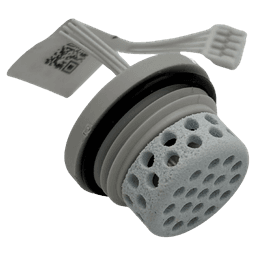

How ambient CO2 is measured outdoors using NDIR sensors. Applications from GHG baselines to urban monitoring and ventilation assessment.
Carbon dioxide is the primary greenhouse gas driving climate change, and atmospheric concentrations have now reached approximately 425 ppm globally — rising by roughly 2.6 ppm each year. The UK is legally committed to net zero greenhouse gas emissions by 2050, with an interim target of 81% reduction by 2035 against 1990 levels.
Yet national emissions inventories are modelled estimates of total output. They do not measure actual CO2 concentrations in the air at the local level. As local authorities, developers, and researchers seek to quantify carbon baselines, verify net zero progress, and assess the real-world impact of decarbonisation measures, the need for continuous ambient CO2 monitoring environmental data has grown considerably.
This guide explains why ambient carbon dioxide monitoring matters, how NDIR CO2 sensor technology works, and where outdoor CO2 measurement adds practical value.
Why Monitor Ambient CO2?
Unlike nitrogen dioxide or particulate matter, carbon dioxide is not regulated as an ambient concentration. The Climate Change Act sets targets for total UK emissions, not for the CO2 level in the air at any particular location. There is no statutory limit for outdoor CO2 concentration.
However, ambient CO2 measurement serves several purposes that modelled inventories cannot:
- ·Greenhouse gas baselines. Before a development, transport scheme, or green infrastructure project begins, measured CO2 data establishes the actual starting point — not a modelled assumption. After completion, repeat measurement quantifies the genuine change.
- ·Net zero verification. Over 300 UK local authorities have declared climate emergencies. Organisations reporting under SECR disclose Scope 1 and 2 emissions. Measured ambient data provides a reality check against reported figures and modelled inventories.
- ·Urban CO2 mapping. Cities generate measurable CO2 domes — research consistently shows urban concentrations 40 to 65 ppm above rural background levels. Mapping this spatial variation identifies emission hotspots.
Additional applications include:
- ·Ventilation reference. ASHRAE Standard 62.1 recommends maintaining indoor CO2 no more than 700 ppm above outdoor levels. Where outdoor concentrations vary significantly — a building intake facing a busy road versus one opening onto a park — accurate outdoor measurement matters.
- ·Carbon sequestration validation. Tree planting, urban forests, and green walls are promoted as carbon reduction measures. Ambient CO2 monitoring provides measured evidence of their effectiveness.
Ambient CO2 Levels — What the Numbers Mean
Global atmospheric CO2 stands at approximately 425 ppm, as measured by NOAA's Mauna Loa observatory. But this figure represents a well-mixed global average. At the local level, concentrations vary meaningfully.
| Environment | Typical CO2 (ppm) | Drivers |
|---|---|---|
| Rural background | 420–445 | Vegetation uptake, minimal combustion |
| Suburban | ~442 | Domestic heating, moderate traffic |
| Urban centre | 440–490 | Traffic, heating, industry, reduced green space |
| Roadside corridor | 450–500+ | Direct vehicle exhaust during peak hours |
Research across multi-year urban monitoring campaigns attributes approximately 60% of local CO2 variation to vehicular traffic, 20% to green space coverage (or lack of it), and 10% to domestic energy consumption.
Concentrations also follow diurnal and seasonal patterns. Night-time levels run higher than daytime — a stable nocturnal atmosphere traps emissions while photosynthesis ceases. Winter concentrations exceed summer levels, driven by heating demand and reduced vegetation uptake. These patterns are real and measurable, but only with continuous, distributed monitoring — single spot measurements capture little of this complexity.
How NDIR CO2 Sensors Work
NDIR — non-dispersive infrared — is the standard technology for ambient CO2 measurement. The operating principle relies on the fact that CO2 molecules absorb infrared radiation at a specific wavelength of approximately 4.26 micrometres.
An NDIR CO2 sensor draws ambient air into a measurement chamber. An infrared lamp emits broadband IR light through the chamber. CO2 molecules in the air sample absorb energy at the 4.26 µm band, and a detector on the far side measures how much IR radiation passes through. The reduction in intensity is directly proportional to the CO2 concentration.
A reference channel — typically filtered to a wavelength not absorbed by CO2 — compensates for drift in the light source and changes in optical path conditions. This dual-channel design gives NDIR sensors their long-term stability.
Several characteristics make NDIR the preferred technology for outdoor CO2 sensor deployment:
- ·Selectivity. The 4.26 µm absorption band is highly specific to CO2, with minimal cross-sensitivity to other gases.
- ·No consumables. Unlike electrochemical sensors used for other gases, NDIR uses no chemical reagents. There is nothing to deplete or replace.
- ·Longevity. NDIR sensors have a typical operational lifespan of 10 to 15 years — far exceeding the 12 to 24 months common for electrochemical cells.
- ·Low maintenance. Auto-baseline correction algorithms reference the ~420 ppm background concentration, maintaining accuracy without manual recalibration. For outdoor deployment where the sensor regularly sees fresh ambient air, this works reliably.
For outdoor use, temperature, humidity, and barometric pressure all influence NDIR readings. Compensation algorithms that take input from onboard environmental sensors correct for these factors — an essential feature for any CO2 monitor intended for ambient outdoor deployment rather than stable indoor conditions.
NDIR vs Reference Methods — Accuracy in Context
Three tiers of CO2 measurement technology serve different purposes:
| Method | Accuracy | Cost | Power | Best for |
|---|---|---|---|---|
| NDIR sensors | ±30 ppm ±3% (±3–5 ppm calibrated) | Low–medium | Low / solar | Distributed outdoor networks |
| Photoacoustic (PAS) | Similar to NDIR | Low | Very low | Indoor and compact applications |
| Cavity Ring-Down (CRDS) | Sub-ppm (±0.1 ppm) | Very high (GBP 30,000+) | Mains | National reference stations |
Cavity ring-down spectroscopy, used by NOAA and national monitoring networks, delivers extraordinary precision — but at a cost that confines it to permanent research installations with mains power and climate-controlled enclosures. Photoacoustic sensors match NDIR accuracy in stable conditions, but their sensitivity to vibration makes them less suitable for outdoor mounting on poles, buildings, or temporary structures.
For distributed ambient CO2 measurement — multiple monitoring points across a city, development site, or transport corridor — NDIR provides the appropriate balance of accuracy, durability, and practical deployability. It is the technology of choice for any CO2 sensor outdoor deployment where long-term reliability matters more than sub-ppm precision.
Sensorbee CO2 Sensor Module — NDIR Monitoring Without Mains Power
The Sensorbee CO2 Sensor Module (SB4212) uses NDIR technology for continuous ambient CO2 measurement. It integrates with the Pro2 base unit (SB8202/SB8203), which manages power, data logging, and wireless transmission.
The practical advantage is deployment reach. Because the Pro2 runs entirely on solar power, the SB4212 can be installed at monitoring positions where mains electricity is unavailable — urban street furniture, park boundaries, development site perimeters, transport corridors. Data transmits in real time via NB-IoT or LTE-M connectivity, with no site visits required to retrieve readings.
On a single Pro2 station, the CO2 module operates alongside particulate matter sensors (SB4102), nitrogen dioxide (SB4202), ozone, noise, and weather modules. This multi-parameter capability means a single solar-powered unit delivers contextualised greenhouse gas data — CO2 concentration paired with co-pollutant levels, temperature, humidity, wind speed, and wind direction. For GHG baseline studies and urban monitoring programmes, this co-located data is substantially more useful than isolated CO2 readings.
CO2 Monitoring Applications in Practice
CO2 monitoring applications continue to expand as net zero commitments move from targets to implementation:
- ·Urban GHG baselines. Establishing measured CO2 levels before development, transport interventions, or policy changes. Without a pre-intervention baseline, it is impossible to quantify impact.
- ·Smart city networks. Dense NDIR CO2 sensor deployment maps spatial variation across a city — traffic corridors, green spaces, industrial zones, residential areas — identifying hotspots and tracking trends. See how Sensorbee supports urban air quality monitoring.
- ·Transport and planning. Before-and-after CO2 measurement for low-traffic neighbourhoods, pedestrianisation schemes, and cycling infrastructure projects provides measured evidence of emissions impact.
Further use cases include:
- ·Green infrastructure assessment. Quantifying actual CO2 reduction from tree planting programmes, urban forests, and green walls — measured outcomes rather than modelled projections.
- ·Ventilation studies. Characterising outdoor CO2 at building air intakes, particularly where levels vary between urban canyon locations and open sites, to inform HVAC design.
- ·Construction GHG impact. Combining ambient CO2 monitoring with dust, noise, and vibration measurement for comprehensive environmental datasets on major developments.
Deploying CO2 Monitors — Practical Considerations
Effective ambient CO2 monitoring requires attention to siting and data interpretation:
Placement. Mount sensors at 2 to 4 metres above ground level for breathing-zone relevance. Avoid positioning directly adjacent to exhaust flues, ventilation outlets, or busy loading bays — unless the study purpose is specifically to measure those sources.
Context. CO2 readings in isolation are difficult to interpret. Co-located temperature, humidity, and wind data explains whether elevated readings reflect genuine emissions or atmospheric conditions trapping existing concentrations. Pair CO2 sensors with meteorological instruments wherever possible.
Calibration. NDIR sensors with auto-baseline correction — backed by proper calibration and certification — maintain accuracy in outdoor settings where they regularly encounter near-background concentrations (~420 ppm). In locations with persistently elevated CO2 — enclosed courtyards, urban canyons with limited ventilation — periodic manual calibration against a reference gas may be necessary.
Averaging. Fifteen-minute or hourly averages smooth short-term spikes from passing vehicles and transient sources, revealing the underlying concentration patterns that matter for baseline studies and trend analysis.
Network design. A single monitoring point captures local conditions at one position. For urban or site-wide CO2 characterisation, distributed networks of multiple sensors are needed to map spatial variation and provide representative coverage.