Why meteorological data matters for environmental monitoring. Temperature, humidity and pressure affect sensor accuracy, pollutant dispersion and compliance.
A PM10 reading spikes at 07:30 on a construction site boundary. The site manager receives an alert. Dust suppression is activated, work is paused, and the project loses half a morning — only for the consultant to confirm later that the spike was caused by fog, not dust. Relative humidity had exceeded 85%, and the particle sensor was counting water droplets.
This is what happens when environmental monitoring operates without meteorological context. Every air quality measurement is influenced by weather conditions. Effective temperature humidity monitoring, barometric pressure monitoring, and wind measurement are not optional extras — they are fundamental to distinguishing real exceedances from environmental artefacts, attributing pollution to its source, and demonstrating compliance with confidence.
Why Weather Data Is Not Optional
Temperature, humidity, atmospheric pressure, wind speed, and wind direction each affect how pollutants behave in the atmosphere — and how accurately sensors measure them.
Temperature inversions trap pollutants near ground level, producing elevated concentrations that have nothing to do with site activity. Wind speed and direction determine where emissions travel and how quickly they disperse. Barometric pressure governs atmospheric stability: low pressure promotes vertical mixing that dilutes pollutants, while high pressure creates stagnant conditions where concentrations accumulate.
Humidity is perhaps the most practically significant factor. Research published in Atmospheric Measurement Techniques found that particle concentrations measured by optical sensors increased by 28% at relative humidity above 75%, with particles larger than 2.5 micrometres increasing by over 50% during fog periods. For any site relying on particulate matter data for compliance, humidity data is not supplementary — it is essential for interpreting whether a reading reflects actual dust or atmospheric moisture.
How Temperature and Humidity Affect Sensor Accuracy
Optical particle counters — the technology used in most continuous dust monitors — work by passing air through a laser beam and counting the light scattered by individual particles. The method assumes those particles are solid. When relative humidity rises, hygroscopic particles absorb moisture from the air, swelling in size and scattering more light. The sensor reports a higher concentration than actually exists.
Sensors without heated inlets are particularly vulnerable. Below roughly 75% relative humidity, the effect is modest. Above that threshold, readings become increasingly unreliable. In the UK, where relative humidity regularly exceeds 80% — particularly on early mornings and during autumn and winter — this is not an edge case. It is normal operating conditions.
Temperature creates a different problem. An ambient temperature sensor mounted outdoors without proper shielding absorbs solar radiation, reading several degrees above actual air temperature. This matters because temperature data is used to correct other sensor readings, calculate atmospheric stability, and validate dispersion models. An unshielded temperature sensor reading 35 degrees Celsius when the actual air temperature is 28 degrees Celsius introduces systematic errors across every calculation that depends on it.
The practical question on a construction site is straightforward: when PM10 spikes on a foggy Tuesday morning, is it your excavator or the weather? Without co-located humidity data, you cannot answer that question — and neither can the regulator reviewing your compliance report.
Meteorological Parameters for Environmental Compliance
UK regulatory guidance is clear on the role of meteorological data in environmental monitoring. Defra's monitoring strategy guidance states that meteorological measurements must be collected concurrently with pollution concentrations and that knowledge of wind speed and direction is essential when attributing pollution episodes to individual sources.
For construction sites operating under Section 61 consents or planning conditions, meteorological monitoring construction requirements routinely include weather data collection alongside particulate matter measurement. The parameters regulators expect depend on the application, but a consistent core set applies across most environmental assessments.
| Parameter | What it measures | Why regulators expect it |
|---|---|---|
| Temperature | Ambient air temperature | Sensor correction, atmospheric stability, inversion identification |
| Relative humidity | Moisture content of air | PM sensor accuracy validation, fog/condensation identification |
| Barometric pressure | Atmospheric pressure | Stability classification, dispersion modelling input |
| Wind speed | Air movement rate | Pollutant transport rate, dust trigger conditions |
| Wind direction | Air movement direction | Source attribution — identifying which site or source caused an exceedance |
| Rainfall | Precipitation | Natural dust suppression, wet deposition of pollutants |
Wind direction is arguably the most operationally valuable parameter. When a monitoring station records a PM10 exceedance, wind direction data immediately indicates whether the plume originated from the construction site, the adjacent road, or another source entirely. Without it, every exceedance is assumed to be the site's responsibility.
Co-Locating Weather and Air Quality Sensors
The value of meteorological data depends on it being measured at the same location and on the same timeline as environmental data. A weather station positioned 500 metres from an air quality monitor may record different conditions — localised wind patterns, building-induced turbulence, and microclimatic variations all affect readings over short distances.
Co-location eliminates this uncertainty. A weather station environmental teams can trust is one where temperature, humidity, and wind data share the same timestamp and GPS coordinates as particulate matter readings — ideally from certified monitoring equipment, producing an internally consistent dataset. Regulators can trust that the meteorological corrections applied to sensor data are valid for that specific measurement point.
From an operational perspective, co-location also simplifies infrastructure. Separate weather stations require their own power supply, mounting hardware, data transmission, and maintenance schedule. On a construction site with four boundary monitoring positions, that means four additional installations — each requiring a power source that site boundaries rarely provide.
Sensorbee EnviroSense Module — Integrated Weather Monitoring
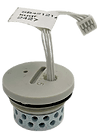
The Sensorbee EnviroSense Module (SB4502) adds meteorological and air quality context directly to the Pro2 monitoring station (SB8202/SB8203). The module measures relative humidity, atmospheric pressure, and air quality indices for volatile organic compounds (VOCs) and nitrogen oxides (NOx) — providing the environmental context that transforms raw sensor readings into defensible data.
For temperature measurement, the Precision Temp and Humidity Sensor (SB3104) includes a dedicated solar radiation shield that prevents radiative heating errors. This is not a cosmetic accessory — it is the difference between accurate ambient temperature readings and measurements biased several degrees high by direct sunlight. The Pro2 system achieves temperature accuracy of plus or minus 0.1 degrees Celsius, humidity accuracy of plus or minus 1.0% RH, and pressure accuracy of plus or minus 0.5 hPa.
Because the SB4502 and SB3104 are integrated into the Pro2 base unit, meteorological data shares the same timestamp, power source, and data pipeline as particulate matter, noise, and vibration measurements. There is no separate weather station to install, power, or maintain. All data reaches the Sensorbee Cloud platform via LTE-M or NB-IoT and appears alongside every other parameter on a single dashboard — correlated by time and location, ready for compliance reporting.
Choosing an Environmental Weather Monitoring System
Not all environmental monitoring systems include meteorological capability, and not all meteorological integrations are equal. The criteria that matter most are accuracy, integration, and practical deployability.
| Criterion | What to check | Why it matters |
|---|---|---|
| Integrated or standalone | Does weather monitoring sit on the same unit as air quality? | Separate stations double infrastructure, power, and maintenance |
| Temperature shielding | Does the temperature sensor have a radiation shield? | Unshielded sensors read several degrees high in direct sunlight |
| Humidity measurement | Is RH measured at the same point as PM? | Essential for validating and correcting particulate matter data |
| Power source | Solar or mains? | Site boundaries and remote locations rarely have grid power |
| Data integration | Single dashboard or multiple platforms? | Correlated data simplifies compliance reporting and source attribution |
| Accuracy specification | Published accuracy for temperature, RH, pressure? | Vague claims without specifications suggest uncalibrated sensors |
The most effective approach for construction and environmental monitoring is a system where meteorological sensors are built into the same platform as particulate matter, noise, and vibration monitoring — powered by solar, connected by IoT, and reporting to one platform.
From Data Points to Defensible Decisions
Environmental weather monitoring is not a separate discipline from air quality monitoring. It is the context that makes air quality data meaningful. A PM10 reading without humidity data is an unvalidated number. A dust exceedance without wind direction is an unattributed event. A temperature record without radiation shielding is a biased measurement.
When meteorological and environmental data are co-located on a single platform, the result is a dataset that withstands regulatory scrutiny — one where every reading can be cross-referenced against the conditions that influenced it. That is the difference between data and evidence.
For a deeper look at particulate matter measurement and how weather conditions affect dust monitoring accuracy, see our guide to particulate matter monitoring.