How wind speed and direction monitoring supports dust management, source attribution and compliance. Ultrasonic sensors for construction and industry.
A particulate matter sensor tells you PM10 concentrations spiked at 14:32 on a Tuesday afternoon. What it cannot tell you is whether the dust came from your earthworks, the quarry two kilometres upwind, or traffic on the adjacent road. Without wind data, air quality monitoring captures symptoms but not causes.
Wind speed and direction monitoring provides the meteorological context that transforms concentration data into actionable intelligence — for dust management, source attribution, and regulatory compliance across construction, mining, and industrial sites.
Why Wind Data Matters for Environmental Monitoring
Wind is the primary transport mechanism for airborne particulate matter. It determines how far dust travels, which receptors are affected, and whether mitigation measures are working. A site generating dust in calm conditions creates a localised problem. The same site in a 25 mph wind creates a problem reaching residential properties hundreds of metres away.
Regulatory frameworks reflect this. IAQM guidance on construction dust assessment requires site-specific consideration of wind patterns when determining risk categories. Environmental Impact Assessments require meteorological baseline data before planning consent. And dust management plans specify wind speed thresholds above which dusty activities must cease.
Wind monitoring is the data layer that makes every other measurement meaningful.
Wind and Dust Dispersion — How Particles Travel
Two mechanisms govern the relationship between wind and dust.
Uplift occurs when wind speed at ground level exceeds the threshold velocity for a given surface. Dry, loose soil lifts at lower speeds than compacted gravel. Threshold velocities for construction dust typically sit between 5 and 10 m/s, depending on moisture content and particle size.
Transport carries suspended particles downwind. Fine particles (PM2.5 and below) travel kilometres. Coarser fractions (PM10 and above) deposit within hundreds of metres. Wind direction determines which sensitive receptors fall in the transport corridor.
Environmental monitors should therefore be positioned both upwind and downwind of the site. The upwind monitor measures background concentrations. The downwind monitor measures what leaves. The difference isolates the site's contribution — a method regulators accept for demonstrating compliance.
Wind rose construction site analysis — polar plots showing frequency and strength of wind from each compass direction — reveals prevailing patterns and informs where to position dust barriers, suppression systems, and monitoring equipment.
Source Attribution — Identifying Where Pollution Comes From
On a construction site surrounded by roads, railways, and neighbouring operations, attributing a dust exceedance to the correct source is both technically important and legally significant.
Wind direction provides the most direct evidence. If PM10 concentrations spike consistently when wind blows from the north-east, the source lies to the north-east. Correlating time-stamped wind direction with concentration data builds a directional fingerprint that identifies — or exonerates — potential sources.
This works at multiple scales: on a single site, distinguishing demolition on the west side from stockpiles on the east; across a wider area, separating site-generated dust from road traffic or neighbouring operations.
Atmospheric dispersion modelling — required for regulatory assessments — depends on continuous wind data as its primary meteorological input. Without on-site measurements, models rely on distant weather stations that may not reflect local conditions.
Ultrasonic vs Mechanical Anemometers
Traditional mechanical anemometers use rotating cups to measure wind speed and a separate vane for direction. They are well understood and inexpensive, but have limitations for environmental monitoring.
| Characteristic | Mechanical (cup and vane) | Ultrasonic |
|---|---|---|
| Moving parts | Cups, bearings, vane | None |
| Maintenance | 6–12 months (bearing wear) | Minimal — annual inspection |
| Response time | 1–3 seconds (cup inertia) | Milliseconds |
| Gust accuracy | Overshoots in gusts, undershoots in lulls | Captures rapid changes faithfully |
| Dust and debris | Bearings affected by buildup | No moving parts to clog |
| Ice and freezing | Cups freeze, bearings seize | Resistant (heated models available) |
| Typical lifespan | 2–5 years | 10+ years |
| Speed + direction | Two separate sensors | Single unit, simultaneous |
The core issue for any anemometer environmental deployment is reliability in unattended conditions. Construction sites and fenceline installations leave equipment exposed to dust, rain, and temperature extremes for months or years. Mechanical bearings degrade. When a cup anemometer fails silently — bearings stiffened, readings drifting low — the data gap may go unnoticed until the next calibration visit.
Higher ultrasonic purchase cost is offset by lower lifetime cost: fewer site visits, no bearing replacements, and no data gaps from mechanical failure.
Sensorbee Wind Monitoring — Ultrasonic, Solar-Powered, Integrated
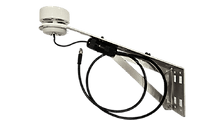
The Sensorbee Wind Speed and Direction Sensor (SB3612) is an ultrasonic wind direction sensor that measures both speed and direction from a single unit with no moving parts — designed for long-term, unattended deployment.
The SB3612 mounts on the Pro2 base unit (SB8202/SB8203) alongside other sensor modules. Wind data in isolation has limited value. Its power comes from correlation with other parameters, which happens automatically on a Sensorbee station:
- ·Wind + PM data identifies whether a dust exceedance coincides with high winds (wind erosion) or calm conditions (active earthworks)
- ·Wind + noise data determines whether sound propagation was unusual during a complaint
- ·Wind direction + PM pinpoints which activity or external source caused an exceedance
For sites requiring rainfall data, the Wind and Rain Combo Sensor (SB3602) combines ultrasonic wind measurement with optical infrared rainfall detection in a single module — providing wet/dry context for dust suppression decisions.
Both sensors operate on the Pro2's solar power system. No mains connection, no battery changes, no separate weather station.
Wind Data in Dust Management Plans
UK construction sites operating under IAQM guidance require dust management plans that address meteorological conditions. Wind monitoring feeds into these plans at every stage.
During planning: Wind rose analysis from baseline monitoring informs risk assessment on construction sites. Sites where prevailing winds blow towards sensitive receptors receive a higher risk category.
During construction: Real-time wind speed monitoring enables automated alerts when conditions exceed thresholds. A common trigger is sustained speeds above 9 m/s (approximately 20 mph), at which point dusty activities should cease or additional suppression be deployed.
After an exceedance: Wind data dust management forensics provide evidence for accountability. If PM10 spiked while wind blew from off-site, external sources are the likely cause. If wind was blowing from active earthworks toward the monitor, site activity is probable. This analysis requires co-located, time-synchronised wind and particulate data.
Choosing a Wind Sensor for Environmental Monitoring
| Criterion | What to check | Why it matters |
|---|---|---|
| Technology | Ultrasonic vs mechanical | Ultrasonic for unattended, dusty environments |
| Measurement range | 0–60 m/s typical | Ensure range covers site conditions including gusts |
| Direction resolution | 1° standard for ultrasonic | Finer resolution improves source attribution |
| Integration | Connects to existing monitoring platform | Avoids separate weather station and data silo |
| Combined sensors | Wind + rain in one unit | Reduces hardware count and failure points |
| Power source | Solar-powered vs mains required | Remote boundary positions rarely have grid power |
| Durability | IP rating, temperature range | UK sites require all-weather operation year-round |
The most effective wind sensor is not necessarily the most precise laboratory instrument. It is the one that delivers reliable, continuous data from an unattended position for years — integrated with the air quality and noise parameters it needs to contextualise.