How IoT data loggers with NB-IoT and LTE-M connectivity enable remote environmental monitoring. Solar-powered, multi-sensor deployment explained.
Construction sites without mains power. Industrial boundaries kilometres from the nearest building. Urban monitoring points on lampposts where running cables is impractical. These are the locations where environmental data matters most — and where traditional data loggers fail.
An IoT environmental data logger — sometimes called an IoT monitoring station or remote monitoring station — solves this by combining environmental data logging with cellular transmission. Instead of downloading data manually via USB every week, the device pushes readings to the cloud in real time over mobile networks. Dust levels spike at 3 AM? You know immediately. Vibration exceeds the BS 7385 threshold during piling? An automated alert reaches the site manager's phone before the next impact.
What Is an IoT Environmental Data Logger?
At its core, an IoT environmental data logger is a device that measures one or more environmental parameters — particulate matter, noise, vibration, gases, or weather conditions — and transmits that data wirelessly to a cloud platform without requiring local internet infrastructure.
Traditional data loggers record measurements to internal memory or an SD card. Someone physically visits the device, connects a laptop, and downloads the data. This approach works for short-term studies, but it falls apart for continuous monitoring. If a dust exceedance happens on a Friday evening, nobody sees the data until Monday morning. By then, the regulatory breach has already been logged.
IoT-connected loggers change this fundamentally. Data arrives at a cloud dashboard within minutes of measurement. Threshold alerts trigger automatically. Site managers can check conditions from anywhere with a mobile signal. The device itself can be configured remotely — no site visit needed to adjust sampling intervals or alarm levels.
The global environmental monitoring market reflects this shift: IoT-based monitoring technologies are forecast to reach $17.9 billion by 2026, driven by regulatory requirements, public awareness, and the practical advantages of real-time data over periodic downloads.
NB-IoT vs LTE-M — Choosing the Right Connectivity
Not all cellular IoT is the same. The two dominant LPWAN technologies for environmental monitoring are NB-IoT (Narrowband IoT) and LTE-M (LTE for Machines). Both operate on licensed mobile network spectrum — meaning they use existing infrastructure from operators like EE, Vodafone, and Three — but they serve different use cases.
NB-IoT is designed for devices that send small amounts of data at regular intervals. It offers a peak downlink speed of around 26 Kbps with latency of 1.6 to 10 seconds. What it lacks in speed, it gains in coverage and efficiency: NB-IoT penetrates buildings and underground locations better than standard LTE, and devices can operate for up to a decade on a single battery. For a monitoring station sending 15-minute averaged readings of PM2.5, temperature, and humidity, NB-IoT is more than sufficient.
LTE-M provides higher data rates — up to 1 Mbps — with lower latency of 10 to 20 milliseconds. This makes it suitable for applications that need faster response times, support voice communication, or require over-the-air firmware updates. LTE-M also supports handover between cell towers, which matters for mobile monitoring applications.
For a fixed NB-IoT environmental sensor or LTE-M data logger used as a remote monitoring station, NB-IoT is typically the better choice. The data volumes are low, the devices are stationary, and the superior power efficiency extends battery life between solar charges. LTE-M earns its place when you need real-time streaming or when the monitoring station runs multiple high-frequency sensors simultaneously.
Both technologies share a critical advantage over WiFi and LoRaWAN: they require no on-site gateway infrastructure. WiFi needs a router within range. LoRaWAN needs a dedicated gateway, which itself needs power and backhaul. NB-IoT and LTE-M simply connect to the existing mobile network — a significant advantage on temporary construction sites where infrastructure changes weekly.
Why Solar Power Changes the Deployment Equation
The most common barrier to environmental monitoring isn't the sensor technology — it's getting power to the monitoring location.
On a construction site, mains power involves an electrician, a temporary supply board, cable runs across active work areas, and PAT testing. That is days of lead time and hundreds of pounds before a single measurement is taken. At a remote industrial boundary, the nearest power socket might be 500 metres away. In urban deployments, connecting to the grid at each lamppost location requires local authority approvals.
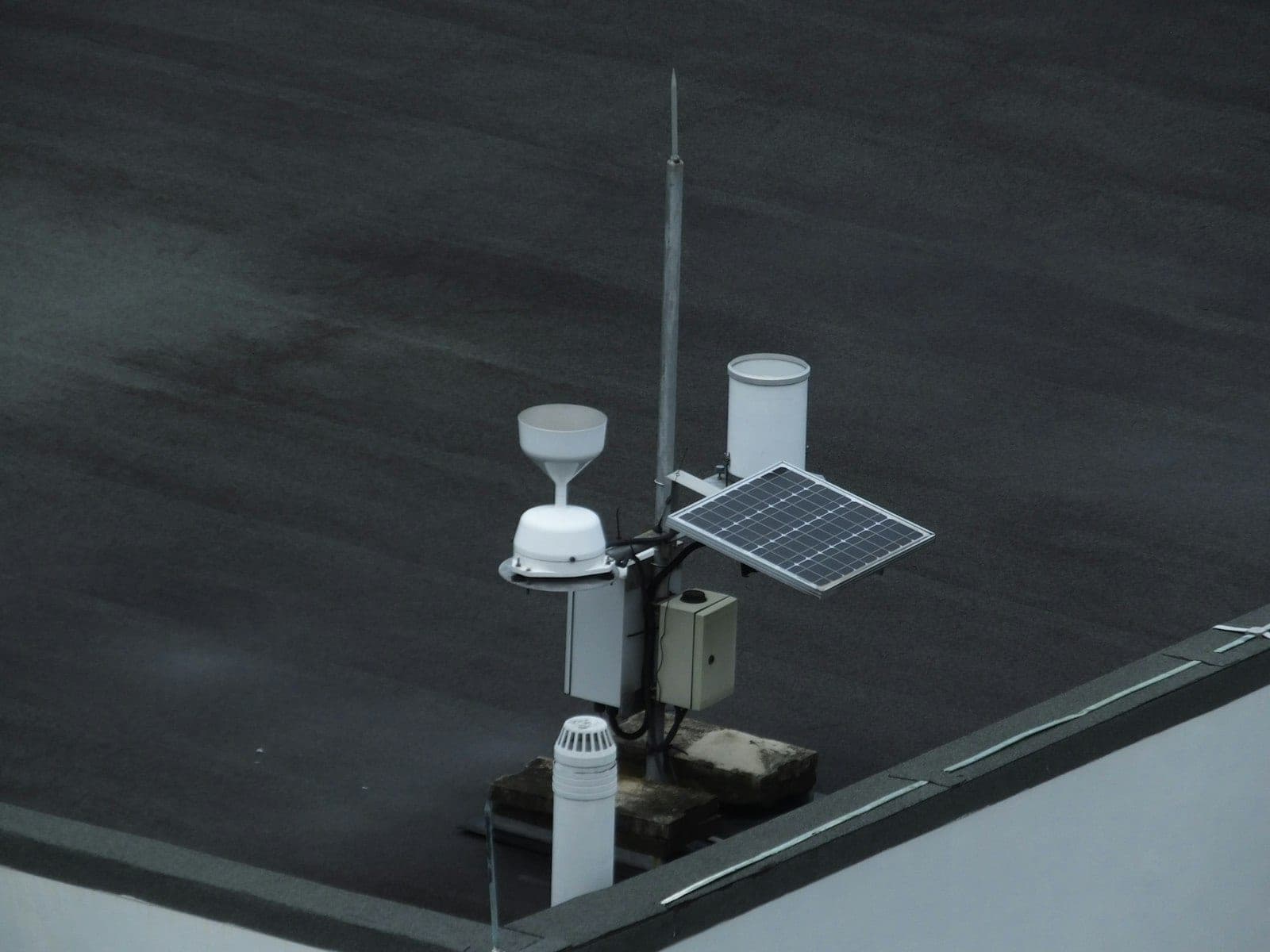
Solar-powered monitoring stations eliminate this entirely. A 30 W panel, properly angled, generates enough energy to power modern low-consumption IoT sensors year-round in the UK — including through winter months, with the internal battery bridging extended periods of low light. Installation becomes a matter of clamping the unit to a scaffold pole or street furniture and switching it on.
The practical difference is transformative. A monitoring station that once required two days of site preparation now deploys in under five minutes. A network of 20 air quality nodes across a city no longer needs 20 separate electrical connections. And when the construction project finishes, the stations unbolt and move to the next site with zero decommissioning cost.
Multi-Sensor Architecture — One Station, Many Parameters
Environmental compliance rarely involves a single measurement. A Section 61 notice under the Control of Pollution Act 1974 typically requires continuous monitoring of dust, noise, and vibration simultaneously. An industrial environmental permit might demand particulate matter alongside specific gases like SO2 or H2S at the site boundary.
The most efficient approach is a hub-and-spoke architecture: a central IoT data logger that connects multiple sensor modules through a single platform. One device. One data stream. One dashboard.
This contrasts with the traditional approach of deploying separate instruments for each parameter — a dust monitor here, a sound level metre there, a vibration sensor on the ground nearby. Each device has its own power supply, its own data connection, its own software login. Three devices mean three points of failure, three sets of batteries to maintain, and three separate data exports to reconcile.
A modular data logger accepts interchangeable sensor modules: optical particle counters for PM1, PM2.5, PM10, and TSP; a sound level metre for LAeq and LAFmax; a triaxial vibration sensor for Peak Particle Velocity (PPV); electrochemical cells for NO2, CO, O3, SO2, H2S, NH3, and VOC; and weather sensors for wind speed, wind direction, rainfall, temperature, humidity, and atmospheric pressure.
The data from all connected modules flows through a single cellular connection to a unified cloud platform — correlated by timestamp and location.
The Sensorbee Pro2 — Built for IoT Environmental Monitoring
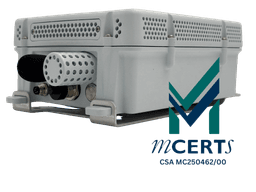
The Sensorbee Pro2 (SB8202 / SB8203) is a purpose-built IoT environmental data logger designed around the principles outlined above: solar power, cellular IoT, and modular multi-sensor architecture.
The Pro2 connects via both NB-IoT and LTE-M, automatically selecting the strongest available network. It runs entirely on solar power from a 30 W panel, with an internal battery sized for continuous operation through periods of low sunlight. At approximately 1.9 kg, it mounts to any standard pole or scaffold fitting and deploys in under five minutes — no tools, no electrician, no cable runs.
The base unit measures dust (PM1, PM2.5, PM10 via optical particle counting), temperature, humidity, and atmospheric pressure. The SB8202 variant carries MCERTS certification for PM2.5 and PM10, meeting the regulatory standard for indicative ambient particulate monitoring in England and Wales. The SB8203 serves indicative monitoring applications where MCERTS is not required.
What distinguishes the Pro2 is its expandability. Connect the Sound Level Metre module (SB4652) for continuous LAeq and LAFmax noise data. Add the Vibration Sensor (SB3641) for triaxial PPV measurement compliant with BS 7385 assessment criteria. Plug in any combination of nine electrochemical gas sensor modules for NO2, NO, CO, CO2, O3, SO2, H2S, NH3, or VOC monitoring.
No other single device on the market combines dust, noise, and vibration monitoring — the three parameters required for construction Section 61 compliance — in one solar-powered, IoT-connected station. Competitors require separate instruments from separate manufacturers, each with its own power supply and data platform.
Real-World Deployment Scenarios
Construction site boundary monitoring. A contractor receives a Section 61 notice requiring continuous dust, noise, and vibration monitoring at four boundary positions. With conventional equipment, this means 12 separate devices (three per position), four mains power connections, and three separate software platforms. With a modular IoT data logger, it means four solar-powered stations — deployed in 20 minutes total — feeding a single cloud dashboard with automated threshold alerts.
Industrial fenceline monitoring. A waste processing facility needs to demonstrate compliance with environmental permit conditions for dust and H2S at its site boundary. The boundary is 200 metres from the nearest building. Solar-powered IoT stations at four perimeter points measure PM10 and H2S continuously, with data transmitted to regulators via API. No trenching, no temporary power supply.
Urban air quality network. A local authority deploys 30 monitoring nodes across the borough to support its Local Air Quality Management (LAQM) obligations. Each node measures PM2.5, NO2, and O3. NB-IoT connectivity means no WiFi configuration at each location. Solar power means no electrical infrastructure. The entire network installs in a single day.
Choosing an IoT Environmental Data Logger — What to Look For
Not all IoT data loggers are equivalent. When evaluating options, consider these criteria:
| Criterion | What to check |
|---|---|
| Connectivity | NB-IoT/LTE-M preferred over WiFi (no on-site infrastructure) or LoRaWAN (requires gateway) |
| Power | Solar as standard, not as an optional extra — battery should sustain operation through winter |
| Sensor expandability | Modular design with interchangeable sensor modules vs fixed-parameter devices |
| Certifications | MCERTS for regulatory dust monitoring; CE and ISO for quality assurance |
| Data platform | Cloud dashboard with API access, automated alerts, and exportable reports |
| Deployment | Weight under 3 kg; tool-free mounting; setup time under 10 minutes |
The trend across the environmental monitoring industry is clear: standalone, mains-powered, manually-downloaded instruments are giving way to connected, solar-powered, modular platforms. The question is no longer whether to adopt IoT monitoring — it is which platform best fits the parameters you need to measure and the sites where you need to measure them.
Frequently Asked Questions
What is the range of NB-IoT for environmental monitoring?
NB-IoT operates on licensed mobile network spectrum, so its range matches the coverage of the mobile operator — typically several kilometres from the nearest cell tower, with better building penetration than standard 4G. In rural areas with limited coverage, LTE-M may provide a stronger signal due to its wider bandwidth.
Can solar-powered monitors work year-round in the UK?
Yes, with correct battery sizing. Modern IoT sensors consume very little power. A 30 W solar panel paired with an appropriately sized lithium battery maintains continuous operation through UK winters. The key is matching battery capacity to the number of connected sensor modules and the data transmission frequency.
What parameters can an IoT environmental data logger measure?
Modern modular systems can measure particulate matter (PM1, PM2.5, PM10, TSP), noise levels (LAeq, LAFmax), ground vibration (PPV), gaseous pollutants (NO2, NO, CO, CO2, O3, SO2, H2S, NH3, VOC), and weather conditions (temperature, humidity, pressure, wind speed, wind direction, rainfall, solar irradiance). The specific parameters depend on which sensor modules are connected to the data logger.