
How NO2 is measured in ambient air: electrochemical vs reference methods, UK limits and Clean Air Zones. Deploy solar-powered NO2 monitoring today.
Nitrogen dioxide remains the UK's most stubborn urban air quality problem. Despite decades of regulation, five of the UK's 43 air quality zones still exceeded the annual mean NO2 limit in 2024. Clean Air Zones in cities from Bath to Birmingham exist because of NO2. Local authorities declare Air Quality Management Areas because of NO2. And the gap between the UK's legal limit and what the World Health Organisation considers safe is a factor of four.
Effective nitrogen dioxide monitoring underpins every aspect of the UK's response to this persistent pollutant — from roadside compliance to Clean Air Zone assessment to urban development planning. This guide explains where NO2 comes from, how it is measured, and what the regulatory framework demands.
What Is Nitrogen Dioxide and Where Does It Come From?
Nitrogen dioxide (NO2) is a reddish-brown gas with a sharp, acrid odour. It forms in the atmosphere when nitric oxide (NO), produced during high-temperature combustion, reacts with ozone. Together, NO and NO2 are referred to as nitrogen oxides (NOx).
Road traffic is the dominant source of NO2 in UK urban areas. Diesel engines are the primary contributor, producing significantly more NOx per kilometre than petrol equivalents. Other sources include gas boilers and heating systems, industrial combustion processes, power generation, and diesel-powered non-road mobile machinery (NRMM) on construction sites.
The health effects are well documented. Short-term NO2 exposure inflames the airways, reduces lung function, and worsens asthma symptoms. Long-term exposure is linked to increased respiratory infections, impaired lung development in children, and heightened susceptibility to chronic obstructive pulmonary disease. NO2 also acts as a marker for the broader cocktail of traffic-related pollutants, meaning elevated NO2 levels signal exposure to a range of harmful substances beyond the gas itself.
UK NO2 Limits and the Regulatory Framework
The UK operates two statutory limits for nitrogen dioxide under the Air Quality Standards Regulations 2010:
| Metric | Limit | Permitted Exceedances |
|---|---|---|
| Annual mean | 40 µg/m3 | None |
| 1-hour mean | 200 µg/m3 | Max 18 per calendar year |
These limits are legally binding. In the 2024 compliance assessment, 38 of the UK's 43 zones met the annual mean limit — but five zones, predominantly in major urban areas, continued to exceed 40 µg/m3.
Under Part IV of the Environment Act 1995, local authorities are required to review and assess air quality against these objectives. Where an objective is unlikely to be met, the authority must declare an Air Quality Management Area (AQMA) and prepare an action plan. NO2 is by far the most common reason for AQMA declarations across the UK.
The WHO updated its nitrogen dioxide air quality guidelines in 2021, recommending an annual mean of just 10 µg/m3 — four times stricter than the current UK limit. While the WHO guideline is not legally binding, it highlights the scale of the health challenge that remains even where UK limits are nominally met.
Clean Air Zones and NO2 Monitoring
Clean Air Zones (CAZs) exist for one purpose: to bring NO2 concentrations within statutory limits in the shortest possible time. Under the UK Clean Air Zone Framework, local authorities with persistent NO2 exceedances must implement measures to reduce roadside concentrations.
Active CAZs currently operate in Bath, Birmingham, Bradford, Bristol, Portsmouth, Sheffield, and Tyneside. London's Ultra Low Emission Zone (ULEZ) covers Greater London following its expansion in August 2023. Each zone charges or restricts the most polluting vehicles entering the area.
Demonstrating that a CAZ is working requires NO2 monitoring UK-wide. National reference stations provide high-accuracy data at fixed locations, but they cannot capture the spatial variation across an entire zone. A single monitoring point on one street may show compliance while concentrations two roads away remain elevated.
This is where distributed sensor networks become essential. Deploying multiple NO2 monitors across a CAZ boundary and within the zone itself provides the spatial resolution needed to assess whether NO2 reductions are occurring uniformly or only at specific locations.
How Nitrogen Dioxide Is Measured
Three principal methods exist for measuring ambient NO2 concentration. Each involves trade-offs between accuracy, cost, and practicality.
Chemiluminescence (Reference Method)
Chemiluminescence analysers are the reference standard for regulatory NO2 monitoring in the UK, conforming to EN 14211. The instrument draws ambient air into a reaction chamber where NO reacts with internally generated ozone. This reaction produces excited NO2 molecules that emit light — the intensity of which is directly proportional to the NO concentration. To measure NO2 specifically, the air first passes through a catalytic converter that reduces NO2 back to NO. The total NOx is measured, and NO2 is calculated as the difference.
These instruments deliver high accuracy with response times of seconds. However, they are expensive (typically exceeding GBP 10,000), require mains power, need a climate-controlled enclosure, and demand regular calibration with certified gas standards by a trained operator. They form the backbone of the UK's Automatic Urban and Rural Network (AURN) but are impractical for dense spatial monitoring.
Electrochemical Sensors
Electrochemical NO2 sensors work by allowing ambient NO2 to diffuse through a membrane into an electrolyte solution. The gas undergoes an electrochemical reaction at a working electrode, generating a current proportional to the NO2 concentration.
Published research demonstrates that electrochemical sensors achieve good correlation with reference instruments at hourly averaging periods, with R-squared values exceeding 0.8. Accuracy diminishes at finer time resolutions — below one minute, R-squared can drop below 0.5.
The principal limitations are cross-sensitivity to ozone (which can bias readings) and drift over time, with studies reporting up to 20% bias after nine months of continuous operation. Periodic calibration, co-location with reference instruments, and use of certified monitoring equipment addresses both issues.
The key advantage is practical: electrochemical sensors are compact, consume minimal power, and cost a fraction of chemiluminescence equipment. This makes them suitable for distributed networks where dozens of monitoring points are needed across an urban area or along a roadside corridor.
Passive Diffusion Tubes
Diffusion tubes are the simplest NO2 monitoring method. NO2 diffuses along a small tube and is absorbed by a chemical reagent (triethanolamine). After an exposure period of two to four weeks, the tube is sent to a laboratory for analysis.
Diffusion tubes are very inexpensive (GBP 2-5 per tube) and require no power. However, they provide only monthly averages with an uncertainty of ±20-30%. They are widely used by local authorities for LAQM screening and spatial surveys but cannot deliver real-time data or trigger alerts.
Sensorbee NO2 Sensor Module — Solar-Powered Ambient Monitoring
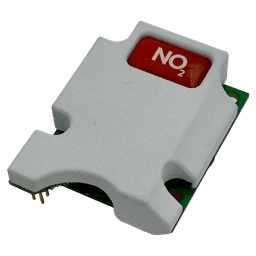
The Sensorbee NO2 Sensor Module (SB4202) is an electrochemical sensor designed for continuous ambient NO2 measurement. It integrates with the Pro2 base unit (SB8202/SB8203), which handles power management, data logging, and wireless transmission.
The practical advantage is deployment flexibility. Because the Pro2 operates entirely on solar power, the SB4202 can be installed at roadside locations, urban monitoring positions, and CAZ boundaries where mains electricity is unavailable. Data is transmitted in real time via NB-IoT or LTE-M connectivity — no site visits required to retrieve readings.
On a single Pro2 station, the NO2 module can operate alongside particulate matter sensors (SB4102), a sound level metre (SB4652), and a vibration sensor (SB3641). For urban development projects or construction perimeter monitoring, this delivers multi-parameter environmental data from one solar-powered unit at each monitoring position.
Deploying NO2 Monitors — Siting and Practical Considerations
Where you place an NO2 monitor matters as much as which instrument you choose. Siting guidance for ambient NO2 measurement follows established principles:
- ·Roadside monitoring: Position within 5 metres of the kerbside, at a height of 1.5 to 4 metres above ground level, to capture breathing-zone concentrations relevant to pedestrian exposure.
- ·Urban background: Away from direct traffic influence, representing the general urban NO2 concentration that the wider population experiences.
- ·Industrial boundary: At the facility perimeter, orientated toward the nearest sensitive receptors.
Avoid locations where buildings, trees, or other obstructions restrict airflow and create unrepresentative micro-environments. For electrochemical sensors, be aware that temperature and humidity affect performance — instruments with onboard compensation algorithms handle this automatically, but uncompensated sensors may show seasonal bias.
Data quality is highest at hourly averages for electrochemical sensors. Reporting at this resolution aligns with both the demonstrated accuracy of the technology and the time resolution of UK regulatory limits.
Nitrogen Dioxide Monitoring Applications
NO2 monitoring serves a range of practical purposes across environmental management:
- ·LAQM compliance: Supporting local authority air quality reviews and AQMA assessments with continuous or supplementary monitoring data
- ·Clean Air Zone assessment: Demonstrating NO2 reduction following CAZ implementation, with spatial coverage across zone boundaries
- ·Construction perimeter screening: Monitoring NO2 from diesel NRMM alongside dust and noise at site boundaries
- ·Urban development: Pre-application baseline studies and post-completion monitoring for planning conditions
- ·Transport scheme assessment: Environmental impact data for road schemes, bus corridor changes, and traffic management interventions
- ·Smart city networks: Dense spatial mapping of NO2 across urban areas to identify pollution hotspots and inform public health interventions
Frequently Asked Questions
What is the UK annual mean limit for nitrogen dioxide?
The UK annual mean limit for NO2 is 40 µg/m3, set under the Air Quality Standards Regulations 2010. The 1-hour mean limit is 200 µg/m3, with a maximum of 18 permitted exceedances per year. In 2024, five of the UK's 43 air quality zones still exceeded the annual mean limit. The WHO 2021 guideline recommends a significantly lower annual mean of 10 µg/m3.
How accurate are electrochemical NO2 sensors compared to reference methods?
Electrochemical NO2 sensors show good agreement with chemiluminescence reference instruments at hourly averaging periods, with published R-squared values exceeding 0.8. The main limitations are cross-sensitivity to ozone and signal drift of up to 20% over nine months of continuous deployment. Regular calibration or co-location with reference instruments manages both issues. For ambient NO2 measurement applications requiring spatial coverage rather than single-point reference accuracy, electrochemical sensors offer the most practical balance of performance and cost.
Do Clean Air Zones require NO2 monitoring?
Local authorities implementing Clean Air Zones must demonstrate that their measures are reducing NO2 concentrations toward compliance with statutory limits. This requires monitoring — both within the zone and at boundary locations. While national reference stations provide high-accuracy fixed-point data, distributed NO2 sensor networks deliver the spatial resolution needed to assess whether reductions are occurring consistently across the entire zone.
Can NO2 be monitored using solar power?
Yes. Electrochemical NO2 sensors consume very little power, making solar-powered deployment entirely practical. The Sensorbee SB4202 NO2 module, paired with the solar-powered Pro2 base unit, provides continuous ambient NO2 data at locations without mains electricity — including roadside positions, urban monitoring sites, and CAZ boundaries where grid power is rarely available.