Guide to ground-level ozone monitoring: formation chemistry, UV and electrochemical sensors, UK DAQI thresholds, and multi-parameter O3 measurement.
Ozone is a pollutant you cannot see, smell at low concentrations, or trace to a single chimney. Unlike nitrogen dioxide or particulate matter, ground-level ozone is not emitted directly — it forms in the atmosphere when precursor gases react in sunlight. This makes ozone monitoring fundamentally different from monitoring other pollutants: you cannot measure it at source, and the highest concentrations often appear tens of kilometres downwind from the emissions that caused them.
In 2024, UK monitoring stations recorded 64 hours of Moderate or higher ozone pollution, with May producing the highest concentrations at both rural and urban sites — driven by the warmest May on record. For environmental consultants and air quality managers, understanding how ozone forms, where it accumulates, and what the UK thresholds require is essential for designing effective O3 monitoring programmes.
How Ground-Level Ozone Forms — The Photochemical Process
Ground-level ozone is a secondary pollutant produced through photochemical reactions. The process requires three ingredients: nitrogen oxides (NOx), volatile organic compounds (VOCs), and ultraviolet sunlight.
The chemistry works as follows. Sunlight splits nitrogen dioxide (NO2) into nitric oxide (NO) and a free oxygen atom. That oxygen atom combines with atmospheric O2 to form ozone (O3). Under normal conditions, ozone would react with NO and be destroyed — maintaining equilibrium. But VOCs interfere: they react with NO before it can destroy ozone, causing net ozone to accumulate in the air.
The precursors come from predictable sources. NOx is produced by vehicle exhaust, power generation, and industrial combustion. VOCs are released by solvents, paints, fuel evaporation, and natural sources including trees. This is why photochemical smog monitoring is particularly relevant near industrial zones and major road corridors where both precursor groups are concentrated.
UK ozone concentrations typically peak in April and May — earlier than continental Europe, where peaks occur in June and July. This is partly because easterly winds transport ozone and its precursors from the continent during spring, and partly because increased summer traffic in UK cities generates NOx that actually destroys ozone locally. This creates a counter-intuitive pattern: ozone concentrations are frequently higher in rural areas than in city centres, because urban NOx scavenges ozone before it can accumulate.
Health Effects of Ozone Exposure
Short-term exposure to elevated ozone causes airway inflammation, reduced lung function, and breathing difficulties — effects that can appear within hours of exposure. Hospital admissions for respiratory conditions increase measurably during ozone episodes.
Long-term exposure is associated with aggravated asthma, increased risk of stroke, and chronic obstructive pulmonary disease. Children, elderly people, and those with existing respiratory conditions are disproportionately affected. The European Climate and Health Observatory links ground-level ozone to over 20,000 premature deaths annually across Europe.
These health impacts are why ozone air quality UK thresholds exist at multiple levels — from routine Daily Air Quality Index reporting through to emergency alert systems.
UK Ozone Thresholds and the Daily Air Quality Index
The UK reports ozone levels through the Daily Air Quality Index (DAQI), which rates air pollution on a scale of 1 to 10 based on the running 8-hour mean concentration.
| Band | DAQI Index | Concentration (µg/m³) |
|---|---|---|
| Low | 1–3 | 0–100 |
| Moderate | 4–6 | 101–160 |
| High | 7–9 | 161–240 |
| Very High | 10 | 241 or more |
Beyond the DAQI, several regulatory thresholds apply:
- ·National air quality objective: 100 µg/m³ as an 8-hour running mean, not to be exceeded more than 10 times per calendar year
- ·Target value (Air Quality Standards Regulations 2010): 120 µg/m³ maximum daily 8-hour mean, not to be exceeded on more than 25 days per year averaged over three years
- ·Information threshold: 180 µg/m³ as a 1-hour mean — triggers public health information alerts
- ·Alert threshold: 240 µg/m³ as a 1-hour mean — triggers emergency public warnings
In 2024, no UK sites recorded exceedances of the 180 µg/m³ information threshold. However, numerous sites exceeded the 100 µg/m³ national objective during the spring ozone season, and climate projections suggest that rising temperatures will increase the frequency and intensity of ozone episodes in coming decades.
O3 Sensor Technologies — UV Absorption vs Electrochemical
Two principal technologies dominate ambient ozone monitoring. Each involves trade-offs between accuracy, cost, and practicality.
UV Photometry (Reference Method)
Ozone absorbs ultraviolet light strongly at 254 nm. UV photometric analysers draw ambient air through a measurement chamber and quantify ozone concentration using the Beer-Lambert law. This is the European reference method (EN 14625) and the technology deployed in the UK's Automatic Urban and Rural Network (AURN).
UV analysers deliver accuracy of ±1–2 ppb with response times around 10 seconds. They are highly selective — few atmospheric gases interfere at 254 nm. However, they are expensive, typically require mains power, and are housed in temperature-controlled enclosures. They are instruments for fixed monitoring stations, not portable field deployment.
Electrochemical Sensors
Electrochemical ozone sensors use a porous membrane through which O3 diffuses into an electrolyte cell. The resulting electrochemical reaction generates a current proportional to ozone concentration. These sensors are compact, low-power, and cost a fraction of UV analysers.
The principal limitation is cross-sensitivity to nitrogen dioxide. Standard electrochemical oxidising gas sensors cannot distinguish O3 from NO2 — both produce similar responses. Since NO2 is nearly always present in ambient air, this creates a measurement problem. The established solution uses paired sensors: one responding to both O3 and NO2, another filtered to respond only to NO2. Subtracting the NO2 signal isolates the ozone reading.
| Feature | UV Photometry | Electrochemical |
|---|---|---|
| Accuracy | ±1–2 ppb | ±10–20 ppb (paired sensors) |
| Selectivity | Excellent | Requires NO2 correction |
| Power | Mains (>100 W) | Low (<5 W) |
| Cost | High (£5,000–£15,000+) | Low (£50–£200 per sensor) |
| Portability | Fixed installation | Field-deployable |
| Reference standard | EN 14625 | Indicative monitoring |
For regulatory reference monitoring, UV photometry remains essential. For dense network coverage, screening studies, and multi-parameter environmental stations, electrochemical sensors provide the practical balance of performance, power, and cost that enables widespread deployment.
Ozone Monitoring as Part of a Multi-Parameter Station
Ozone does not exist in isolation. It is produced from NOx and destroyed by NO — meaning O3 concentrations are directly linked to the nitrogen oxide levels at any given location. Monitoring ozone alongside NO2 and NO reveals the photochemical dynamics at play: whether a site is ozone-producing (VOC-rich, low-NOx) or ozone-destroying (high-NOx urban).
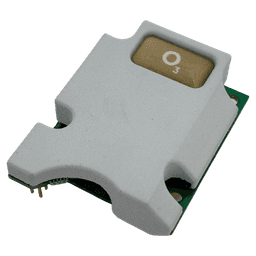
The Sensorbee O3 Sensor Module (SB4272) mounts on the Pro2 base unit (SB8202/SB8203) to provide continuous ozone measurement as part of a multi-parameter monitoring station. Because the Pro2 operates on solar power with NB-IoT/LTE-M connectivity, it can be deployed at locations where mains power is unavailable — rural monitoring sites, roadside positions, industrial perimeters — without infrastructure requirements.
The same Pro2 station accepts modules for particulate matter, NO2, noise, vibration, and weather parameters. For air quality programmes that need to understand the full pollution picture — how traffic emissions, photochemistry, and meteorology interact — this multi-parameter approach provides correlated data from a single location and timeline, eliminating the alignment problems that arise when combining data from separate instruments.
Where Ozone Monitoring Is Needed
Ozone monitoring requirements span multiple sectors and applications:
Urban air quality networks. Local authorities and public health bodies need ozone data alongside NO2 and PM2.5 to report the DAQI and issue health advisories during photochemical episodes.
Industrial fenceline monitoring. Refineries, chemical plants, and facilities handling solvents release VOCs that contribute to ozone formation. Fenceline ozone monitoring demonstrates whether operations are influencing local photochemistry.
Near-road and transport corridors. Traffic is the primary source of NOx. Monitoring ozone alongside NO2 at roadside and downwind locations quantifies the photochemical impact of transport emissions.
Research and smart city deployments. Dense sensor networks mapping ozone across an urban area reveal the spatial gradients between NOx-rich city centres (where ozone is suppressed) and suburban or rural zones (where it accumulates).
Frequently Asked Questions
What is the difference between stratospheric ozone and ground-level ozone?
Stratospheric ozone sits 15–35 km above the Earth's surface in the ozone layer, where it absorbs harmful UV radiation and protects life. Ground-level ozone forms at the surface through photochemical reactions between NOx and VOCs in sunlight. Chemically identical, the two have opposite effects: stratospheric ozone is protective, while ground-level ozone is a harmful air pollutant that damages lungs and vegetation.
Why is ozone concentration often higher in rural areas than cities?
Urban areas have high concentrations of nitric oxide (NO) from vehicle exhaust. NO reacts with ozone and destroys it (NO + O3 → NO2 + O2). In rural areas, less NO is available to scavenge ozone, so it accumulates to higher levels. Additionally, ozone and its precursors are transported downwind from cities, forming ozone in areas far from the original emissions.
What is the UK limit for ground-level ozone?
The UK national air quality objective for ozone is 100 µg/m³ as a running 8-hour mean, not to be exceeded more than 10 times per year. The Air Quality Standards Regulations 2010 set a target value of 120 µg/m³. Public information alerts are triggered at 180 µg/m³ (1-hour mean), and emergency alerts at 240 µg/m³.
Can ozone be measured accurately with low-cost sensors?
Electrochemical sensors can measure ozone at ambient concentrations, but the primary challenge is cross-sensitivity to NO2 — standard sensors cannot distinguish between the two gases. The established solution uses paired sensors: one that responds to both O3 and NO2, and another that responds only to NO2. Subtracting the NO2 reading isolates the ozone concentration. With proper calibration, NO2 correction, and certified monitoring equipment, electrochemical sensors achieve accuracy suitable for indicative monitoring and dense network deployment, though they do not match the ±1–2 ppb precision of reference UV analysers.