
Posted by Oscar Sjöberg on · 10 min read
If you specify, purchase, or operate air quality monitoring equipment in the UK or Europe, the regulatory ground beneath you is moving. The standards that define what "certified" means are being updated, tightened, and — in some cases — entirely replaced.
For years, MCERTS has been the benchmark in the UK. But MCERTS does not exist in isolation. It sits within a broader European framework of EN standards that govern how monitoring equipment is tested, certified, and deployed. And that framework is now being reshaped by the most significant piece of EU air quality legislation in over a decade.
This article explains the current state of monitoring standards, what is changing, and what it means for anyone buying or specifying environmental monitoring equipment today.
MCERTS: The UK Foundation
The MCERTS (Monitoring Certification Scheme) is administered by the UK Environment Agency and assessed by approved certification bodies — principally CSA Group UK Ltd. Equipment bearing the MCERTS mark has been independently tested and verified to meet defined performance standards for accuracy, precision, and reliability.
MCERTS covers two broad categories of ambient monitoring:
Continuous Ambient Monitoring Systems (CAMS) — reference-grade or equivalent instruments for regulatory networks, certified against pollutant-specific EN standards.
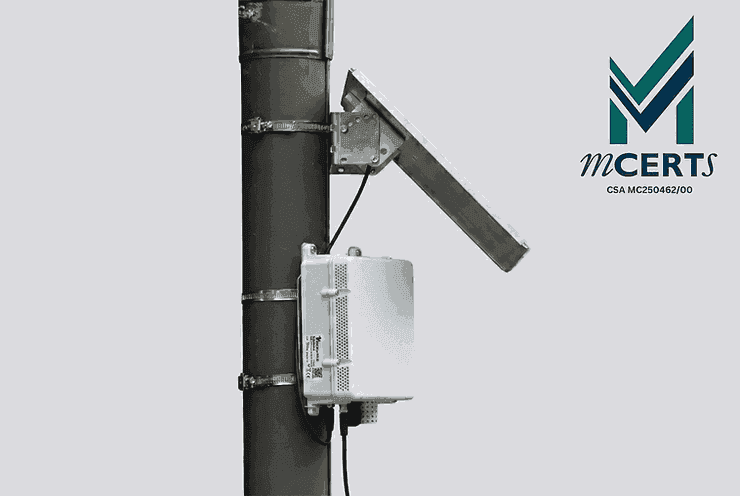
Indicative Ambient Particulate Monitors — lower-cost continuous monitors used for screening, supplementary, and site-boundary applications. The Sensorbee Air Pro 2 holds MCERTS certification in this category for PM10 and PM2.5 (Certificate No: CSA MC250462/00).
What many people do not realise is that MCERTS already uses European EN standards as its testing template. When equipment is submitted for MCERTS certification, it is assessed against the relevant EN standard for that pollutant type — not against a separate, UK-only set of criteria.
The EN Standard Framework
The European Committee for Standardisation (CEN) publishes the standards that underpin air quality monitoring certification across Europe. MCERTS directly references these standards and requires equipment to meet their performance criteria.
EN 15267: The Certification Framework
The EN 15267 series defines the process for certifying automated measuring systems:
- ·EN 15267-1 — General principles of certification (updated 2023)
- ·EN 15267-2 — Initial assessment of the manufacturer's quality management system and ongoing surveillance
- ·EN 15267-3 — Performance criteria and test procedures for stationary source emissions (stack monitoring)
- ·EN 15267-4 — Performance criteria for portable automated measuring systems
This series provides the structural framework within which all air quality monitoring certification operates — whether it carries the MCERTS label in the UK, QAL1 approval in Germany, or equivalent certification in other European countries.
EN 16450: Particulate Matter
EN 16450:2017 is the standard specifically for automated measuring systems that monitor PM10 and PM2.5 concentrations in ambient air. It defines:
- ·Laboratory test requirements for accuracy, precision, and environmental sensitivity
- ·Field test requirements for demonstrating equivalence with the gravimetric reference method (EN 12341)
- ·Data validation procedures for assembling daily and yearly average concentration values
- ·A measurement range up to 1,000 µg/m³ for 24-hour averages
When the Sensorbee Air Pro 2 was certified under MCERTS for particulate matter, the testing was conducted against EN 16450 requirements — including field validation against the reference-grade Fidas 200S at a UK monitoring station. This means the certification carries weight not just in the UK but across any jurisdiction that recognises the EN framework.
Pollutant-Specific EN Standards
Beyond particulate matter, each regulated gas pollutant has its own EN standard. These have been recently updated:
| Pollutant | EN Standard | Status |
|---|---|---|
| NO / NO₂ | EN 14211:2024 | Updated 2024 |
| SO₂ | EN 14212:2024 | Updated 2024 |
| O₃ | EN 14625:2024 | Updated 2024 |
| CO | EN 14626:2024 | Updated 2024 |
| Benzene / VOCs | EN 14662-3:2015 | Current |
| PM10 / PM2.5 | EN 16450:2017 | Current |
The 2024 updates to the gas standards reflect the latest measurement science and tighten performance requirements. Equipment certified to earlier versions must demonstrate compliance with the latest standard at recertification.
CEN/TS 17660: The Standard for Sensor Systems
Perhaps the most consequential development for the indicative monitoring market is the CEN/TS 17660 series — the first European standard specifically designed for evaluating air quality sensor systems (commonly called "low-cost sensors" or "indicative monitors").
Traditional EN standards were written for reference-grade analysers costing tens of thousands of pounds. CEN/TS 17660 recognises that compact, lower-cost sensor systems now play a legitimate role in air quality monitoring — provided their performance is properly characterised and classified.
Part 1: Gaseous Pollutants (Published 2021)
CEN/TS 17660-1:2021 covers sensor systems for O₃, NO/NO₂/NOx, CO, SO₂, and benzene. It classifies sensors into three performance tiers:
- ·Class 1 — highest performance, suitable for indicative measurements as defined in the EU Air Quality Directive
- ·Class 2 — intermediate performance
- ·Class 3 — suitable for screening and objective estimation
Classification is determined through a combination of laboratory and field testing. The standard provides a consistent framework for comparing sensor performance across manufacturers — something the market has lacked until now.
Part 2: Particulate Matter (Published 2024)
CEN/TS 17660-2:2024 extends the same classification framework to PM10 and PM2.5 sensor systems. This is particularly relevant for the construction and urban monitoring sectors, where compact particle sensors are widely deployed for boundary monitoring and network applications.
With Part 2 now published, there is a complete European framework for evaluating both gas and particulate sensor systems. This standard is expected to become increasingly referenced in procurement specifications, planning conditions, and regulatory guidance across Europe.
What This Means for Equipment Buyers
CEN/TS 17660 does not replace MCERTS or EN 15267. Instead, it fills a gap — providing a standardised way to evaluate the growing category of compact sensor systems that sit between full reference-grade instruments and uncertified consumer devices.
For environmental consultancies specifying monitoring equipment, the practical impact is clear: ask for CEN/TS 17660 classification data. A manufacturer who can demonstrate Class 1 performance under this standard is providing evidence-based assurance that their sensor system meets the data quality requirements for indicative monitoring.
Sensorbee's electrochemical gas sensors are tested to CEN/TS 17660-1 protocols, with detection limits and repeatability documented against the standard's requirements. The NO₂ sensor (3 ppb limit of detection, CEN/TS 17660-1:2022), SO₂ sensor, O₃ sensor, and other gas modules all reference these testing protocols in their specifications.
The New EU Air Quality Directive (2024/2881)
On 10 December 2024, the new EU Ambient Air Quality Directive entered into force. Directive (EU) 2024/2881 replaces the previous air quality directives (2004/107/EC and 2008/50/EC) and represents the most significant overhaul of European air quality legislation in nearly two decades.
EU Member States must transpose the directive into national law by 11 December 2026, with rules applying from 12 December 2026.
What Is Changing
Dramatically tighter PM2.5 limits — The annual limit value for PM2.5 drops from 25 µg/m³ to 10 µg/m³ by 2030. This is more than a halving of the permitted concentration — and it has direct implications for the precision and accuracy required of monitoring equipment. Instruments that were adequate under the old limit may lack the measurement certainty needed at these lower concentrations.
New pollutants for the first time — The directive requires monitoring of ultrafine particles (UFP) — particles below 100 nm in diameter — and black carbon. These were previously unregulated despite growing evidence of their health impacts. Monitoring networks will need new instrumentation categories to address these requirements.
Expanded monitoring networks — The directive mandates more monitoring points, including the establishment of supersites — advanced monitoring stations capable of measuring traditional pollutants alongside UFP, black carbon, and other emerging compounds. This expansion creates significant demand for both reference-grade and indicative monitoring equipment.
Modelling becomes compulsory — Air quality modelling receives a central and compulsory role, particularly in areas where limit values are exceeded. Models require calibration and validation against monitoring data — increasing the demand for dense, spatially distributed sensor networks that provide the ground-truth data models need.
UK Position
The UK is no longer bound by EU directives post-Brexit. However, the UK's own regulatory trajectory is closely aligned:
- ·The Environment Act 2021 set a legally binding PM2.5 target of 10 µg/m³ annual mean by 2040 — the same concentration as the EU's 2030 target, but with a longer timeline
- ·A 35% reduction in population exposure to PM2.5 by 2040 (against a 2018 baseline) is also legally binding
- ·The UK Environment Agency continues to reference EN standards within MCERTS, and the September 2025 update to the MCERTS performance standards incorporated the latest 2024 EN standard revisions
- ·Defra's monitoring requirements specify compliance with EN 12341:2023 and EN 16450:2017 as the basis for PM measurement
In practice, equipment that meets the EN standards and carries MCERTS certification is positioned to comply with both UK and EU requirements. The standards frameworks are converging, not diverging.
What This Means for the Industry
The combined effect of these regulatory changes is a market that demands more monitoring, in more places, to higher standards, at lower cost per measurement point. This favours exactly the kind of equipment Sensorbee designs: compact, modular, solar-powered monitoring stations that deliver certified data quality without the infrastructure cost of traditional reference stations.
For Environmental Consultancies
If you are specifying monitoring equipment for construction sites, urban networks, or industrial fencelines, the standards evolution means:
- Certification carries more weight than ever — as limits tighten and legal consequences increase, uncertified or poorly characterised equipment becomes a liability. MCERTS certification and CEN/TS 17660 classification provide the evidence trail that regulators and planning authorities expect.
- Multi-parameter capability matters — the new directive's focus on PM2.5 alongside gases, UFP, and meteorological data favours all-in-one stations that can measure multiple pollutants simultaneously. The Air Pro 2 supports up to six gas sensor modules alongside MCERTS-certified particulate monitoring and a sound level meter.
- Network density is the direction of travel — dense indicative networks supplementing sparse reference stations is the model the directive promotes. Solar-powered, cellular-connected sensors like the Air Lite are designed for exactly this kind of mass deployment.
For Equipment Manufacturers
The message from regulators is clear: prove your performance against published standards, or risk being excluded from specifications. The era of "trust us, it works" claims is ending. CEN/TS 17660 gives buyers a standardised framework to compare sensor systems, and manufacturers who embrace it will have a competitive advantage.
What to Ask When Specifying Equipment
If you are purchasing or specifying air quality monitoring equipment today, these are the questions that matter:
- Is it MCERTS certified? — For UK applications, MCERTS remains the gold standard. Ask for the certificate number and check it against the CSA Group register.
- Which EN standard was it tested against? — For particulate matter, the answer should be EN 16450:2017. For gases, ask for the relevant EN 14211/14212/14625 standard.
- Does it have CEN/TS 17660 classification data? — For indicative sensor systems, ask what class the sensors achieve under CEN/TS 17660-1 (gases) or CEN/TS 17660-2 (PM). Class 1 meets the data quality objectives for indicative measurements under the EU Air Quality Directive.
- How does the manufacturer handle standard updates? — Standards are living documents. Ask how the manufacturer plans to address the 2024 revisions to EN 14211, EN 14212, and EN 14625, and whether their certification pathway accounts for future EN 16450 revisions.
- Is the data legally defensible? — Ultimately, monitoring data must withstand regulatory scrutiny. Certified equipment, calibrated sensors, and traceable data chains are the foundation of legally defensible environmental evidence.
Frequently Asked Questions
Is MCERTS being replaced by EN 15267?
No. MCERTS is a certification scheme administered by the UK Environment Agency. EN 15267 is the European standard that defines the certification process. MCERTS already uses EN 15267 as its framework and references EN pollutant-specific standards (EN 16450, EN 14211, etc.) as its testing criteria. The two systems are complementary, not competitive. What is happening is that MCERTS is progressively updating its requirements to align with the latest EN standard revisions.
Does the new EU Air Quality Directive apply in the UK?
The UK is not bound by EU directives post-Brexit. However, the UK's Environment Act 2021 sets a PM2.5 target of 10 µg/m³ annual mean by 2040 — matching the EU's 2030 target with a longer timeline. The UK Environment Agency continues to reference EN standards within MCERTS, and equipment certified to EN standards is accepted for both UK and EU regulatory purposes.
What is CEN/TS 17660 and why does it matter?
CEN/TS 17660 is the first European standard for evaluating air quality sensor systems — the compact, lower-cost monitors increasingly used for indicative and network monitoring. Part 1 (2021) covers gaseous pollutants; Part 2 (2024) covers particulate matter. It classifies sensors into three performance tiers (Class 1 being highest). This standard gives buyers a standardised way to compare sensor performance and gives regulators a framework for specifying minimum data quality requirements for indicative monitoring networks.
Will existing MCERTS-certified equipment still be valid?
Yes. Existing MCERTS certificates remain valid for their stated period. However, when equipment comes up for recertification, it must meet the requirements of the latest published EN standard. The Environment Agency requires manufacturers to demonstrate compliance with current standards at renewal.
What does the PM2.5 limit change mean for monitoring equipment?
The reduction from 25 µg/m³ to 10 µg/m³ means monitoring equipment must deliver reliable measurements at much lower concentrations. Equipment that was adequate at the old limit may have insufficient precision or excessive measurement uncertainty at the new, lower concentrations. This favours higher-quality sensor systems with documented performance at low ambient concentrations — exactly what MCERTS and CEN/TS 17660 certification demonstrates.
Is Sensorbee equipment ready for these new standards?
The Sensorbee Air Pro 2 is MCERTS-certified for PM10 and PM2.5 under EN 16450. Gas sensor modules are tested to CEN/TS 17660-1 protocols. The modular sensor architecture means the platform can adapt to new pollutant requirements — including potential UFP monitoring — as standards evolve. Sensorbee holds ISO 9001 and ISO 14001 management system certifications, meeting the quality management requirements of EN 15267-2.

Oscar Sjöberg
Partner & Embedded Software Engineering Manager