
Posted by David Löwenbrand on · 8 min read
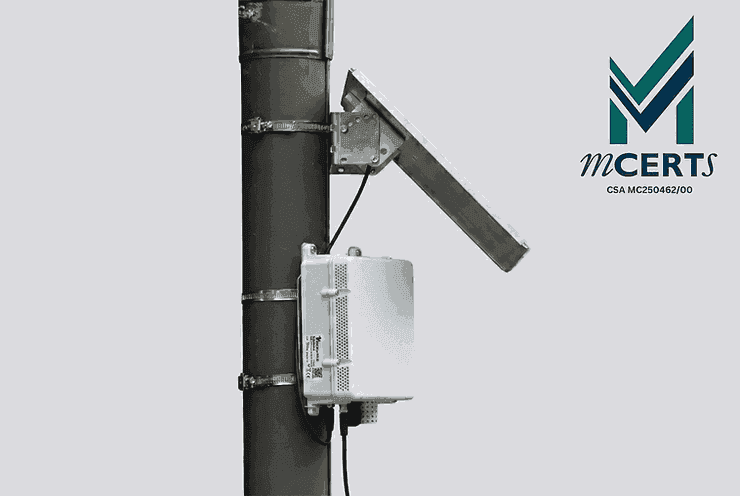
The Sensorbee Air Pro 2 has received MCERTS certification from the CSA Group on behalf of the UK Environment Agency. The Air Pro 2 is now independently certified as an Indicative Ambient Particulate Monitor for PM2.5 and PM10, meeting the Environment Agency's MCERTS Performance Standards for Ambient Air Quality Monitoring Systems.
This certification means the Air Pro 2 delivers data quality validated to the same standard the Environment Agency applies across its own monitoring programmes. For organisations that need monitoring data regulators will accept without question, this certification provides that assurance.
What the Certification Covers
MCERTS (the Environment Agency's Monitoring Certification Scheme) is the UK's performance standard for environmental monitoring equipment. Certification is not a manufacturer's claim. It is an independent, third-party verification conducted by an accredited testing body.
The Air Pro 2's MCERTS certification covers its performance as an indicative ambient particulate monitor, specifically for PM2.5 and PM10 measurement. The certification applies to the complete system: the optical sensor, the housing, the power management, the data transmission, and the on-board processing.
The certification process involved three distinct evaluation phases.
Laboratory testing. Controlled environment validation of sensor accuracy, precision, and response to known particulate concentrations. The Air Pro 2 was tested across a range of PM2.5 and PM10 concentrations representative of both clean air and pollution episode conditions.
Field collocation. Extended real-world testing at an urban background monitoring station in London, running side-by-side with reference-grade instruments for over three months. This validation confirmed the Air Pro 2 performs accurately across the temperature ranges (approximately -10 degrees C to 40 degrees C), humidity conditions (20% to 95% RH), and particulate compositions encountered in actual deployment environments.
Manufacturing quality audit. Assessment of Sensorbee's manufacturing quality management systems to confirm that production units consistently meet the performance demonstrated during testing. This ensures every Air Pro 2 shipped meets certification standards, not just the units tested.
Indicative vs Reference: What the Classification Means
The Air Pro 2 is certified as an indicative monitor, not a reference monitor. Understanding this distinction is important for selecting the right monitoring approach.
Reference monitors are laboratory-grade instruments meeting EN 12341:2014 for PM10 and PM2.5 gravimetric measurement. They cost EUR 24,000 to EUR 47,000 per unit, require climate-controlled enclosures, mains electrical power, and frequent maintenance including filter changes and flow calibration. Government agencies use reference monitors for the legal compliance networks that generate official air quality statistics.
Indicative monitors (MCERTS certified) are professional-grade instruments tested to EN 15267 performance requirements and validated against reference equipment during 12+ week field collocation studies. They cost EUR 3,500 to EUR 7,000, operate independently of fixed infrastructure, and require minimal maintenance. Indicative monitors provide data quality suitable for regulatory reporting, permit compliance, and enforcement evidence.
For construction site dust monitoring, industrial perimeter assessment, urban air quality networks, and environmental consultancy work, MCERTS-certified indicative monitoring delivers the data quality authorities require at a cost and deployment practicality that makes dense coverage achievable.
What This Means for Regulatory Compliance
MCERTS certification directly addresses the most common challenge in environmental monitoring: data credibility. When an environmental officer reviews monitoring results during a site inspection or complaint investigation, the first question concerns whether the equipment producing the data meets recognised standards.
Without certification, that question triggers additional scrutiny. Regulators may request collocated reference measurements to validate sensor accuracy, costing EUR 5,900 to EUR 12,000 and delaying resolution by weeks.
With MCERTS certification, the question is answered before it is asked. The data was produced by equipment independently validated against the same performance standards the Environment Agency uses across its own programmes.
This credibility has practical consequences across several regulatory scenarios.
Environmental permit compliance. Many permits require monitoring equipment meeting defined performance standards. MCERTS certification satisfies these requirements without interpretation or dispute.
Enforcement defence. If monitoring data shows compliance during a complaint investigation, certified measurements carry weight that uncertified data does not. Regulators accept certified data quality on the basis of independent validation.
Planning conditions. Local planning authorities increasingly specify MCERTS or equivalent certification for monitoring required under planning conditions, particularly for construction projects near sensitive receptors.
Legal proceedings. In enforcement or civil proceedings relating to environmental damage, the evidential standard for monitoring data is high. MCERTS certification provides documented provenance that withstands legal challenge.
Technical Specifications of the Certified System
The MCERTS certification applies to the Air Pro 2 in its standard operational configuration, including solar power, cellular connectivity, and weatherproof enclosure. No additional equipment or external infrastructure is required to operate within the certified performance envelope.
Key specifications of the certified system:
- ·Measured parameters: PM2.5 and PM10 (certified), PM1 (non-certified, included in data output)
- ·Measurement principle: Laser light scattering with proprietary correction algorithms
- ·Power: Integrated solar panel with battery backup, maintaining operation through extended cloudy periods
- ·Connectivity: NB-IoT or LTE-M cellular, with on-board data buffering during connectivity gaps
- ·Enclosure: IP65-rated weatherproof housing tested across -20 degrees C to 60 degrees C operational range
- ·Installation time: Under 10 minutes using pole mount, wall bracket, or magnetic base
- ·Data platform: Sensorbee Cloud with real-time dashboards, threshold alerts, and data export
The modular architecture allows certified particulate monitoring to operate alongside additional gas sensors. Up to six gas modules can be added for NO2, O3, SO2, H2S, CO, CO2, and VOC measurement. External connectors support wind, noise, and vibration sensors.
The MCERTS certification covers particulate measurement. Gas and environmental sensor modules operate independently of the particulate certification and are validated through separate calibration procedures.
Deployment Applications
MCERTS certification expands the range of applications where the Air Pro 2 meets regulatory requirements for validated data quality.
Construction site dust monitoring
Construction projects operating under environmental permits or planning conditions typically require MCERTS-certified (or equivalent) particulate monitoring at site boundaries. The Air Pro 2's solar-powered, rapid-deployment design enables certified monitoring at perimeter locations without electrical infrastructure. Multiple units positioned around a site boundary create a monitoring network that tracks dust dispersion relative to wind direction, satisfying requirements under BS 5228 and site-specific permit conditions.
Municipal air quality networks
Local authorities expanding their air quality monitoring capability can deploy MCERTS-certified Air Pro 2 units to supplement existing reference stations. A network of certified indicative monitors at 200 to 500 metre intervals provides the spatial coverage needed to identify exceedance hotspots and evaluate the effectiveness of clean air zone or traffic management interventions.
Industrial environmental permits
Facilities operating under Environment Agency permits can deploy certified monitoring at fence-line and receptor locations. The combination of certified particulate monitoring with gas sensors (NO2, SO2, VOCs) on the same platform provides comprehensive emissions characterisation from a single solar-powered node.
Environmental consultancy
Consultants conducting baseline surveys, pollution incident investigations, or compliance assessments can deploy certified monitoring equipment rapidly. The 10-minute installation and solar operation mean certified data collection begins immediately at any location, without advance site preparation or infrastructure contracts.
Maintenance and Ongoing Compliance
The Air Pro 2 requires minimal field maintenance to maintain its certified performance. Solar operation eliminates the need for electrical inspections. Cellular connectivity removes wired data infrastructure from the maintenance scope.
Periodic maintenance consists of visual inspection, cleaning of the optical sensor inlet, and verification of data transmission. This maintenance interval is substantially longer than reference equipment, which typically requires weekly filter changes and monthly flow calibration.
For organisations operating monitoring networks across multiple sites, the reduced maintenance burden translates directly into lower operational costs and more consistent data collection, addressing one of the primary barriers to maintaining regulatory-grade monitoring at scale.
Certification in Context
The Air Pro 2 joins a select group of monitoring instruments holding MCERTS certification for indicative particulate monitoring. Other certified devices in this category include the Aeroqual Dust Sentry (certified for PM10 and PM2.5), the Earthsense Zephyr, the Sonitus DM30, and AQMesh pods — each validated through the same CSA Group testing programme. The MCERTS scheme is administered by the UK Environment Agency and recognised as the primary performance standard for environmental monitoring equipment in England and Wales.
Certification is not permanent. The Environment Agency conducts periodic reviews and surveillance testing to confirm that production equipment continues to meet the standards demonstrated during initial certification. Sensorbee's quality management systems are subject to ongoing audit as part of this process.
For organisations evaluating monitoring equipment, MCERTS certification provides an objective basis for comparison. Rather than relying on manufacturer accuracy claims, which vary in methodology and reporting, MCERTS certification confirms performance against a consistent, independently administered standard.
Frequently Asked Questions
What does MCERTS certification mean for the Air Pro 2?
MCERTS certification confirms that the Air Pro 2 has been independently tested and validated by the CSA Group on behalf of the UK Environment Agency. The certification covers its performance as an indicative ambient particulate monitor for PM2.5 and PM10. This means the data it produces meets the quality standard the Environment Agency applies across its own monitoring programmes, and regulators accept MCERTS-certified data for permit compliance, enforcement, and reporting purposes.
Is the Air Pro 2 a reference monitor or an indicative monitor?
The Air Pro 2 is certified as an indicative monitor. Reference monitors are laboratory-grade instruments costing EUR 24,000 or more that require mains power and climate-controlled enclosures. Indicative monitors provide data quality validated against reference equipment at a lower cost and with practical deployment advantages. For construction, industrial, and municipal monitoring applications, MCERTS-certified indicative monitoring meets the data quality standard required by regulators.
Does MCERTS certification cover the gas sensors on the Air Pro 2?
No. The current MCERTS certification covers PM2.5 and PM10 particulate measurement only. The Air Pro 2's modular gas sensor modules (NO2, SO2, CO, VOC, and others) operate independently of the particulate certification and are validated through separate calibration procedures. The MCERTS certification applies to the complete particulate measurement system, including the optical sensor, housing, power management, and data transmission.
How long does MCERTS certification last?
MCERTS certification is subject to periodic review by the Environment Agency. Ongoing surveillance testing and quality management audits confirm that production units continue to meet certification standards. Sensorbee maintains its manufacturing quality systems in compliance with the certification scheme requirements to ensure continued validity.

David Löwenbrand
Founder & CEO