Loading...
SB4282
OVERVIEW
Hydrogen sulfide is the gas responsible for the distinctive "rotten egg" smell associated with landfills, wastewater treatment, and industrial processes involving sulfur compounds. What makes H2S uniquely challenging to monitor is its extremely low odour threshold — humans can detect it at concentrations as low as 0.5–3 ppb, meaning a sensor must measure at single-digit parts per billion to correlate with community odour complaints. The Sensorbee H2S Sensor delivers exactly this capability: a 2 ppb limit of detection and 1 ppb resolution, making it the most sensitive gas sensor in the Sensorbee range. This 25-gram electrochemical module integrates with the Air Pro 2 platforms for continuous odour monitoring at waste facilities, industrial sites, and environmental monitoring networks.
CAPABILITIES
Electrochemical sensing with 2 ppb limit of detection
1 ppb resolution across 0–2,000 ppb range
Most sensitive gas sensor in the Sensorbee range
Critical for odour monitoring and complaint management
Compact 25 g plug-in module with polyamide enclosure
>1 year operational life with field replacement
SPECIFICATIONS
| Sensor Type | Electrochemical |
| Measurement Range | 0 to 2,000 ppb |
| Resolution | 1 ppb |
| Limit of Detection | 2 ppb |
| Repeatability | 4 ppb |
| Typical Accuracy | +/-10 ppb |
| Response Time | <55 sec |
| Guarantee Range | 100 ppm |
| Dimensions | 55 x 40 x 30 mm |
| Weight | 25 gram |
| Enclosure | Polyamide |
| Operating Temperature | -30 to +50 C |
| Operating Pressure | 800 to 1200 hPa |
| Operating Humidity | 15 to 90 %RH |
| Operational Life | >1 Year |
The H2S sensor uses electrochemical detection optimised for extreme sensitivity. Hydrogen sulfide molecules diffuse through a gas-permeable membrane and react at a working electrode, generating a measurable electrical current proportional to the gas concentration. The electrochemical cell is designed specifically for H2S, with electrode chemistry and membrane characteristics tuned to achieve the 2 ppb detection limit required for odour monitoring applications.
The module measures 55 × 40 × 30 mm and weighs 25 grams, housed in a polyamide enclosure rated for outdoor operation across -30 to +50°C. It connects to the Air Pro 2 base station as a plug-in module, where the platform handles signal processing, temperature compensation, and data transmission. Each sensor is factory-calibrated to CEN/TS 17660-1:2022 standards.
Hydrogen sulfide presents both odour nuisance and health hazard concerns. At low concentrations (below 100 ppb), H2S is primarily an odour issue — generating complaints from communities near waste, wastewater, and industrial facilities. At higher concentrations, H2S becomes a direct health hazard:
The 2 ppb limit of detection means the Sensorbee H2S sensor operates below the human odour threshold — it can detect hydrogen sulfide before people smell it. This capability is essential for proactive odour management, where the goal is to identify and address emission events before they generate complaints.
Landfills, wastewater treatment plants, composting facilities, and rendering plants are required to manage odour emissions as a condition of their environmental permits. H2S serves as a surrogate indicator for general odour from anaerobic decomposition processes, since many of the most offensive odorous compounds (mercaptans, organic sulfides) co-occur with hydrogen sulfide.
Continuous H2S monitoring at facility boundaries provides:
The H2S sensor achieves ±10 ppb typical accuracy with 4 ppb repeatability across a 0–2,000 ppb measurement range. The 2,000 ppb upper range covers the concentrations encountered at facility boundaries and in surrounding communities — significantly below the safety-relevant concentrations found at emission sources.
Response time is under 55 seconds, appropriate for the one-minute averaging periods commonly used in odour monitoring programmes. The 100 ppm guarantee range protects the sensor from damage if briefly exposed to high concentrations during source-level monitoring or maintenance activities near emission points.
The 2 ppb limit of detection is certified to CEN/TS 17660-1:2022, verifying through standardised testing that the sensor genuinely resolves hydrogen sulfide at the concentrations that matter for odour assessment. This certification is particularly important for H2S monitoring, where sensor manufacturers' published specifications must withstand regulatory scrutiny in environmental enforcement proceedings.
The H2S sensor plugs directly into the Air Pro 2 base station. For comprehensive odour and environmental monitoring at waste and industrial facilities, combine the H2S sensor with:
All data feeds to the Sensorbee Cloud, where configurable alert thresholds notify operations teams when H2S concentrations approach or exceed permit limits. Historical data supports trend analysis, regulatory reporting, and complaint investigation.
Install the H2S sensor by inserting the module into the Air Pro 2 base station — the platform recognises the sensor and begins measurement automatically. For facility boundary monitoring, deploy multiple stations at strategic points around the site perimeter, positioned to capture downwind emissions under the prevailing and secondary wind directions.
The sensor has an operational life exceeding one year. Replace by removing the old module and inserting a new factory-calibrated unit — a two-minute process requiring no site calibration. For facilities with multiple monitoring stations, coordinate annual sensor replacement across all stations to maintain consistent data quality.
The H2S sensor measures hydrogen sulfide concentration, not odour intensity directly. Odour is subjective and involves multiple compounds. However, H2S is the most commonly used surrogate indicator for anaerobic odour. Continuous H2S monitoring complements periodic olfactometric surveys by providing the temporal resolution that human panel assessments cannot achieve.
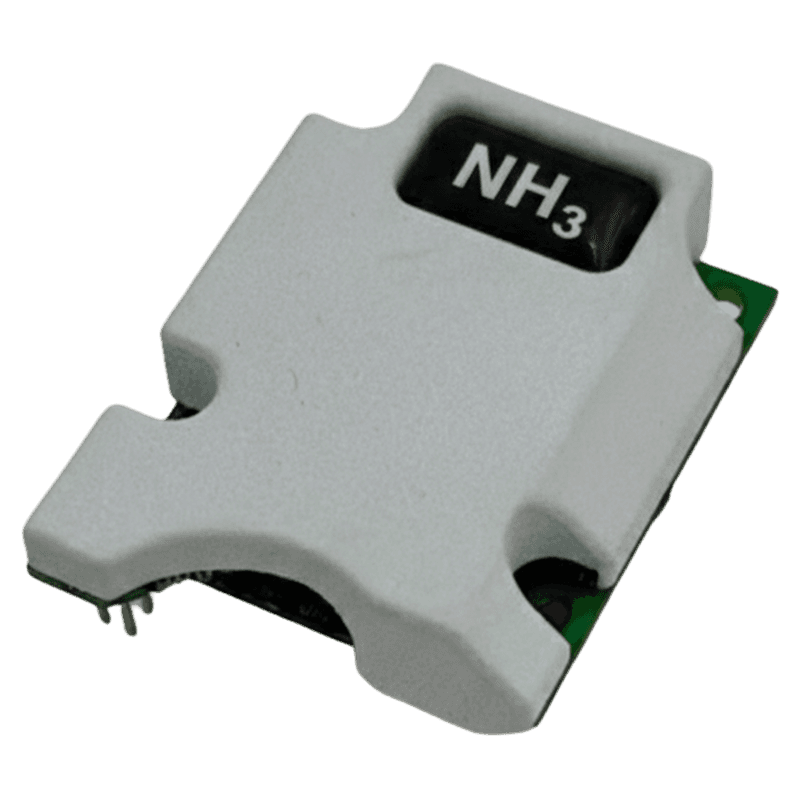
Hydrogen sulfide is one component of complex odour mixtures. For facilities where ammonia is also a concern (e.g., agricultural operations, composting), add the Sensorbee NH₃ sensor (SB4232) alongside the H2S module. For broader volatile organic compound detection, the VOC sensor (SB4292) provides general coverage of organic odour compounds.
The 0–2,000 ppb range is optimised for boundary and community-level odour monitoring, where concentrations are typically in the single-digit to low-hundred ppb range. This focused range maximises resolution and accuracy at the concentrations that matter for odour assessment, rather than sacrificing low-end sensitivity for a wider range that would rarely be used in ambient applications.
H2S measurements must be interpreted alongside wind data to determine emission source direction and impact area. The Air Pro 2 platform can integrate wind speed and direction sensors, enabling the Sensorbee Cloud to correlate H2S concentrations with wind patterns for source identification and dispersion analysis.
The H2S sensor is selective for hydrogen sulfide. It does not directly measure mercaptans (thiols) or other organic sulfur compounds. However, in anaerobic odour environments, H2S and mercaptans typically co-occur, making H2S an effective indicator of overall sulfur-based odour conditions.
LEARN MORE
Looking for AQMesh alternatives? Compare Sensorbee, Aeroqual, Kunak, and other air quality monitoring systems with specs, certifications, and honest guidance for UK projects.
Read More →How electrochemical H2S sensors detect hydrogen sulphide at ppb levels for odour monitoring at landfills, wastewater plants, and industrial boundaries.
Read More →Speak to our technical team about specifications, site suitability, and pricing.
Used in: Industry monitoring