
How electrochemical H2S sensors detect hydrogen sulphide at ppb levels for odour monitoring at landfills, wastewater plants, and industrial boundaries.
A wastewater treatment plant on the edge of a residential area. A landfill site where decomposing organic waste produces gas around the clock. A biogas facility processing agricultural slurry. These are the operations where hydrogen sulphide — the colourless gas behind the unmistakable smell of rotten eggs — drives odour complaints, regulatory enforcement, and community opposition.
The human nose can detect H2S at concentrations as low as a few parts per billion. That sensitivity is both a warning system and a problem: by the time a neighbour notices the smell, the environmental permit condition may already have been breached. Continuous hydrogen sulphide monitoring at site boundaries provides the data operators need to demonstrate compliance proactively — and to act before complaints arrive.
Where Hydrogen Sulphide Comes From — Sources and Sectors
H2S forms wherever organic material decomposes under anaerobic (oxygen-free) conditions. The gas is a natural byproduct of bacterial activity, which is why it appears across a predictable set of industries.
Wastewater treatment is the single largest source of H2S odour complaints in the UK. The gas generates at every stage where oxygen levels drop — in rising mains and gravity sewers, at inlet works, in primary settlement tanks, and during sludge thickening and dewatering. Sewage entering treatment works can carry dissolved H2S concentrations of several ppm, and agitation at inlet screens or weirs releases it into the air above the works.
Landfill sites produce H2S as part of the landfill gas mixture. While methane and carbon dioxide dominate, hydrogen sulphide concentrations in raw landfill gas can reach hundreds of ppm. At the surface, fugitive emissions through the cap or at cell boundaries create odour plumes that reach surrounding communities. High-profile enforcement cases — including the Environment Agency's intervention at Walleys Quarry in Staffordshire — demonstrate the regulatory consequences of uncontrolled H2S emissions from landfills.
Oil and gas operations encounter H2S wherever "sour" crude oil or natural gas is extracted or processed. Refinery operations, tank farms, and loading terminals all present potential release points.
Biogas and anaerobic digestion facilities — increasingly common in the UK as part of the circular economy — generate H2S during the breakdown of food waste, crop residues, and animal slurry. These facilities frequently sit near agricultural land that borders residential areas.
Industrial processes including paper mills, tanneries, and chemical manufacturing also produce H2S as a process byproduct or fugitive emission. For more on monitoring at these types of facilities, see our industrial and odour monitoring sector page.
H2S Odour Thresholds and Why PPB Detection Matters
The relationship between H2S concentration and human perception is what makes this gas so problematic for site operators. The population-average odour detection threshold sits at approximately 8 ppb (geometric mean), though individual sensitivity varies widely — some people detect H2S at 0.5 ppb, while others require concentrations above 300 ppb.
The recognition threshold — the concentration at which 50% of people can identify the characteristic rotten-egg smell — is approximately 4.7 ppb. At 10-20 ppm, eye irritation begins. At around 100 ppm, olfactory fatigue sets in and the nose can no longer detect the gas, making high concentrations extremely dangerous precisely because the warning signal disappears.
UK workplace exposure limits (WELs) for H2S are set at 5 ppm for an 8-hour time-weighted average and 10 ppm for a 15-minute short-term exposure limit. But these occupational thresholds are irrelevant to the odour problem. Neighbours complain — and regulators act — at concentrations measured in parts per billion, three orders of magnitude below workplace limits.
This is why H2S monitoring instruments must resolve to single-digit ppb. A sensor that reads in whole ppm cannot distinguish between "no detectable odour" and "significant nuisance" — the entire range of odour-relevant concentrations falls below 1 ppm.
How Electrochemical H2S Sensors Work
The dominant technology for ambient hydrogen sulphide monitoring is the electrochemical sensor. The operating principle is straightforward: H2S gas diffuses through a hydrophobic membrane into an electrolyte solution, where it undergoes an electrochemical reaction at a working electrode. This reaction generates a current proportional to the gas concentration.
Modern electrochemical H2S sensors achieve detection limits in the low ppb range, with practical field instruments typically resolving to single-digit ppb — well within the range needed for H2S odour monitoring applications. The measurement range extends from ppb levels up to hundreds of ppm, covering both ambient odour monitoring and safety alarm functions in a single sensor.
Key performance characteristics include high selectivity against common interferent gases (CO, NH3, NO, NO2), with SO2 cross-sensitivity being the primary consideration to manage. Response times are typically 15-30 seconds (T90), fast enough for real-time boundary monitoring. The sensors are compact, consume minimal power, and operate reliably in outdoor environmental conditions — characteristics that make them well suited to solar-powered field deployment.
Fenceline Monitoring for Environmental Permits
Under the Environmental Permitting Regulations 2016, permitted installations must ensure that emissions are "free from odour at levels likely to cause pollution outside the site, as perceived by an authorised officer of the Environment Agency." In practice, this means operators need to demonstrate — with data — that their odour controls are working.
An odour management plan (OMP) is a standard permit condition for facilities that handle odorous materials. The OMP must identify potential odour sources, describe control measures, and set out a monitoring regime. Continuous H2S monitoring at the site boundary is the most direct way to evidence that odour is being contained.
The alternative — waiting for complaints — is reactive and risky. Many permits include an odour condition that can be deemed breached the moment the problem is noticed, meaning the violation has already occurred before the operator is aware. Boundary monitoring inverts this: it provides a continuous record that either confirms containment or triggers an internal alert before the gas reaches neighbouring properties.
Effective fenceline H2S monitoring requires multiple measurement points around the site perimeter. Wind direction determines which boundary receives the highest concentrations at any given time, so a single downwind point is insufficient. Each monitoring station must record timestamped concentration data alongside meteorological conditions — wind speed, wind direction, temperature, and atmospheric stability — to enable source attribution and demonstrate regulatory diligence.
The Sensorbee H2S Sensor Module
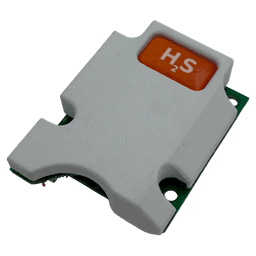
The Sensorbee H2S Sensor Module (SB4282) uses electrochemical detection technology and integrates directly with the Pro2 base unit (SB8202/SB8203). This means H2S monitoring at a site boundary requires no mains power, no WiFi infrastructure, and no manual data collection — the Pro2's solar panel powers the station, and NB-IoT or LTE-M connectivity delivers concentration data to the cloud platform in real time.
For fenceline monitoring, this matters. Boundary positions are typically the most remote points on a site — 200 metres from the nearest building, on a landfill bund, at the edge of a treatment works compound. Running power cables and data connections to these locations is expensive and impractical. A solar-powered, cellular-connected monitoring station eliminates that barrier entirely.
The modular architecture of the Pro2 platform means H2S monitoring does not have to stand alone. Add the wind speed and direction module to correlate H2S concentrations with wind data for source attribution. Combine with PM sensors to monitor dust alongside gas emissions. Each additional parameter feeds into the same cloud dashboard, the same alert system, and the same compliance report — no separate instruments, no separate data platforms.
Deployment Applications — Landfill, Wastewater, and Industrial Boundaries
H2S landfill monitoring. Four solar-powered stations positioned at the landfill boundary, each measuring H2S alongside wind speed and direction. When concentrations rise at the eastern boundary during prevailing westerly winds, the data identifies the active cell as the source. Operators can respond with targeted capping or extraction before the plume reaches the housing estate downwind.
H2S wastewater monitoring. A treatment works surrounded by residential development deploys continuous H2S monitoring at three fenceline positions. Real-time alerts notify operations staff when boundary concentrations approach trigger levels — allowing process adjustments (increased aeration, chemical dosing) before odour reaches neighbours. The monitoring record provides evidence of proactive management during any regulatory review.
Industrial fenceline monitoring. A biogas facility operating under an environmental permit installs multi-parameter stations at four perimeter points: H2S, PM10, wind speed, wind direction, temperature, and humidity. The combined dataset satisfies permit monitoring conditions, supports the odour management plan, and provides the evidence base for annual compliance reporting.
Choosing an H2S Monitoring System — Key Considerations
| Criterion | What to evaluate |
|---|---|
| Detection range | Must resolve to low ppb for odour applications — ppm-only sensors miss the critical range |
| Power source | Solar essential for remote boundary locations where mains power is unavailable |
| Connectivity | Cellular IoT (NB-IoT/LTE-M) for real-time alerts without on-site network infrastructure |
| Multi-parameter capability | H2S alone is rarely sufficient — wind data, PM, and meteorology provide context for source attribution |
| Data platform | Automated threshold alerts, regulatory reporting templates, API access for integration |
| Deployment flexibility | Lightweight, pole-mountable, redeployable between sites as operational needs change |
The pattern across UK environmental regulation is clear: operators are expected to monitor proactively, not respond reactively. For any facility where hydrogen sulphide emissions could affect neighbouring communities, continuous boundary monitoring with ppb-resolution sensors, certified equipment, and real-time data transmission is the practical standard — and the most effective defence against enforcement action.