Loading...
SB4103
OVERVIEW
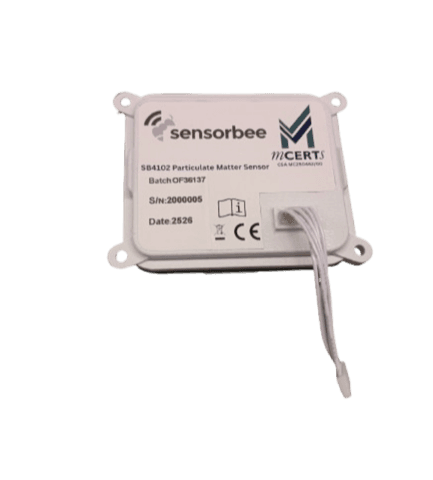
The Sensorbee Particle Matter Module (SB4103) is an optical particle counter for indicative PM1, PM2.5, and PM10 measurement. Built on the same hardware platform as the MCERTS-certified SB4102, this module delivers accurate particulate matter data at a lower cost per unit — making it the practical choice for screening, trend analysis, and monitoring applications where formal certification is not a regulatory requirement. The integrated heating element and 2.5 lpm airflow rate ensure reliable outdoor performance in all weather conditions.
CAPABILITIES
High accuracy optical particle counter
Heating element for humid conditions
2.5 lpm airflow for robust PM10 readings
>2 year operational life
Cost-effective indicative monitoring
Upgradeable to MCERTS (SB4102)
SPECIFICATIONS
| Type | Optical particle counter |
| Airflow | 2.5 lpm |
| Resolution | 1 ug/m3 |
| Mass Concentration Range | 0 to 1000 ug/m3 |
| Number Concentration Range | 0 to 2600 #/cm3 |
| PM1.0 Precision | +/-5% (0.3-1.0um) |
| PM2.5 Precision | +/-5% (0.3-2.5um) |
| PM10 Precision | +/-10% (0.3-10.0um) |
| Heating Element | Active when >60% humidity |
| Dimensions | 70 x 60 x 26 mm |
| Weight | 65 gram |
| Enclosure | Polyamide |
| Operating Temperature | -20 to +60 C |
| Operating Humidity | 0 to 95 %RH |
| Operational Life | >2 Years |
The SB4103 uses optical particle counting to classify airborne particles by size and calculate mass concentrations across three fractions — PM1, PM2.5, and PM10. A high-flow 2.5 lpm air intake draws a consistent sample volume through the sensing chamber, covering the full 0–1000 µg/m³ measurement range. Particle number concentrations are recorded up to 2600 particles per cm³ for research and comparative analysis.
An integrated heating element activates automatically when relative humidity exceeds 60%, preventing moisture condensation from artificially inflating particle counts. This active conditioning is particularly important for outdoor monitoring in temperate climates where fog, dew, and high humidity are common.
The SB4103 provides the same measurement parameters and precision specifications as the MCERTS-certified SB4102:
The 1 µg/m³ resolution provides the sensitivity needed to detect changes in ambient particulate levels, even in relatively clean air environments.
The SB4103 is the right choice when your monitoring objective does not require formally certified data for regulatory submissions:
The SB4103 and SB4102 are physically and electrically interchangeable. If your monitoring requirements change — for example, if a planning condition requires MCERTS-certified data — you can swap the SB4103 for the MCERTS-certified SB4102 in the field. No base station replacement, firmware changes, or reconfiguration required. This upgrade path protects your initial investment and allows you to scale certification as project demands evolve.
The SB4103 connects to the Air Pro 2 via the M8 sensor port. The base unit detects the module automatically and begins recording particulate data without configuration. Installation takes seconds, and no tools are required.
The module has an operational life exceeding two years under normal ambient monitoring conditions. When replacement is due, disconnect the old module and connect the replacement — the Air Pro 2 recognises the new sensor immediately.
The SB4103 uses the same hardware, optics, and measurement specifications as the SB4102. The difference is certification: the SB4102 undergoes individual 3-point calibration with a traceable certificate and holds MCERTS certification. The SB4103 is suitable for indicative monitoring without formal certification.
Yes. The SB4103 delivers ±5% precision for PM1 and PM2.5, and ±10% for PM10. These specifications are consistent with the measurement performance of the certified variant. The data is accurate for screening, trending, and comparative analysis.
Yes. Many monitoring programmes deploy MCERTS-certified modules at key compliance positions and SB4103 modules at supplementary locations for spatial coverage. The Sensorbee Cloud platform displays data from both module types on the same dashboard.
The SB4103 does not ship with an individual calibration certificate. For traceable calibration documentation, choose the MCERTS-certified SB4102.
MORE PRODUCTS
Speak to our technical team about specifications, site suitability, and pricing.