
Posted by Elixer Rodil on · 10 min read
If you are an environmental consultancy managing dust, noise, and vibration (NDV) monitoring on construction sites, you already know the hardware side of the equation. Sensors need to be accurate, robust, and deployable without fuss. But hardware alone does not win contracts, retain clients, or grow your business.
What separates a consultancy that struggles with spreadsheets and site visits from one that scales effortlessly across dozens of simultaneous projects is the software platform behind the sensors. The cloud is where raw data becomes compliance evidence, where alerts prevent breaches before they happen, and where your clients see the value of what they are paying for — without you driving to site to show them.
This article explains how the Sensorbee Cloud platform is designed specifically for the way environmental consultancies operate, and why getting the software right is as important as getting the hardware right.
The Problem: Hardware Without Software Is a Liability
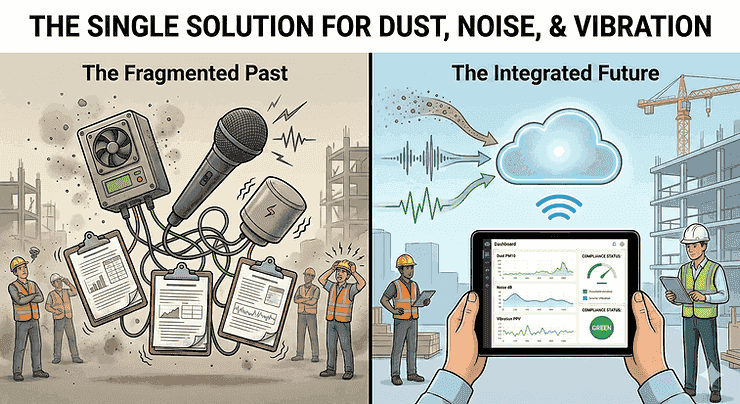
Most construction monitoring still works like this: a consultant deploys sensors at a site boundary, data accumulates on a manufacturer's generic portal, and every week someone logs in, exports a CSV, reformats it in Excel, writes a summary, and emails it to the client. Alerts are either absent or sent to one person who may or may not be on site.
This workflow has real costs:
- ·Site visits to check equipment — driving to remote sites weekly just to confirm sensors are still transmitting wastes hours that could be billable
- ·Manual reporting — reformatting data into client-ready documents is time-intensive and error-prone
- ·Reactive complaint handling — without real-time alerts reaching the right people, dust or noise breaches are discovered after the fact, when a complaint has already been filed
- ·No upselling opportunity — clients only see the parameters they originally requested, even though the monitoring station may be recording additional data that has commercial value
- ·Scaling bottleneck — every new project multiplies the manual workload linearly, capping the number of sites one consultant can manage
The Sensorbee Cloud platform addresses each of these problems directly — not with generic IoT dashboards bolted on as an afterthought, but with features designed around how construction site monitoring projects actually run.
Project Management Built for Multi-Site Operations
Environmental consultancies rarely manage one site at a time. A typical firm might have 15–30 active construction projects across the UK, each with different clients, different Section 61 consent conditions, and different monitoring requirements.
Sensorbee Cloud organises monitoring around projects, not just devices. Each project groups all the monitoring units deployed at a single site, with its own alert configurations, reporting schedules, and user permissions. This means:
- ·One dashboard, all sites — view the status of every project at a glance, with traffic-light indicators showing which sites are operating normally and which need attention
- ·Standardised project setup — apply a template of alert thresholds and reporting schedules across all units in a new project with a single action, rather than configuring each device individually. This alone can cut project setup time from hours to minutes
- ·Scalable without adding headcount — the platform's automation means a three-person consultancy can manage 30 sites as comfortably as a larger firm with dedicated site technicians
For consultancies running multiple projects simultaneously, this project-based architecture is not a convenience — it is a requirement for profitability.
White-Label Portal: Your Brand, Not Ours
When your client logs into the monitoring portal, they should see your company — your logo, your colour scheme, your brand. Not a third-party sensor manufacturer's branding.
Sensorbee Cloud supports full white-label configuration. The consultant portal can be branded with your company identity, so every interaction your client has with the monitoring data reinforces your professional image and your role as the expert managing their compliance.
This matters commercially. A branded portal communicates ownership and expertise. It positions the consultancy as the provider of the monitoring service — not merely a reseller of someone else's hardware. When contract renewal discussions happen, the client associates the entire monitoring experience with your brand.
Competitor platforms like Casella247 and Sonitus Cloud present their own branding to end users. The consultancy becomes invisible in the data delivery chain. Sensorbee takes the opposite approach: the technology is yours to present as part of your service offering.
Selective Data Sharing and Upselling
Not every parameter recorded by a monitoring station needs to be shared with every client from day one. A construction contractor may commission boundary dust monitoring, but the Sensorbee Air Pro 2 simultaneously records noise levels, vibration, temperature, humidity, and potentially multiple gas parameters.
Sensorbee Cloud lets the consultancy control which parameters are visible to each client. This creates two powerful business opportunities:
Deliver exactly what was contracted — the client sees a clean, focused dashboard showing only the PM10 and PM2.5 data they are paying for, without being overwhelmed by additional parameters they did not request.
Upsell additional data later — when the project encounters noise complaints or the local authority asks about vibration levels near a listed building, the consultant can unlock additional parameters from data that was already being recorded. No new hardware deployment required — just a portal configuration change and a new line item on the invoice.
This selective sharing model transforms a single monitoring deployment into a platform for ongoing revenue growth. The hardware is already on site, already measuring, already transmitting. The consultancy controls what the client sees and when.
Automated Reporting That Eliminates Manual Work
Compliance reporting is where most consultancies lose the most unbillable time. Formatting data, generating charts, writing summaries, attaching to emails — week after week, site after site.
Sensorbee Cloud automates the entire reporting workflow:
- ·Scheduled reports — configure reports to be generated and delivered automatically on a daily, weekly, monthly, or project-end basis. Reports are sent directly to client email addresses without the consultant lifting a finger
- ·MCERTS-certified data — reports include timestamped, audit-ready data from the MCERTS-certified Particle Matter Module, carrying the regulatory weight that planning authorities and the Environment Agency require
- ·Professional formatting — reports are generated as branded PDF documents, ready for inclusion in Section 61 compliance submissions, planning authority reviews, or community liaison packs
- ·Custom date ranges — generate ad-hoc reports for any time period when a client or regulator requests specific data outside the scheduled cycle
The time savings compound rapidly. A consultancy managing 20 sites with weekly reporting obligations might spend 10–15 hours per week on manual report generation. Automated scheduling recovers all of that time — time that can be redirected to winning new contracts or providing higher-value advisory services.
Intelligent Alerts: Right Message, Right Person, Right Time
A dust threshold exceedance at 3 AM on a Saturday has a very different alert audience than a noise complaint during weekday working hours. Generic alerting systems that send every notification to the same email address are worse than useless — they create alert fatigue, and the important warnings get lost in the noise.
Sensorbee Cloud provides granular alert routing:
- ·Parameter-specific alerts — set different thresholds for PM10, PM2.5, noise (LAeq, LAFmax), and vibration (PPV) with individual trigger levels matching your Section 61 or BS 5228 consent conditions
- ·Alert groups — route different alert types to different people. Dust exceedances go to the site environmental manager and the consultant. Noise complaints outside working hours go to the project manager and the community liaison officer. Equipment health warnings go to the consultant's technical team only
- ·SMS and email delivery — choose the delivery channel per alert type. Critical threshold breaches warrant an SMS. Routine daily summaries work as emails
- ·Project-wide alert templates — when setting up a new project, apply a standard set of alert configurations to all monitoring units at once. This eliminates the repetitive task of configuring each device individually and ensures consistent compliance coverage from day one
The Sensorbee Sound Level Meter provides the LAeq, LAFmax, and statistical Ln metrics that BS 5228 assessments require, while the Vibration Sensor delivers PPV and frequency analysis to BS 7385. Alerts can be configured against any of these parameters.
Equipment Health Monitoring: Know Before You Need to Visit
The most expensive site visit is the unnecessary one. Driving two hours to check whether a sensor is still transmitting — only to find it working perfectly — is a direct cost that erodes project margins.
Sensorbee Cloud includes comprehensive health monitoring that keeps the consultancy informed about every deployed unit without leaving the office:
- ·Battery level tracking — receive an alert when a unit's battery drops below a configurable threshold, giving you time to schedule a site visit before the unit goes offline. The solar-powered design means most units run indefinitely, but seasonal variations and site shading can affect charging
- ·Connectivity status — the platform monitors cellular connectivity for every unit and alerts if a device fails to report within its expected transmission interval
- ·Sensor diagnostics — internal health parameters including enclosure humidity, sensor element status, and data quality indicators are tracked continuously. If something degrades, you know about it before the data quality is affected
- ·Firmware status — track which firmware version each unit is running and manage over-the-air updates remotely
This proactive health monitoring means consultancies can adopt a predictive maintenance model — visiting sites only when the data says they need to, rather than on a fixed schedule driven by uncertainty. For a consultancy managing 20+ sites across the UK, this translates to significant savings in travel time, fuel costs, and engineer hours.
The Business Case: How Cloud Features Drive Consultancy Profitability
Every feature described above translates directly into either revenue growth or cost reduction for the environmental consultancy:
| Feature | Business Impact |
|---|---|
| White-label portal | Stronger client relationships, higher contract renewal rates |
| Selective data sharing | Upsell additional parameters from existing deployments |
| Automated reporting | 10–15 hours/week recovered from manual report generation |
| Alert groups and templates | Faster project setup, fewer configuration errors |
| Health monitoring | 50–70% reduction in unnecessary site visits |
| Project management | Scale from 10 to 30 sites without adding headcount |
| MCERTS-certified data | Win contracts that require certified monitoring data |
The consultancies that grow fastest are those that spend the least time on administrative overhead and the most time on billable advisory work. The Sensorbee Cloud platform is designed to shift that balance decisively in the consultancy's favour.
How Sensorbee Compares
Traditional NDV monitoring solutions treat the cloud platform as a secondary feature — a place to view data, not a business tool. Casella's Guardian2 system requires mains power (100–250 VAC) and offers its Casella247 portal with basic reporting and alerts, but no white-labelling or project-based management. Sonitus Cloud provides automated reporting and stakeholder notifications, but the platform carries Sonitus branding throughout.
Sensorbee takes a different approach. The Air Pro 2 combines dust, noise, and vibration in a single solar-powered, 1.9 kg device — eliminating the need for separate instruments from separate suppliers with separate data platforms. And the Sensorbee Cloud platform is built from the ground up as a tool for the environmental consultancy, not just a data viewer for the hardware manufacturer.
The result: fewer devices to manage, one unified data platform, branded for your business, with the automation features that let you scale without scaling your costs proportionally.
Getting Started
Sensorbee Cloud is included with every Air Pro 2 deployment. There is no separate software licence fee — the platform is part of the monitoring service.
For environmental consultancies looking to evaluate how the platform fits their operations, Sensorbee offers guided demos with live project data. You can see exactly how project setup, reporting automation, alert routing, and white-label configuration work in practice before committing to a deployment.
Explore the full platform documentation for technical details, or contact our team to arrange a live demonstration.
Request a Demo →
Frequently Asked Questions
Is there a separate software licence fee for Sensorbee Cloud?
No. Sensorbee Cloud access is included with every Air Pro 2 unit. There are no per-user fees, no per-report charges, and no feature tiers. Every customer gets access to the full platform including white-label configuration, automated reporting, alert groups, and health monitoring.
Can I brand the portal with my company logo and colours?
Yes. Sensorbee Cloud supports full white-label configuration. Your clients see your company identity when they access the monitoring portal — not Sensorbee's branding. This positions your consultancy as the service provider, not a hardware reseller.
How quickly can a new project be set up on the platform?
A new project with standard alert thresholds and reporting schedules can be configured in minutes using project templates. Template-based setup applies a consistent set of alert configurations, user permissions, and reporting schedules to all units in a project simultaneously.
What reporting formats are available?
Reports are generated as professional PDF documents suitable for regulatory submissions. Scheduled delivery options include daily, weekly, monthly, and project-end summaries. Ad-hoc reports for custom date ranges can be generated at any time. All reports include MCERTS-certified data where applicable.
Can different people receive different types of alerts?
Yes. Alert groups allow you to route specific alert types to specific recipients via SMS or email. Dust exceedances can go to the site manager, noise alerts to the community liaison officer, and equipment health warnings to your technical team — ensuring the right people get the right information without alert fatigue.
Does the platform work with all Sensorbee monitoring equipment?
Yes. Sensorbee Cloud is the unified platform for all Sensorbee monitoring equipment including the Air Pro 2, Air Lite, and all sensor modules. Data from every parameter — dust, noise, vibration, gas, and weather — feeds into the same project dashboard.

Elixer Rodil
Cloud Development Manager