
Posted by David Löwenbrand on · 7 min read
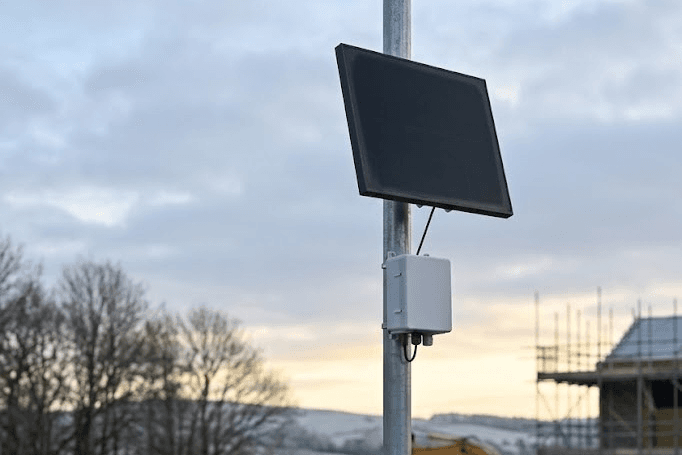
The real numbers behind year-round solar-powered NDV compliance monitoring — measured, sourced, and honest. Updated August 2026.
Every construction and demolition project that needs boundary monitoring faces the same question sooner or later: can we run this without mains power? Generators are noisy (ironic, for a noise monitor), cables get cut, and mains hook-ups on a live site are slow and expensive to arrange.
The industry's honest answer has usually been "solar in summer, something else in winter." At Sensorbee we build for the hard case: a full noise + dust + vibration (NDV) compliance station running on solar all year round — including a UK or Nordic winter. Here is the maths, with real measured numbers rather than optimistic brochure talk.
The configuration in question
This is the exact setup one of our UK acoustics customers asked us about this month:
| Item | Article no. | Role |
|---|---|---|
| Air Pro 2 Cellular MCERTS station | SB8202 | Base unit with MCERTS-certified particulate monitoring (PM1/PM2.5/PM10, module SB4102, individually 3-point calibrated with certificate) plus temperature, humidity and pressure |
| External Class 1 Noise Sensor (IEC 61672-1) | SB4651 | Compliance-grade noise (LAeq, LAFmax/min, percentiles) |
| External Vibration Sensor | SB3641 | Triaxial PPV/PCPV + FFT to BS 7385-1 / BS 6472-1 |
| 30 W Solar Panel | SB6104 | Pole/wall-mounted, adjustable angle |
Everything reports over LTE-M/NB-IoT into Sensorbee Cloud — dashboards, alarms, automated reports, CSV and API. One person installs it on a pole in under half an hour; commissioning is scanning a QR code.
What it actually draws
We measure our stations on the bench, per sensor, and cross-check against component datasheets. Average consumption:
- ·Base station + vibration sensor (PM sampling on a duty cycle): well under 0.2 W. The vibration sensor itself draws just 7 mW.
- ·External Class 1 noise sensor, measuring continuously: up to ~0.6 W — the single biggest load in the system.
- ·Particulate sensor in continuous operation with its heated inlet active (the heater manages humidity above 60 % RH — essential for honest PM data in a damp British or Nordic winter): up to 0.4 W per the sensor datasheet (5 VDC, under 80 mA typical), with brief peaks during fan and heating bursts that the internal battery absorbs.
Worst case, everything on, 24/7: roughly 1.1 W average, or about 27 Wh per day. That is the whole compliance station — noise, dust and vibration together. For context, that is less than a WiFi router.
What a 30 W panel really delivers in winter
Here is where most solar claims fall apart, so let's use published data instead of hope. London receives about 0.52 kWh/m²/day of solar energy in December, against 4.74 in July — a ninefold seasonal swing (Wikipedia: Solar power in the UK). Sweden is darker still: mid-winter global radiation in the Stockholm region runs at roughly 0.3 kWh/m²/day (SMHI).
For a steeply tilted 30 W panel (SB6104 mounts at an adjustable angle — set it near-vertical for winter) that translates to roughly:
- ·UK, December: ~15–25 Wh/day
- ·Southern Scandinavia, December: ~8–15 Wh/day
- ·Rest of the year, both regions: a wide surplus (summer harvest is 5–10× consumption)
So the honest picture: a single 30 W panel covers the full always-on Class 1 configuration for most of the year in the UK, with December–January close to break-even — and in the Nordics the darkest six to eight weeks need help. Which is exactly why the system is designed in layers.
Layer 2: the 100 Ah external battery
The SB6221 External Battery Pack is a 100 Ah / 12.8 V LiFePO₄ pack — 1,280 Wh in an IP66/IP67 enclosure with built-in BMS, quick-swap pole/wall mounting and over 5,000 charge cycles. Two things make it the winter workhorse:
- At 1.1 W worst-case draw, 1,280 Wh is 6+ weeks of full operation with zero solar input. That bridges the darkest stretch of a Nordic winter on its own.
- It accepts two 30 W panels through its integrated 5 A charge controller — doubling winter harvest to ~30–50 Wh/day in the UK, comfortably above consumption even in December.
One station, two panels, one battery pack: a genuinely year-round solar NDV monitor at 59° north. (The SB6212 carry case keeps the whole power kit organised between deployments.)
The numbers get better if your requirements allow it
Not every project needs Class 1 noise running around the clock:
- ·Class 2 / indicative noise instead of Class 1: the integrated Sound Level Meter module (SB4652, ±1 dB(A), LAeq and percentiles) draws a fraction of the external Class 1 sensor. Total system consumption drops to roughly 0.3–0.5 W — a single 30 W panel then covers even a Nordic December.
- ·Workday-only supervision: if your consent only requires monitoring 07:00–19:00 on weekdays, scheduling the noise sensor accordingly cuts its average draw by ~65 %, bringing the full Class 1 system to roughly 0.7 W (~17 Wh/day) — single-panel territory in a UK winter.
And if the worst happens: graceful degradation, not a dead station
A hard lesson from the field: a monitor that dies silently in week three of a dark January is worse than useless — it is a compliance gap. Sensorbee stations therefore degrade gracefully instead of falling over:
- ·The particulate sensor steps into power-saving modes (reduced duty cycle) as battery reserves drop, trading time-resolution before losing data entirely.
- ·Scheduling rules let you reduce accuracy or sampling where it does not matter — nights, weekends, holidays — and bank that energy for the periods your consent actually covers.
- ·Longer reporting intervals slash transmission energy: our bench data shows base consumption falling from ~97 mW at 5-minute reporting to ~48 mW at 10-minute and a few mW at hourly intervals — the built-in data buffer means nothing is lost, only delayed.
- ·When the sun returns, the station steps back up to full resolution automatically. Every reading remains time-stamped, traceable and in your cloud record.
How that compares
We respect our competitors — Casella, Sonitus and Turnkey all provide credible systems for construction and boundary monitoring in the UK. The difference worth examining is not whether a manufacturer offers a solar panel, but how many parameters are integrated, what the complete configuration draws, and how much solar and battery capacity it therefore needs:
| System | Scope | Power approach |
|---|---|---|
| Sensorbee SB8202 + SB4651 + SB3641 | MCERTS dust + Class 1 noise + triaxial vibration in one station | ~1.1 W worst case; one or two 30 W panels + 1,280 Wh battery = year-round solar |
| Casella Guardian2 | Configurable boundary monitor: PM1/PM2.5/PM10, Class 1 noise, triaxial vibration, optional wind and VOC | Mains, battery or solar; solar builds use a separate controller and battery enclosure with single-, dual- or triple-panel arrays |
| Sonitus DM30N Sitesens + partner vibration | MCERTS-approved PM + Class 1 noise in one unit; vibration via AVA Monitoring equipment into Sonitus Cloud | 110–240 VAC or 12 VDC; published maximum 24 W with the inlet heater at full power (heater output adjustable); solar and battery options for remote sites |
| Turnkey iVIBEpeli + particulate monitor | Class 1 noise + vibration in one instrument; dust from a separate Turnkey monitor, unified in AirQWeb | External leisure batteries or Turnkey's combined solar-and-wind power system |
Casella Guardian2 is the closest direct all-in-one comparison. It can combine simultaneous PM1, PM2.5 and PM10 measurement, IEC 61672-1 noise, triaxial vibration and optional wind or VOC sensing, with real-time data, automatic reports and email or text alerts. Casella offers mains, battery and solar power configurations; its battery-only enclosure is quoted at roughly five to nine days of operation depending on configuration, with solar arrays available in single-, dual- and triple-panel versions sized to the installation.
Sonitus DM30N Sitesens is particularly relevant to UK and Irish construction: it pairs a Class 1 sound level monitor with an MCERTS-approved particulate sensor (PM1/PM2.5/PM10) and heated inlet in one unit, reporting into Sonitus Cloud. Sonitus publishes a power input of 110–240 VAC or 12 VDC and a maximum consumption of 24 W with the inlet heater at full power (the heater output is user-adjustable); the unit weighs about 11 kg in its stainless-steel surround. Vibration is not integrated into Sitesens itself — Sonitus supports it with AVA Monitoring equipment feeding the same cloud platform. A comprehensive project-level solution, delivered across more than one physical device.
Turnkey Instruments takes a modular British approach: the iVIBEpeli combines Class 1 noise and vibration in one connected instrument, with particulates supplied by a separate Turnkey monitor and everything brought together in the AirQWeb platform. Turnkey quotes operation from external leisure batteries or its combined solar-and-wind power system.
All three are capable systems — which is exactly why "solar-powered" cannot be treated as a yes-or-no specification. A configuration drawing 20 W or more needs a very different winter power installation from one drawing around 1 W, and a solution split across several instruments can multiply the power feeds, batteries, mounting points and communications arrangements a site has to manage. Sensorbee's approach is to minimise the energy requirement of the complete measurement chain first — sensors, firmware, communications and power designed together — and only then size the panel and battery.
Three parameters, one 1.9 kg box, no generator, no battery-swap rota, no electrician. For the wider story of what going off-grid does to project costs, see how solar power solved construction monitoring's biggest problem.
Compliance, without the complexity
MCERTS-certified particulate measurement (certificate CSA MC250462/00), IEC 61672-1 Class 1 noise when you need it, vibration to BS 7385-1 and BS 6472-1, factory 3-point-calibrated modules each shipped with their own certificate — and everything lands in Sensorbee Cloud with alarms by email/SMS, automated reporting, CSV export and REST/Push APIs.
Planning an NDV deployment for the coming winter? Send us your site and consent requirements and we'll size the power system for you — honestly.
Consumption figures are Sensorbee bench measurements (October 2025, firmware 3.37) and component datasheet values; solar yield estimates are based on published irradiation data for London and Stockholm cited above. Your site's yield depends on orientation, shading and local climate — we're happy to run the numbers for your exact location.

David Löwenbrand
Founder & CEO