Loading...
OVERVIEW
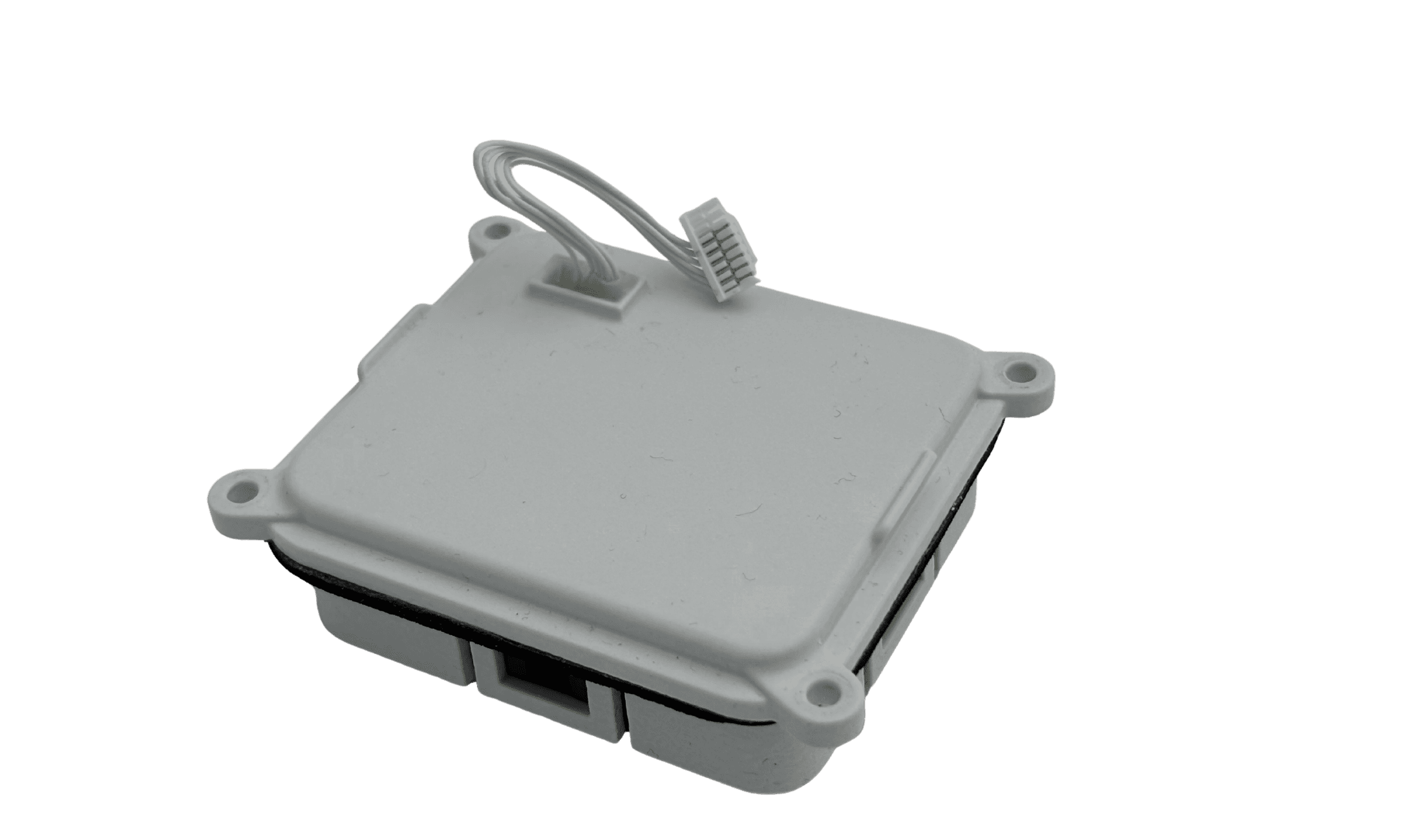
The Sensorbee Vibration Sensor (SB3641) is a triaxial vibration monitor designed for construction, blasting, and traffic vibration assessment. Measuring Peak Particle Velocity (PPV), Peak Component Particle Velocity (PCPV), peak frequency, and full FFT frequency spectrum across all three axes, this sensor delivers the data required for BS 7385-1 building damage assessment and BS 6472-1 human vibration evaluation. The IP67 weatherproof aluminium housing is built for long-term outdoor deployment on construction sites, near blasting operations, and at sensitive receptor locations.
CAPABILITIES
Triaxial vibration measurement (X, Y, Z)
IP67 weatherproof aluminium housing
BS 7385-1 and BS 6472-1 compliant
Real-time PPV, PCPV, and FFT data
2.5m cable with M8 connector
Ultra-low 7 mW power consumption
SPECIFICATIONS
| Velocity Range | +/- 200 mm/s |
| RMS Noise | 0.05 mm/s |
| Bandwidth | 1 to 100 Hz (sampled at 4096 Hz) |
| Output Data | PPV, PCPV (X,Y,Z), Peak Frequency, FFT spectrum |
| Interface | M8 extension port (Modbus RTU) |
| Waterproof Rating | IP67 |
| Dimensions | 100 x 100 x 30 mm |
| Weight | 350 gram |
| Housing | Aluminium with 5mm plate |
| Cable Length | 2.5m |
| Power | 5 to 24 VDC, 7 mW |
| Operating Temperature | -30 to +60 C |
| Temperature Sensor | -20 to 50 C: +/-0.1 C |
| Operating Humidity | 0 to 99 %RH |
| Compliance Standards | BS 7385-1, BS 6472-1 |
The SB3641 contains three accelerometers oriented along the X, Y, and Z axes, sampling vibration at 4096 Hz across a 1–100 Hz bandwidth. This high sample rate captures the full range of ground-borne vibrations generated by construction plant, piling, blasting, demolition, and road traffic. Raw accelerometer data is processed onboard to calculate Peak Particle Velocity (PPV) — the primary metric used in BS 7385-1 for assessing the risk of cosmetic or structural damage to buildings.
The sensor also outputs Peak Component Particle Velocity (PCPV) for each axis independently, peak dominant frequency, and full FFT frequency spectrum data. These parameters enable detailed vibration characterisation beyond the headline PPV value, supporting forensic analysis of vibration sources and frequency-dependent damage risk assessment.
Data is transmitted to the Air Pro 2 base station via Modbus RTU over the M8 extension port, and from there to the Sensorbee Cloud for real-time monitoring, alerting, and reporting.
The SB3641 delivers the full set of vibration metrics used in standards-based assessment:
The ±200 mm/s velocity range and 0.05 mm/s RMS noise floor provide the dynamic range and sensitivity needed for both high-energy blasting events and low-level traffic vibration.
The SB3641 is designed to meet the measurement requirements of the standards used in environmental vibration assessment:
These standards are referenced in planning conditions, Section 61 consent agreements, and environmental impact assessments for construction and infrastructure projects.
Vibration monitoring on construction sites has traditionally required expensive standalone instruments with separate data loggers, communications, and power supplies. The SB3641 integrates directly with the Air Pro 2, creating a unified dust, noise, and vibration monitoring station.
The SB3641 connects to the Air Pro 2 via the M8 extension port using the included 2.5 m cable. Place the sensor on a solid surface or mount it using the 5 mm aluminium base plate. For ground vibration monitoring, position the sensor on a firm, level surface with good ground coupling — a concrete slab, structural floor, or purpose-made ground mount.
The Air Pro 2 detects the vibration sensor automatically via Modbus RTU and begins recording and transmitting vibration data to the Sensorbee Cloud. No configuration, calibration, or firmware updates are required at the time of installation.
For buildings or structures where internal vibration assessment is needed, extension cables allow the sensor to be placed at the assessment position while the Air Pro 2 remains at its outdoor mounting location.
Yes. The SB3641 provides PPV and peak frequency measurements in the 1–100 Hz bandwidth specified by BS 7385-1 for evaluating vibration impact on buildings. The triaxial measurement covers all required directional components.
Place the sensor on a solid, level surface with good ground coupling — typically a concrete slab, structural floor, or building foundation. For external ground monitoring, a purpose-made ground mount or sand bag coupling may be appropriate depending on ground conditions.
The SB3641 has a velocity range of ±200 mm/s, which comfortably covers the range of construction and blasting vibrations encountered in typical monitoring applications. This range exceeds the damage threshold limits defined in BS 7385-1.
The SB3641 communicates via Modbus RTU and can be connected to any Modbus-compatible data logger or controller. However, integration with the Air Pro 2 provides the simplest path to cloud connectivity, real-time alerts, and combined environmental monitoring.
The SB3641 ships with a 2.5 m cable and M8 connector. Extension cables are available from Sensorbee for installations where the sensor and base station require greater separation.
MORE PRODUCTS
LEARN MORE
Guide to construction vibration monitoring: PPV limits, BS 7385 thresholds, and sensor placement. Monitor dust, noise and vibration from one device.
Read More →Compare Sensorbee and Aeroqual for dust, air quality, and construction monitoring. Side-by-side specs for Dust Sentry, AQS 1, and AQM 65 against Sensorbee Pro 2.
Read More →Side-by-side comparison of Sensorbee and Casella Guardian2 for construction dust, noise, and vibration monitoring. Specs, power, certifications, and honest buyer guidance.
Read More →Speak to our technical team about specifications, site suitability, and pricing.
Used in: Construction, Construction-vibration, Airports monitoring