
Posted by Filip Sobecki on · 8 min read
The Cost of Managing Multiple Monitoring Systems
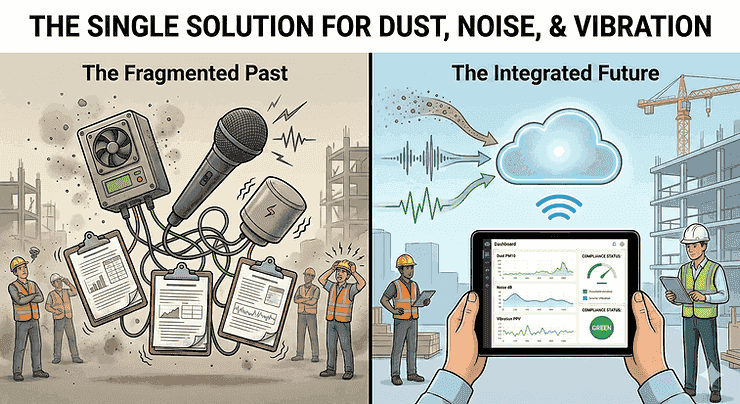
Most UK construction projects subject to Section 61 agreements need to monitor dust, noise, and vibration simultaneously. Traditionally, this has meant deploying separate systems for each parameter — one device for particulate matter, another for noise levels, and a third for vibration measurements.
This fragmented approach creates problems that extend far beyond the initial equipment cost. Multiple vendors mean multiple contracts, different calibration schedules, separate data platforms, and increased complexity in reporting to regulatory authorities. When a compliance issue arises, correlating data from three different systems to understand the full environmental picture becomes a time-consuming challenge.
Multi-parameter environmental monitoring — integrated solutions that track multiple environmental factors from a single device — addresses these problems directly. A single deployment covers all three parameters with unified data, consolidated reporting, and lower total cost.
Understanding Multi-Parameter Environmental Monitoring
Multi-parameter monitoring refers to environmental monitoring systems that measure multiple environmental factors simultaneously from one integrated device. For construction sites, the critical parameters typically include:
Air Quality (Particulate Matter)
- ·PM10 and PM2.5 dust particles from excavation, demolition, and material handling
- ·Real-time tracking of dust emissions at site boundaries -- the EU daily limit for PM10 is 50 µg/m³ (not to be exceeded more than 35 times per year), while the WHO 2021 guideline for PM2.5 is just 15 µg/m³ (24-hour mean)
- ·Automatic alerts when dust levels approach regulatory thresholds, typically set at 80% of the applicable limit to allow corrective action before an exceedance
Noise Monitoring
- ·Continuous sound level measurement in decibels (dB), typically LAeq over 1-hour or 15-minute intervals
- ·Class 1 or Class 2 sound level meters conforming to IEC 61672-1 -- Class 1 is required for enforcement monitoring under BS 5228-1:2009+A1:2014
- ·24/7 monitoring to capture noise from all construction activities, with typical Section 61 limits ranging from 65–75 dB LAeq,T depending on the time of day and receptor sensitivity
Vibration Monitoring
- ·Peak Particle Velocity (PPV) measurement from pile driving, blasting, or heavy equipment -- measured triaxially across three orthogonal axes
- ·Protection against structural damage using BS 7385-2:1993 guide values: 15 mm/s PPV at 4 Hz for residential structures, rising to 50 mm/s at 40 Hz and above
- ·Compliance with vibration limits for sensitive receptors, including BS 6472-1:2008 Vibration Dose Values (VDV) for human comfort in occupied buildings
Weather Conditions
- ·Temperature, humidity, pressure, wind speed and direction
- ·Essential context for understanding how weather affects dust dispersion
- ·Documentation showing environmental conditions during compliance periods
The Problem with Separate Monitoring Solutions
Complexity and Coordination Challenges
Managing three separate monitoring systems means three times the complexity. Each system requires:
- ·Individual setup and calibration
- ·Separate maintenance schedules
- ·Different vendor support contacts
- ·Multiple data platforms to log into
- ·Disparate reporting formats for regulators
When you're managing multiple active construction sites, this complexity multiplies quickly. Project managers waste valuable time coordinating between different monitoring vendors instead of focusing on construction progress.
Data Integration Difficulties
Environmental compliance isn't about isolated measurements -- it's about understanding the complete picture. When dust levels spike, you need to know:
- ·Was it windy that day? (Weather context)
- ·Were there simultaneous noise violations? (Activity correlation)
- ·Was heavy equipment operating nearby? (Cause identification)
With separate systems logging to different platforms, correlating this data requires manual exports, spreadsheet manipulation, and time-consuming analysis. By the time you've assembled the full picture, the opportunity to take corrective action may have passed.
Higher Total Cost of Ownership
While individual single-parameter monitors might seem less expensive upfront, the total cost tells a different story:
- ·Multiple equipment purchases: Three separate devices instead of one integrated solution
- ·Separate connectivity costs: Individual data plans for each device
- ·Triple the maintenance: Three calibration schedules, three sets of replacement parts
- ·Increased labour: More time spent on setup, data management, and reporting
- ·Higher project risk: Greater chance of compliance gaps when managing multiple systems
Construction companies that analyse their total monitoring costs over a project lifecycle often find that integrated multi-parameter solutions deliver significant savings.
Benefits of Integrated Multi-Parameter Monitoring
Unified Data Platform
All environmental data flows into a single cloud dashboard. Sensorbee Cloud, for example, allows you to view dust, noise, and vibration measurements side-by-side with weather context, making it easy to:
- ·Identify correlations between different environmental factors
- ·Understand root causes of compliance issues
- ·Generate comprehensive reports for regulatory authorities
Faster Deployment
Setting up three separate monitoring systems can take hours or even days. Integrated solutions dramatically reduce deployment time. Sensorbee Air Pro 2, for instance, can be fully operational in under 10 minutes -- mounted on a light pole or temporary structure, connected to solar power, and transmitting data to the cloud. This rapid deployment is possible thanks to Sensorbee's plug-and-play design and solar-powered independence, eliminating the need for electrical infrastructure at remote construction sites.
This speed advantage matters particularly for:
- ·Mobile monitoring: Moving equipment between construction phases or sites
- ·Emergency response: Quickly deploying monitoring when complaints arise
- ·Temporary projects: Short-duration work where setup time is a significant percentage of the project timeline
Better Compliance Documentation
Environmental regulators increasingly require comprehensive monitoring that shows the full environmental impact of construction activities. Multi-parameter monitoring provides:
- ·Coordinated timestamps: All measurements synchronised to the same clock
- ·Contextual data: Weather conditions and activity correlations
- ·Continuous coverage: No gaps from coordinating multiple systems
- ·Single audit trail: Unified calibration and quality assurance records
This comprehensive documentation protects your company if compliance disputes arise and demonstrates environmental responsibility to regulators and the community. Section 61 of the Control of Pollution Act 1974 allows local authorities to impose conditions on construction noise and vibration before work begins -- having all data aligned to BS 5228-1:2009+A1:2014 (noise) and BS 5228-2:2009+A1:2014 (vibration) requirements in a single platform simplifies reporting significantly and provides an auditable defence if conditions are challenged.
Cost Efficiency
Integrated monitoring delivers measurable cost savings:
- ·Single equipment purchase: One device instead of three separate systems
- ·Consolidated connectivity: One data connection instead of multiple plans
- ·Streamlined maintenance: Single calibration schedule and vendor relationship
- ·Reduced labour: Less time on setup, data management, and reporting
- ·Lower risk of violations: Better oversight reduces the chance of expensive fines and project delays
Modular Design: Start Basic, Expand as Needed
One concern about integrated monitoring is over-buying -- paying for capabilities you don't need. Modern multi-parameter systems address this through modular, expandable design.
A basic air quality monitoring station might include PM10, PM2.5, temperature, and humidity as standard measurements. As project needs evolve, you can add modular sensors for:
- ·Noise monitoring (Class 1 or Class 2 sound level meters)
- ·Vibration sensors for pile driving or blasting activities
- ·Additional gas sensors (NO2, SO2, VOC, CO) for specific industrial applications
- ·Enhanced weather stations for better dust dispersion modelling
True plug-and-play modularity means simply attaching the sensor and restarting the device -- no complex configuration or programming required. Sensorbee's modular design takes this further: when you attach a Sensorbee sensor module (such as a Class 1 noise monitor or vibration sensor), the system automatically detects and begins logging data without any manual configuration. This flexibility allows construction companies to:
- ·Match monitoring to project phases: Add vibration monitoring only during pile driving
- ·Respond to requirements: Quickly add parameters if regulatory requirements change
- ·Optimise investment: Pay only for the monitoring you need at each stage
- ·Reuse equipment: Reconfigure stations for different projects with different requirements
Real-World Application: Construction Site Scenario
Consider a typical urban construction project: a mixed-use development in a residential neighbourhood. The project involves:
- ·Demolition phase: High dust and vibration risk
- ·Foundation phase: Pile driving creating noise and vibration
- ·Construction phase: Ongoing dust and noise from concrete pours and material delivery
Traditional Approach
- ·Deploy separate dust monitor (vendor A), noise monitor (vendor B), and vibration sensor (vendor C)
- ·Setup time: 4-6 hours across three vendors
- ·Three data platforms to monitor daily
- ·Manual correlation when neighbour complaints arise
- ·Separate reports for each parameter
Multi-Parameter Approach (e.g., Sensorbee Air Pro 2)
- ·Deploy one integrated monitoring station
- ·Setup time: 10 minutes with solar power and light pole mounting
- ·Single Sensorbee Cloud dashboard showing all parameters with weather context
- ·Automatic alerts when any threshold approaches
- ·Unified compliance reports generated automatically
The result: simplified operations, better community relations, comprehensive compliance documentation, and significant cost savings over the project lifecycle. Construction companies using Sensorbee's integrated approach report reducing monitoring setup time by 80% compared to traditional multi-vendor deployments.
Choosing the Right Multi-Parameter Solution
When evaluating integrated monitoring systems, construction project managers should consider:
Essential Capabilities
- ·Dust monitoring (PM10 and PM2.5) as baseline
- ·Modular expandability for noise and vibration when needed
- ·Real-time cloud data access with automated alerts
- ·Quick deployment (target: under 10 minutes)
- ·Solar power option for sites without infrastructure
- ·Weather-resistant design for outdoor use
Nice-to-Have Features
- ·Public-facing dashboards for community engagement
- ·Mobile mounting options for vehicle-based monitoring (Sensorbee offers magnetic mounting for mobile units)
- ·API integration with existing project management systems
- ·Automatic Baseline Calibration (ABC) to prevent sensor drift (Sensorbee's ABC technology prevents sensor drift in long-term deployments)
- ·Multiple power options (solar, mains, battery backup)
- ·Robust build quality for extreme weather conditions
Key Questions to Ask
- ·How long does the initial setup take?
- ·Can I add sensors later without replacing the entire system?
- ·Is weather data included for compliance context?
- ·What's the total cost including connectivity and maintenance?
- ·Can neighbours access data for transparency?
- ·How do I generate regulatory compliance reports?
Frequently Asked Questions
Can I start with just dust monitoring and add noise/vibration later?
Yes. Sensorbee Air Pro 2 uses a modular design where you can add Sensorbee sensor modules at any time. Simply attach the sensor, restart the device, and it automatically begins logging data -- no programming required.
How long does it take to set up a multi-parameter monitoring station?
With solar power and light pole mounting, Sensorbee Air Pro 2 can be fully operational in under 10 minutes. Traditional multi-sensor setups typically require several hours.
Do I need separate data plans for each sensor?
No. Multi-parameter systems use a single cellular connection to transmit data from all sensors to the cloud platform.
How does multi-parameter monitoring help with neighbour relations?
Having all environmental data in a single platform makes it straightforward to share real-time information with concerned residents. When a noise or dust complaint arises, you can quickly pull up the relevant measurements alongside weather context to show whether thresholds were exceeded and what site activity was occurring at the time. This transparency builds trust and reduces disputes. Sensorbee Cloud supports public-facing dashboards that give neighbours direct access to live monitoring data.
What happens if I only need vibration monitoring during the pile driving phase?
With modular systems, you can add a vibration sensor module for just the pile driving phase, then remove or redeploy it to another site afterward. The base station continues monitoring dust and other parameters throughout the project.
Can multi-parameter data be exported for regulatory reports?
Yes. Modern cloud platforms allow you to export data in multiple formats (CSV, PDF reports) and can generate automated compliance reports that include all monitored parameters with appropriate timestamps and calibration records.
Conclusion
Multi-parameter systems consolidate dust, noise, and vibration monitoring into a single device with unified data and reporting. The practical benefits are measurable: faster deployment, lower total monitoring cost across the project lifecycle, and compliance documentation that satisfies Section 61 requirements from a single platform.
Modular design means you are not locked into over-buying. Start with particulate monitoring and add noise or vibration modules as project phases demand them. As environmental regulations tighten and local authority scrutiny of construction impacts increases, integrated monitoring addresses the full scope of compliance requirements without the complexity of managing multiple vendors and data platforms.

Filip Sobecki
Production & Logistics Manager