Guide to construction vibration monitoring: PPV limits, BS 7385 thresholds, and sensor placement. Monitor dust, noise and vibration from one device.
An impact piling rig drives a steel section into the ground with repeated blows measured in tonnes. Each strike sends vibration waves through the soil at velocities that depend on ground conditions, energy input, and distance. At 10 metres, peak particle velocity from impact piling routinely reaches 10–50 mm/s. At the nearest residential property — perhaps 25 metres away — those waves may still arrive at 2–12 mm/s, well above the threshold where residents feel the ground move under their feet and pick up the phone to complain.
Construction vibration monitoring exists to quantify that energy, compare it against damage thresholds, and provide evidence that works are being managed responsibly. For a broader overview of construction site monitoring requirements, see our sector guide. For piling, demolition, heavy compaction, and blasting operations near sensitive receptors, it is a practical requirement under Section 61 consent conditions and a necessary defence against stop-work notices.
This guide explains peak particle velocity measurement, the UK standards framework under BS 7385 and BS 5228-2, and how to deploy vibration monitoring effectively on construction sites.
What Is Peak Particle Velocity and Why Does It Matter?
Peak particle velocity (PPV) is the maximum instantaneous speed at which a particle of ground moves as a vibration wave passes through it. It is measured in millimetres per second (mm/s) and is the primary metric used in the UK for assessing construction vibration impact on buildings.
Ground vibration propagates as a wave. As that wave passes a point, the soil particles oscillate — they do not travel with the wave, but they move back and forth around their rest position. PPV captures the fastest point of that oscillation. It correlates well with strain in structures, which is why it is used as a proxy for damage potential rather than displacement or acceleration alone.
Vibration is measured in three orthogonal axes: X (longitudinal), Y (transverse), and Z (vertical). The peak component particle velocity (PCPV) is the highest PPV recorded in any single axis. Some standards and consent conditions specify resultant PPV — the vector sum of simultaneous components across all three axes — which always gives a higher value than PCPV.
To put PPV values in context, the table below sets out what different levels mean in practice.
| PPV (mm/s) | Effect |
|---|---|
| 0.14–0.3 | Threshold of human perception |
| 0.3–1.0 | Perceptible to most people — complaints become likely |
| 1.0–3.0 | Clearly felt — residents report disturbance |
| 5.0–15.0 | Possible cosmetic damage to residential buildings (frequency dependent) |
| 15–25 | Cosmetic damage likely in residential structures |
| >50 | Risk of major structural damage |
The gap between perception and damage is significant. People feel vibration at levels roughly 50 to 100 times below the threshold of cosmetic damage. This is why vibration complaints often arrive long before there is any risk to structures — and why monitoring data is essential for demonstrating that buildings are safe.
Frequency Matters — Why PPV Alone Is Not Enough
A PPV reading of 10 mm/s at 5 Hz is not the same as 10 mm/s at 50 Hz. At lower frequencies, ground particles undergo larger displacements for the same velocity, and those larger movements impose greater strain on building elements. This is why BS 7385 does not provide a single PPV limit — it provides frequency-dependent thresholds.
Dominant frequency analysis, typically performed using Fast Fourier Transform (FFT), identifies the frequency at which the greatest vibration energy occurs. This determines which column of the BS 7385 table applies.
Piling operations typically generate vibration in the 4–30 Hz range — precisely the low-frequency band where damage thresholds are lowest. Blasting produces vibration at higher frequencies (10–100+ Hz), which attenuates more rapidly with distance and falls under more generous limits. Vibratory compaction and demolition sit somewhere between the two.
The practical consequence is that a vibration monitor must capture frequency spectrum data alongside PPV, not simply report a single peak value. Without frequency information, it is impossible to determine which BS 7385 threshold applies or whether a recorded PPV is a concern.
BS 7385 — UK Damage Thresholds for Construction Vibration
BS 7385-2:1993 is the UK standard that provides guide values for vibration levels above which cosmetic damage to buildings could occur. It applies to groundborne vibration from sources including piling, demolition, compaction, blasting, tunnelling, and traffic.
The standard divides buildings into two categories and provides PPV limits that vary with frequency.
| Building type | 4–15 Hz | 15–40 Hz | 40–250 Hz |
|---|---|---|---|
| Reinforced or framed structures; industrial and heavy commercial buildings | 50 mm/s | 50 mm/s | 50 mm/s |
| Unreinforced or light framed structures; residential or light commercial buildings | 15 mm/s (rising to 20 at 15 Hz) | 20–50 mm/s | 50 mm/s |
These values apply to transient vibration measured at the base of the building. For continuous vibration — such as that produced by vibratory piling or continuous compaction — BS 7385-2 advises reducing the transient values by 50%. A residential building with a transient limit of 15 mm/s at low frequency would therefore have an effective continuous limit of 7.5 mm/s.
Three important limitations apply. First, BS 7385 covers cosmetic damage only — hairline cracks in plaster, mortar, or wall linings. It does not address structural damage, which occurs at significantly higher levels. Second, the standard does not cover chimneys, bridges, or underground structures such as tunnels and pipelines. Third, it explicitly applies to groundborne vibration and not to vibration generated by machinery within a building.
BS 7385 sets the ceiling for vibration damage buildings. In practice, the trigger levels used on construction sites are far lower — typically 1–5 mm/s — to provide an early warning margin and manage resident complaints before levels approach anything near the damage thresholds.
BS 5228-2 and Section 61 — The Regulatory Framework
BS 5228-2:2009+A1:2014 is the code of practice for vibration control on construction and open sites. It is the vibration companion to BS 5228-1 (which covers noise) and provides guidance on predicting, assessing, and controlling construction vibration. While not legislation itself, it is routinely referenced in planning conditions and Section 61 consent applications.
Section 61 of the Control of Pollution Act 1974 allows contractors to apply for Prior Consent before noisy or vibration-generating works begin. The local authority reviews the application and sets conditions — including vibration limits — that the contractor must meet. Continuous monitoring is the standard mechanism for demonstrating compliance.
A typical Section 61 consent for piling vibration monitoring near residential properties uses a three-tier framework.
| Level | PPV threshold | Action required |
|---|---|---|
| Trigger (green to amber) | 1.0 mm/s | Review working methods, notify site management |
| Action (amber to red) | 3.0–5.0 mm/s | Investigate cause, implement mitigation measures |
| Limit (red — stop work) | 10–15 mm/s | Cease operations, assess impact, modify technique |
Critically, Section 61 consent conditions almost always cover dust, noise, and vibration together. A site running piling operations needs continuous monitoring of all three parameters to maintain compliance — not just vibration in isolation.
For the noise monitoring requirements that accompany vibration conditions, see our guide to construction noise monitoring.
Monitoring Vibration, Dust, and Noise From One Station
The combined nature of Section 61 consent creates a practical problem. Most vibration monitors on the market are single-parameter devices. Monitoring dust, noise, and vibration together has traditionally required three separate instruments, three power supplies, three data connections, and three sets of maintenance visits.
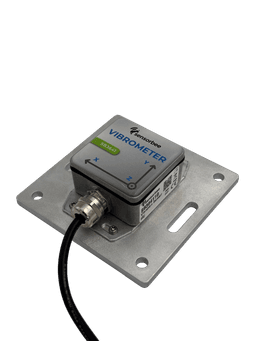
The Sensorbee Pro2 station (SB8202/SB8203) with the SB3641 vibration sensor addresses this directly. The SB3641 is a triaxial vibration sensor that measures PPV, PCPV, and frequency spectrum continuously, housed in an IP67 weatherproof enclosure and connected to the Pro2 via Modbus RTU. Paired with dust and noise sensors on the same station, it provides complete Section 61 compliance data from a single installation point. For sensor-placement guidance, receptor-type PPV thresholds, and how it slots into a UK construction project, see our construction vibration monitoring page.
Three characteristics matter for construction deployment. First, the station is solar-powered — no mains connection to arrange and no battery swaps during a piling campaign that may run for weeks. Second, connectivity is via NB-IoT or LTE-M, low-power wide-area networks that maintain reliable data transmission even on sites without existing infrastructure. Third, all parameters feed into one dashboard, so the environmental manager sees dust, noise, and vibration data together rather than switching between separate systems from different manufacturers.
For construction projects where Section 61 requires evidence across all three parameters, a single device that covers the full scope reduces installation time, ongoing maintenance, and the risk of data gaps from one parameter while the others continue recording. To see how this compares with the Casella Guardian2 approach to multi-parameter construction monitoring, read our Sensorbee vs Casella Guardian2 comparison.
Sensor Placement and Practical Deployment
Where a vibration sensor is placed determines whether the data it collects is useful or misleading. BS 5228-2 and BS 7385 both specify measurement at the building foundation closest to the vibration source — not at an arbitrary distance or at the site boundary.
Coupling is critical. The sensor must be firmly attached to the ground or structure to accurately record ground motion rather than its own movement. Options include ground spikes driven into soil, bolts into concrete, or industrial adhesive onto paved surfaces. A sensor sitting loosely on the ground will over-read high frequencies and under-read low frequencies, producing unreliable data.
Levelling matters. The sensor should be within 10 degrees of horizontal to ensure accurate triaxial measurement. On sloping ground or uneven surfaces, an adjustable mounting plate may be required.
Multiple positions are often needed on larger sites. A common arrangement includes one sensor at the building nearest to works, a second at the site boundary, and sometimes a third near the vibration source itself to correlate energy input with received levels. For piling vibration monitoring near several properties, additional sensors at each sensitive receptor may be required by the consent conditions.
Pre-condition surveys should be completed before piling or demolition begins. Photographing and documenting existing cracks in neighbouring buildings provides a baseline that protects both the contractor and the property owner if a claim is made after works are complete.
Special cases require tighter limits. Listed buildings and heritage structures may have consent conditions as low as 3 mm/s PPV. Buried utilities — water mains, gas pipes, telecommunications ducting — often require PPV to remain below 1.5 mm/s. These limits should be identified during the planning stage and reflected in the monitoring specification.
| Receptor type | Typical PPV limit |
|---|---|
| Residential buildings | 10–15 mm/s (limit), 1.0–3.0 mm/s (trigger) |
| Commercial/industrial buildings | 15–25 mm/s (limit), 5.0 mm/s (trigger) |
| Listed/heritage structures | 3–6 mm/s (limit), 1.0 mm/s (trigger) |
| Buried utilities | 1.5–3.0 mm/s |
| Sensitive equipment (hospitals, labs) | 0.5–1.0 mm/s |
Frequently Asked Questions
What PPV level causes damage to buildings?
BS 7385-2 sets cosmetic damage thresholds starting at 15 mm/s PPV for residential buildings at frequencies between 4 and 15 Hz, rising to 50 mm/s above 40 Hz. These are thresholds for hairline cracking in plaster and wall linings — not structural failure. In practice, construction sites set trigger levels at 1–5 mm/s PPV to provide a safety margin and manage complaints well before damage thresholds are approached. For continuous vibration sources such as vibratory piling, the thresholds are halved.
Is vibration monitoring a legal requirement on UK construction sites?
There is no blanket legal requirement for vibration monitoring on all construction sites. However, Section 61 consent conditions under the Control of Pollution Act 1974 routinely require continuous vibration monitoring during piling, demolition, and heavy compaction near sensitive receptors. Planning conditions may also mandate monitoring. In practice, any project involving impact or vibratory piling within 50 metres of occupied buildings will almost certainly require vibration monitoring as a condition of consent.
How far from piling should vibration monitors be placed?
Monitors should be placed at the nearest sensitive receptor — the building or structure that needs protecting — not at a fixed distance from the piling rig. BS 5228-2 recommends measurement at the building foundation closest to the works. If multiple buildings are at risk, each may need its own monitor. The distance from the source to the monitor is recorded alongside PPV readings so that attenuation relationships can be verified.
Can one device monitor vibration, noise, and dust together?
Yes. The Sensorbee Pro2 with SB3641 vibration sensor measures PPV, noise levels, and particulate concentrations from a single solar-powered station. This is particularly relevant for Section 61 compliance, which typically sets conditions for all three parameters. Combining them into one device eliminates the need for separate instruments, separate power supplies, and separate data systems for each parameter.