
Posted by Oscar Sjöberg on · 15 min read
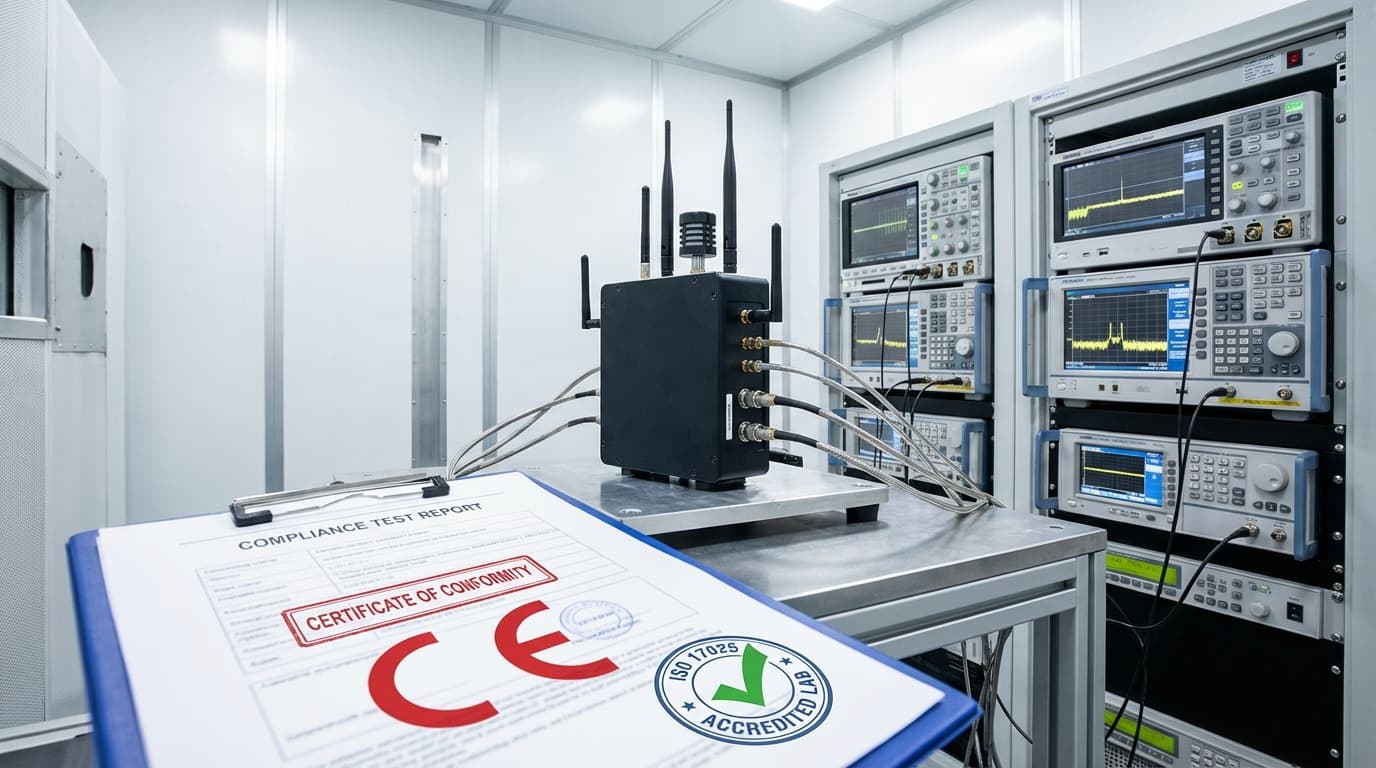
When you see "CE" on an air quality monitor, what does it actually mean? Most people assume it is a single certification — a test the device passed. In reality, for a cellular environmental monitoring device, CE marking under the EU Radio Equipment Directive requires passing five separate testing domains: electrical safety, electromagnetic compatibility, radio frequency performance, human exposure to electromagnetic fields, and — since the latest delegated act — cybersecurity.
Add MCERTS certification for regulatory-grade particulate measurement, IP65 ingress protection for outdoor deployment, RoHS compliance for hazardous substance restrictions, and ISO quality management standards, and the full certification stack for a professional outdoor air quality monitor involves over a dozen individual standards and test campaigns.
This article explains each certification, what it tests, and why it matters — whether you are an environmental consultant specifying equipment for a tender, a construction site manager evaluating monitoring suppliers, or a procurement team comparing products across manufacturers.
The Full Certification Stack at a Glance
Before diving into detail, here is the complete set of certifications and standards that apply to an outdoor, cellular-connected air quality monitor sold in the EU and deployed in the UK:
| Domain | Standard / Scheme | What It Covers |
|---|---|---|
| Electrical safety | EN IEC 62368-1:2020 | Protection from electrical, thermal, and mechanical hazards |
| Electromagnetic compatibility | ETSI EN 301 489-1 / -52 | The device does not interfere with — and is immune to — electromagnetic disturbances |
| Radio frequency | ETSI EN 301 908-1 / -13 | Cellular radio (LTE-M/NB-IoT) operates within spectrum rules |
| Human EMF exposure | EN IEC 62311:2020 | Radio emissions are safe for people near the device |
| Cybersecurity | EN 18031-1:2024 | Secure firmware, encrypted communication, credential management |
| Measurement accuracy | MCERTS Performance Standards | Particulate matter readings are accurate and legally defensible |
| Environmental protection | IP65 (IEC 60529) | Enclosure is dust-tight and protected against water jets |
| Hazardous substances | RoHS Directive 2011/65/EU | No lead, mercury, cadmium, or other restricted substances |
| Quality management | ISO 9001:2015 | Manufacturer operates a certified quality management system |
| Environmental management | ISO 14001:2015 | Manufacturer operates a certified environmental management system |
Every one of these has a purpose. None is optional for a professional-grade device intended for regulatory monitoring on construction sites, industrial perimeters, or urban environments.
CE Marking Under the Radio Equipment Directive
CE marking is not a certification — it is a legal declaration by the manufacturer that the product meets all applicable EU directives. For a cellular environmental monitor, the primary directive is the Radio Equipment Directive (RED) 2014/53/EU, which governs any device that intentionally transmits or receives radio waves.
The RED requires compliance with four articles, each with its own set of harmonised standards:
Article 3(1)(a) — Safety: EN IEC 62368-1
What it tests: EN IEC 62368-1:2020 is the safety standard for audio/video, information, and communication technology equipment. It replaces the older EN 60950-1 (IT equipment) and EN 60065 (audio/video) with a unified, hazard-based safety framework.
The testing covers:
- ·Electrical energy hazards — can the device deliver a dangerous electric shock? The Sensorbee Air Pro 2 operates at 5–20 V DC with a maximum 500 mA input, well below hazardous voltage thresholds, but the standard requires verification regardless.
- ·Thermal hazards — does the device overheat under normal operation or fault conditions? Surface temperatures must remain within safe limits even when the battery is charging in direct sunlight.
- ·Mechanical hazards — are there sharp edges, pinch points, or structural weaknesses that could cause injury? For an IP65-sealed outdoor enclosure, this includes assessing the housing integrity.
- ·Fire hazards — can the device ignite or sustain fire? The 20 Ah lithium battery and solar charging circuit require particular scrutiny under fire enclosure requirements.
- ·Chemical hazards — does the device expose users to harmful substances during normal use or foreseeable misuse?
Why it matters for monitoring: These devices deploy outdoors on construction sites, on building facades, and on industrial perimeters — environments where workers interact with them. A battery-powered, solar-charged device sitting in 40 °C direct sunlight must not present a safety risk. The 78-page safety test report for the Sensorbee Pro 2 documents testing against every applicable clause, including European deviations.
Article 3(1)(b) — Electromagnetic Compatibility: EN 301 489

What it tests: EMC testing has two sides — emissions and immunity. The device must not emit electromagnetic interference that disrupts other equipment, and it must continue functioning correctly when subjected to external electromagnetic disturbances.
The applicable standards are ETSI EN 301 489-1 (common requirements for all radio equipment) and ETSI EN 301 489-52 (specific requirements for cellular UE devices).
Emissions testing:
- ·Conducted emissions (150 kHz – 30 MHz) — measuring electrical noise the device sends back through its power supply and connected cables
- ·Radiated emissions (30 MHz – 6 GHz) — measuring electromagnetic energy the device unintentionally broadcasts into the environment
- ·Harmonic current emissions — verifying the device does not distort the AC mains supply waveform
- ·Voltage fluctuations and flicker — confirming the device does not cause visible light flicker in connected lighting circuits
Immunity testing:
- ·Electrostatic discharge (ESD) — can the device survive static electricity discharges of up to 8 kV contact and 15 kV air discharge, as specified by EN 61000-4-2?
- ·Radiated RF immunity — does the device continue functioning when bombarded by external radio frequency fields (EN IEC 61000-4-3)?
- ·Electrical fast transients (EFT/burst) — can the device handle rapid voltage spikes on its power and data lines (EN 61000-4-4)?
- ·Surge immunity — can the device survive power line surges from lightning strikes or switching events (EN 61000-4-5)?
- ·Conducted RF immunity — does the device withstand RF energy coupled into its cables (EN IEC 61000-4-6)?
- ·Voltage dips and interruptions — how does the device behave during mains power brownouts and blackouts (EN IEC 61000-4-11)?
Why it matters for monitoring: Construction sites and industrial environments are electromagnetically harsh. Heavy machinery, generators, welding equipment, and radio communications all create interference. An air quality monitor that loses cellular connectivity or produces erratic readings when a crane starts up nearby is useless. EMC immunity testing verifies the device performs reliably in exactly these conditions.
Article 3(2) — Radio Frequency Performance: EN 301 908
What it tests: RF testing verifies that the device's cellular radio operates within its allocated spectrum correctly and efficiently, using only the power levels and bandwidths it is authorised to use.
The applicable standards are ETSI EN 301 908-1 (common requirements for IMT cellular networks) and ETSI EN 301 908-13 (specific requirements for E-UTRA / LTE user equipment).
The testing covers:
- ·RF output power — the device transmits at the correct power levels (the Sensorbee Pro 2 operates as LTE Power Class 3 at a maximum 25.4 dBm)
- ·Occupied bandwidth and power spectral density — the signal stays within its allocated channel
- ·Spurious emissions — the device does not leak RF energy into adjacent frequency bands
- ·Unwanted emissions — conducted and radiated emissions outside the operating band are below regulatory limits
- ·Receiver sensitivity and selectivity — the device can receive weak signals and reject interference from adjacent channels
For the Sensorbee Pro 2, testing covers both operating bands: LTE CAT-M Band 8 (880–915 MHz, used across Europe) and Band 20 (832–862 MHz, the 800 MHz band widely deployed for IoT across the EU and UK).
Why it matters for monitoring: A cellular monitor that transmits too much power wastes battery and causes interference to other users of the spectrum. One that does not comply with spectrum regulations cannot legally operate on EU cellular networks. RF testing ensures reliable connectivity while respecting the shared radio spectrum — critical for devices that must maintain continuous data transmission from remote outdoor locations.
Article 3(1)(a) — Human Exposure to EMF: EN IEC 62311
What it tests: This assessment verifies that the device's radio emissions do not exceed the exposure limits defined in EU Council Recommendation 1999/519/EC for protection of the general public from electromagnetic fields (0 Hz to 300 GHz).
For the Sensorbee Pro 2, the assessment is computational rather than requiring full SAR (Specific Absorption Rate) testing. At the specified minimum separation distance of 20 cm (the device is a fixed outdoor installation, not a handheld device), the maximum EIRP of 28 dBm (0.63 W) produces power density levels well below the EU exposure limits:
- ·Band 8 (900 MHz): measured 1.26 W/m² against a limit of 4.4 W/m² — 29% of the limit
- ·Band 20 (800 MHz): measured 1.26 W/m² against a limit of 4.16 W/m² — 30% of the limit
Why it matters for monitoring: Although an outdoor monitoring station is not held against the body like a mobile phone, workers on construction sites may spend extended periods near the device — installing it, maintaining it, or working near a boundary fence where monitors are mounted. EMF compliance confirms the device is safe in all foreseeable deployment scenarios.
Article 3(3)(d) — Cybersecurity: EN 18031-1
The newest addition to the RED certification requirements, and arguably the most complex. EN 18031-1:2024 defines eleven security mechanism categories that every internet-connected radio device must implement — covering secure firmware updates, encrypted communications, hardware-backed credential storage, access control, and device resilience.
We have published a separate, detailed article on this standard: EN 18031-1: What the EU Cybersecurity Standard Means for IoT Environmental Monitors. That article explains each mechanism category, how the LwM2M protocol inherently satisfies many of the requirements, and what questions to ask your monitoring supplier about their cybersecurity compliance.
Why it matters for monitoring: Environmental monitoring data informs regulatory decisions, planning condition compliance, and public health assessments. If a device's firmware can be tampered with, its credentials compromised, or its communication intercepted, the integrity of that data — and every decision based on it — is undermined.
Beyond CE: MCERTS Certification
CE marking confirms the device is safe, electromagnetically compatible, spectrum-compliant, EMF-safe, and cyber-secure. What it does not confirm is whether the device measures anything accurately.
That is where MCERTS certification comes in. Administered by the UK Environment Agency, MCERTS is an independent, third-party certification that verifies an air quality monitor produces particulate matter measurements (PM10 and PM2.5) of sufficient accuracy for regulatory purposes.
The MCERTS process involves:
- ·Laboratory testing at CSA Group's facilities — accuracy, precision, linearity, detection limits, and environmental exposure testing across temperature (-10 °C to 40 °C) and humidity ranges
- ·Extended field collocation — a minimum 12 weeks alongside reference-grade gravimetric samplers (EN 12341:2014)
- ·Statistical equivalence demonstration — regression analysis proving the monitor produces data equivalent to the reference method
- ·Manufacturing quality audit — ensuring every production unit meets the same standard as the tested samples
MCERTS is not mandatory for every monitoring application, but it is increasingly required by planning conditions for construction sites, environmental permits for industrial facilities, and tender specifications from local authorities and environmental consultancies. Data from MCERTS-certified equipment carries significantly more weight in enforcement proceedings, planning appeals, and public inquiries.
For the full explanation of MCERTS — what it covers, who needs it, and how the certification process works — see our dedicated article: What Is MCERTS Certification and Why Does It Matter?
IP65 Ingress Protection
IP65 is not a certification in the directive sense — it is a protection rating defined by IEC 60529 (Degrees of Protection Provided by Enclosures). But for outdoor environmental monitoring, it is non-negotiable.
The two digits mean:
- ·6 (first digit — solids): Dust-tight. Complete protection against ingress of dust. No dust whatsoever can enter the enclosure.
- ·5 (second digit — liquids): Protected against water jets. Water projected from a 6.3 mm nozzle at 12.5 litres per minute from any direction for at least 3 minutes must not cause harmful effects.
For monitoring stations deployed outdoors in the UK — where driving rain, construction dust, coastal salt spray, and temperature extremes from -10 °C to 40 °C are routine conditions — IP65 protection ensures the sensor optics, electronics, and connectors remain functional throughout multi-year deployments.
Many indoor air quality sensors carry IP20 or IP40 ratings, which provide no meaningful protection against moisture or dust. Deploying these devices outdoors, even in a makeshift housing, does not provide the protection that a purpose-built IP65 enclosure delivers.
RoHS Compliance
The Restriction of Hazardous Substances Directive (2011/65/EU, as amended by 2015/863/EU) restricts the use of specific hazardous materials in electrical and electronic equipment: lead, mercury, cadmium, hexavalent chromium, polybrominated biphenyls (PBB), polybrominated diphenyl ethers (PBDE), and four additional phthalates.
RoHS compliance is a legal requirement for any electronic device placed on the EU market. It is not optional, and it applies to every component — from the main PCB to connectors, solder, and cable insulation.
ISO 9001 and ISO 14001
These are manufacturer-level certifications, not product-specific:
- ·ISO 9001:2015 certifies that the manufacturer operates a quality management system covering design, production, testing, and after-sales support. It means every unit is built to a documented, auditable standard.
- ·ISO 14001:2015 certifies the manufacturer operates an environmental management system — demonstrating commitment to reducing the environmental impact of their own operations.
Both are independently audited and require ongoing surveillance to maintain.
What Most Competitors Actually Certify
Looking across the outdoor air quality monitoring market, the certification depth varies enormously:
| Manufacturer | MCERTS | CE (Detailed) | Cybersecurity (EN 18031-1) | IP Rating |
|---|---|---|---|---|
| Sensorbee | Yes (PM10, PM2.5) | Full RED with all 5 domains | Self-declaration published | IP65 |
| Aeroqual | Yes (Dust Sentry) | Listed | Not published | IP65 |
| Turnkey Instruments | Yes (iPM Plus, Topas, Osiris) | Listed | Not published | Varies |
| AQMesh | Yes | Listed | Not published | IP65 |
| Earthsense | Yes (Zephyr) | Listed | Not published | IP65 |
| Oizom | Yes (Dustroid Pro only) | CE, FCC | Not published | Varies |
| Sonitus Systems | Yes (noise + dust) | Listed | Not published | Varies |
The pattern is clear: most manufacturers list "CE" as a single line item without explaining the five testing domains behind it. Almost none have published EN 18031-1 cybersecurity compliance evidence. Several carry MCERTS for specific products but not their full range.
"CE" without detail is a red flag. CE marking is a self-declaration — the manufacturer declares that testing has been done. But without transparency about which standards were tested, which laboratory conducted the testing, and what the test reports contain, the declaration is impossible to verify.
Sensorbee's Certification Stack
The Sensorbee Air Pro 2 Cellular (models SB8202 and SB8203) holds the following certifications, all backed by published test reports and evidence documents:
| Certification | Standard | Report / Certificate |
|---|---|---|
| CE — Safety | EN IEC 62368-1:2020+A11:2020 | LGT25K176SA01 (78 pages) |
| CE — EMC | ETSI EN 301 489-1 V2.2.3, EN 301 489-52 V1.3.1 | LGT25K176EM01 (64 pages) |
| CE — RF | ETSI EN 301 908-1 V15.2.1, EN 301 908-13 V13.3.1 | LGT25K176RF01 (17 pages) |
| CE — EMF | EN 50665:2017, EN IEC 62311:2020 | LGT25K176HA01 (7 pages) |
| CE — Cybersecurity | EN 18031-1:2024 | Self-declaration published |
| CE — Verification | RED 2014/53/EU (all articles) | LGT25K176C01 |
| MCERTS | MCERTS Performance Standards (PM10, PM2.5) | CSA MC250462/00 |
| RoHS | Directive 2011/65/EU, 2015/863/EU | Declared in EU DoC |
| IP65 | IEC 60529 | Verified by design and test |
| ISO 9001 | ISO 9001:2015 | Manufacturer certified |
| ISO 14001 | ISO 14001:2015 | Manufacturer certified |
The EU Declaration of Conformity and CE RED Verification are available for download:
- ·Download: EU Declaration of Conformity — RED (PDF)
- ·Download: CE RED Verification of Compliance (PDF)
- ·Download: EN 18031-1 Cybersecurity Compliance Evidence (PDF)
For MCERTS and ISO certificates, see our certifications page.
What This Means for Procurement
When evaluating outdoor air quality monitoring equipment, certification should be part of your assessment alongside measurement capability, data platform features, and total cost of ownership.
Three practical recommendations:
- Ask to see the EU Declaration of Conformity. Every CE-marked device must have one. It should list every harmonised standard tested against, by name and version number. If the DoC is vague or unavailable, that is a concern.
- Check the depth behind CE. Does the manufacturer's documentation show separate test reports for safety, EMC, RF, EMF, and cybersecurity? Or is CE just a logo on the housing? The difference matters — especially for devices deployed on regulated construction sites where monitoring data has legal significance.
- Verify MCERTS covers your parameters. Some manufacturers hold MCERTS for noise but not dust, or for PM10 but not PM2.5. Check that the certification covers the specific parameters your planning conditions or permit require.
The certification stack is not just a regulatory hurdle — it is evidence that the manufacturer takes every aspect of their product seriously, from the safety of the battery to the integrity of the firmware to the accuracy of the sensor. At Sensorbee, we publish our compliance evidence because we believe transparency builds trust. For a complete list of Sensorbee's certifications with downloadable certificates and test documentation, see our certifications page.
Download our product catalogue to learn more about Sensorbee's monitoring solutions, or contact us to discuss your requirements.
Frequently Asked Questions
What certifications does an outdoor air quality monitor need?
An outdoor, cellular-connected air quality monitor sold in the EU needs CE marking under the Radio Equipment Directive 2014/53/EU (covering safety per EN IEC 62368-1, electromagnetic compatibility per EN 301 489, radio frequency performance per EN 301 908, EMF human exposure per EN IEC 62311, and cybersecurity per EN 18031-1), RoHS compliance, and IP65 ingress protection for outdoor deployment. For regulatory monitoring in the UK, MCERTS certification from the Environment Agency is additionally required or strongly recommended. Manufacturer-level ISO 9001 and ISO 14001 certifications provide further quality assurance.
What does CE marking actually test for air quality monitors?
For a cellular air quality monitor, CE marking under the Radio Equipment Directive requires passing five separate testing domains: electrical safety (EN IEC 62368-1 — protection from shock, fire, thermal, and mechanical hazards), electromagnetic compatibility (EN 301 489 — the device does not cause interference and is immune to external electromagnetic disturbances), radio frequency performance (EN 301 908 — the cellular radio operates correctly within its spectrum allocation), EMF human exposure (EN IEC 62311 — radio emissions are safe for people near the device), and cybersecurity (EN 18031-1 — secure firmware updates, encrypted communications, and proper credential management).
What is the EU Radio Equipment Directive (RED)?
The Radio Equipment Directive 2014/53/EU is the EU legislation governing any device that intentionally transmits or receives radio waves. It requires manufacturers to demonstrate compliance with essential requirements covering safety (Article 3.1a), electromagnetic compatibility (Article 3.1b), efficient use of radio spectrum (Article 3.2), and — since the delegated act — cybersecurity and network protection (Article 3.3d). Any cellular environmental monitor using LTE-M, NB-IoT, 4G, or 5G connectivity falls under the RED.
What is EN IEC 62368-1 and why does it matter for environmental monitors?
EN IEC 62368-1:2020 is the harmonised European safety standard for audio/video, information, and communication technology equipment. It uses a hazard-based approach to verify that a device does not present electrical, thermal, mechanical, fire, or chemical hazards to users. For outdoor environmental monitors — which contain lithium batteries, solar charging circuits, and are deployed in extreme temperature ranges on construction sites — safety testing confirms the device can operate safely in all foreseeable conditions without risk to workers or the public.
What is EN 301 489 EMC testing?
ETSI EN 301 489 is the electromagnetic compatibility standard for radio equipment. Testing has two components: emissions testing (verifying the device does not emit interference that disrupts other equipment) and immunity testing (verifying the device continues functioning correctly when subjected to electrostatic discharge, radio frequency interference, power surges, electrical fast transients, and voltage dips). For monitoring stations deployed on construction sites alongside heavy machinery, generators, and welding equipment, EMC immunity is critical to ensuring reliable, uninterrupted operation.
Is MCERTS certification the same as CE marking?
No. CE marking and MCERTS certification are entirely different schemes that test different things. CE marking confirms a device meets EU requirements for safety, electromagnetic compatibility, radio performance, EMF exposure, and cybersecurity — it says the device is safe and legal to sell. MCERTS certification, administered by the UK Environment Agency, confirms the device produces accurate and reliable environmental measurements — it says the data can be trusted for regulatory purposes. A device needs both: CE to be legally sold, and MCERTS for its monitoring data to be accepted by UK regulators.
What is IP65 and why does an air quality monitor need it?
IP65 is an ingress protection rating defined by IEC 60529. The first digit (6) means the enclosure is completely dust-tight — no dust can enter. The second digit (5) means it is protected against water jets from any direction. For outdoor air quality monitors deployed on construction sites, industrial perimeters, and urban locations in the UK, IP65 protection is essential to prevent rain, dust, and environmental contamination from damaging sensor optics, electronics, and connectors over multi-year deployments.
How do I verify a manufacturer's CE marking claims?
Ask the manufacturer for their EU Declaration of Conformity (DoC) — every CE-marked device must have one. The DoC should list the specific harmonised standards tested against, by name and version number. Look for separate test report references for safety (EN IEC 62368-1), EMC (EN 301 489), RF (EN 301 908), EMF (EN IEC 62311), and cybersecurity (EN 18031-1). If the manufacturer cannot provide a detailed DoC or references to individual test reports, their CE marking claim may not be backed by the full testing required under the Radio Equipment Directive.
Do these certifications apply outside the EU?
The EU Radio Equipment Directive and CE marking apply to the EU and EEA (European Economic Area, which includes Norway, Iceland, and Liechtenstein). However, many of the underlying harmonised standards — EN IEC 62368-1 for safety, the EN 301 489 EMC framework, and EN 18031-1 for cybersecurity — are recognised or mirrored by regulatory frameworks in other jurisdictions. MCERTS is UK-specific but is recognised across England, Scotland, Wales, and Northern Ireland. Many countries outside the EU accept CE-marked products or have mutual recognition agreements, making the EU certification stack a strong baseline for international deployment.
What certifications does the Sensorbee Air Pro 2 hold?
The Sensorbee Air Pro 2 Cellular (models SB8202 and SB8203) holds full CE marking under the Radio Equipment Directive with tested compliance across all five domains (safety, EMC, RF, EMF, and cybersecurity), MCERTS certification for PM10 and PM2.5 indicative ambient particulate monitoring, IP65 ingress protection, RoHS compliance, and is manufactured under ISO 9001 and ISO 14001 certified quality and environmental management systems. The EU Declaration of Conformity, CE verification, and EN 18031-1 cybersecurity compliance evidence are all available for download on the Sensorbee website.

Oscar Sjöberg
Partner & Embedded Software Engineering Manager