Construction dust monitoring explained: IAQM risk categories, PM10 trigger levels, MCERTS certification requirements, and how to meet Section 61 conditions.
Dust is the most visible pollutant on a construction site — and the one most likely to generate complaints, enforcement action, and project delays. A single demolition operation can send PM10 concentrations to 10 or 20 times the 24-hour limit within minutes. Neighbours see it on their cars, smell it in the air, and reach for their phones.
Yet dust monitoring on construction and industrial sites is not simply about measuring what you can see. The particles that cause the greatest health damage — PM2.5 and PM1 — are invisible to the naked eye. Effective dust monitoring requires measuring the right size fractions, at the right locations, with equipment that regulators will accept.
This guide covers the practical framework for dust monitoring on construction and industrial sites in the UK: what IAQM guidance requires, how MCERTS certification fits in, and how to deploy monitoring that satisfies Section 61 consent conditions.
What Dust Monitoring Measures — TSP, PM10, PM2.5, and PM1
Airborne dust is classified by particle size, and the classification determines both the health risk and the regulatory framework that applies.
| Fraction | Diameter | Behaviour | Primary concern |
|---|---|---|---|
| TSP | All sizes | Settles on surfaces, visible as dust clouds | Nuisance, soiling, visibility |
| PM10 | ≤10 µm | Remains airborne, penetrates upper airways | Respiratory disease, regulatory trigger metric |
| PM2.5 | ≤2.5 µm | Penetrates deep lungs, enters bloodstream | Cardiovascular disease, lung cancer |
| PM1 | ≤1 µm | Reaches alveoli and circulatory system | Systemic inflammation, long-term mortality |
On construction sites, mechanical activities — demolition, earthmoving, concrete cutting, material handling — generate predominantly coarse particles (PM10 and TSP). These are the fractions that trigger complaints and are the focus of IAQM construction dust guidance. However, diesel-powered plant and vehicles on site also produce fine particles (PM2.5 and PM1), which carry greater health risks per unit of exposure.
Nuisance dust (TSP) is what people see and complain about. Health-relevant dust (PM10 and PM2.5) is what regulators measure and enforce against. A comprehensive dust monitoring programme captures both.
For a detailed explanation of how particulate matter is classified, measured, and regulated, see our guide to PM1, PM2.5, and PM10 monitoring.
Why Construction Sites Need Dust Monitoring
Construction dust monitoring is not optional for most UK projects involving demolition, earthworks, or significant material handling. The regulatory and contractual drivers include:
- ·Section 61 consent conditions under the Control of Pollution Act 1974 routinely require continuous PM10 monitoring at site boundaries. Section 61 is the mechanism by which contractors agree noise, vibration, and dust limits with the local authority before works begin — and continuous monitoring is how compliance is demonstrated.
- ·Planning conditions imposed by local planning authorities frequently mandate dust monitoring for the duration of construction, particularly for projects near residential areas, schools, or hospitals.
- ·Section 80 notices under the Environmental Protection Act 1990 can require dust control measures and monitoring where a statutory nuisance has been established or is anticipated.
- ·IAQM guidance — the Institute of Air Quality Management's Guidance on the Assessment of Dust from Demolition and Construction (updated January 2024) provides the framework that most UK environmental consultants and local authorities use to assess dust risk and specify monitoring requirements.
- ·Neighbour complaints — even where monitoring is not formally required, proactive dust data provides evidence to resolve complaints quickly and defend against enforcement action.
The practical consequence is straightforward: for any medium or high-risk construction project, continuous dust monitoring is a condition of operating. Without it, a Section 60 notice can halt work.
IAQM Dust Risk Assessment and Trigger Levels
The IAQM framework classifies construction activities by dust risk, which determines the monitoring requirements.
Risk categories
The dust risk assessment considers four types of dust effect: demolition, earthworks, construction, and trackout. Each is rated low, medium, or high based on the scale of activity, proximity to receptors, and sensitivity of the receiving environment. The overall site risk determines the monitoring regime.
- ·Low risk — no continuous monitoring typically required. Visual inspections and reactive measures may suffice.
- ·Medium risk — real-time PM10 monitoring recommended at site boundaries nearest to sensitive receptors. Alert thresholds to trigger dust suppression measures.
- ·High risk — continuous PM10 monitoring required at multiple boundary positions. Automated alerts, real-time data access for site management and regulators, and formal reporting against consent conditions.
PM10 trigger levels
The IAQM guidance recommends a generic PM10 trigger level of 190 µg/m³ as a 15-minute or 1-hour mean for construction sites where a site-specific trigger has not been set. This is an action level — when exceeded, dust suppression measures must be initiated immediately.
The UK Air Quality Regulations set a 24-hour mean limit of 50 µg/m³ for PM10, with a maximum of 35 permitted exceedances per calendar year. While this is the national air quality standard rather than a construction-specific limit, local authorities frequently reference it in Section 61 conditions and planning obligations.
Many Section 61 consents use a tiered alert system:
| Level | PM10 threshold | Action |
|---|---|---|
| Alert | 150–190 µg/m³ (15-min mean) | Review activities, prepare suppression |
| Action | 190 µg/m³ (15-min mean) | Activate dust suppression immediately |
| Stop work | Sustained exceedance despite suppression | Cease dust-generating activities |
Site-specific trigger levels may be lower than the generic 190 µg/m³ figure, particularly near hospitals, care homes, or ecologically sensitive sites. The triggers for your project are set in the Section 61 consent or planning conditions — not by the IAQM guidance alone.
Dust Monitoring Beyond Construction
Construction is the most common context for dust monitoring in the UK, but the same principles apply across several industrial sectors.
Quarrying and minerals extraction — planning conditions for quarries routinely require boundary PM10 monitoring to demonstrate that operations do not cause exceedances at nearby receptors. Blasting, crushing, and material transport all generate significant dust.
Waste management and recycling — composting, shredding, and material handling at waste transfer stations produce airborne dust alongside odour and bioaerosols. Environmental permits typically require boundary monitoring.
Ports and bulk cargo handling — loading and unloading dry bulk cargoes (coal, grain, aggregate, cement) generates dust that drifts across port boundaries into adjacent communities. See our ports sector page for monitoring applications.
Industrial fenceline monitoring — manufacturing, processing, and materials handling facilities use boundary dust monitoring to demonstrate permit compliance and address community concerns. See our industrial monitoring sector page.
Demolition — demolition generates the highest short-term PM10 concentrations of any construction activity, with unmitigated operations producing levels 10 to 20 times the 24-hour limit. IAQM guidance treats demolition as a separate risk category.
How Dust Is Measured on Site
Three measurement approaches are used for construction and industrial dust monitoring. Each serves a different purpose.
Optical particle counting (real-time)
An optical particle counter (OPC) draws air through a measurement chamber where a laser illuminates individual particles. Each particle scatters light in proportion to its size, and a photodetector counts and classifies the scattering events. OPC instruments report PM1, PM2.5, PM10, and optionally TSP concentrations every second.
OPC is the only practical method for automated threshold alerts on construction sites. When PM10 reaches the trigger level, an alert fires within minutes — enabling dust suppression before the exceedance escalates.
Two design features separate reliable construction OPC instruments from unreliable ones. High air flow rate ensures large PM10 particles are drawn into the sensor rather than settling before reaching the inlet. A heated inlet element prevents humidity — common on UK sites — from being counted as particles, which inflates readings above approximately 80% relative humidity. Instruments lacking either feature produce unreliable PM10 data in field conditions.
Gravimetric method (reference)
The gravimetric method (EN 12341) is the regulatory reference standard. Air is drawn through a size-selective inlet onto a pre-weighed filter for 24 hours, then reweighed in a laboratory. This provides the most accurate mass concentration but delivers results 24–48 hours after sampling — too slow for active site management. Gravimetric data is used for compliance reporting and calibration verification, not for real-time dust control.
Beta attenuation and TEOM
Beta attenuation monitors (BAM) and Tapered Element Oscillating Microbalance (TEOM) instruments provide near-reference-quality data in real time but are expensive, require mains power, and need weatherproof enclosures. They are standard in national monitoring networks but impractical for temporary construction deployments where mains power is unavailable and monitoring positions change as the project progresses.
Why MCERTS Certification Matters for Dust Monitoring
MCERTS — the Environment Agency's Monitoring Certification Scheme — provides quality assurance for environmental monitoring equipment. For dust monitors, the relevant category is Indicative Ambient Particulate Monitors.
MCERTS certification requires the instrument to demonstrate less than ±50% uncertainty against reference gravimetric methods over 80 days of comparative testing, and the manufacturer to pass a production quality audit.
Why it matters on construction sites: regulators in England and Wales expect MCERTS-certified equipment for dust monitoring specified in Section 61 consents, environmental permits, and planning conditions. Data from non-certified instruments risks being challenged or rejected during enforcement proceedings — even if the instrument is technically accurate.
Not all MCERTS monitors are equally suited to construction sites. Some certified instruments require mains power, enclosed housings, or manual data retrieval — impractical at a site boundary without grid electricity. The monitors best suited to construction combine MCERTS certification with solar power, cellular data transmission, and robust outdoor housing.
For more on what MCERTS means and how it applies to air quality monitoring, read our article on why MCERTS certification matters for construction site dust monitoring. For a full list of Sensorbee's certifications, visit our certifications page.
Dust Monitoring with Sensorbee — MCERTS-Certified, Solar-Powered
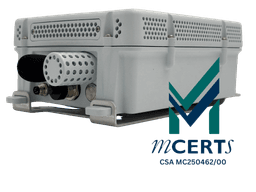
The Sensorbee Particle Matter Module (SB4102) is a MCERTS-certified optical particle counter that measures PM1, PM2.5, and PM10 simultaneously. It uses a 2.5 lpm air flow rate for reliable PM10 measurement and includes a heated inlet element that activates above 60% humidity — addressing the two most common causes of inaccurate construction dust data.
Each SB4102 module is individually 3-point calibrated against reference standards and ships with its own calibration certificate, providing the measurement traceability that regulatory submissions require.
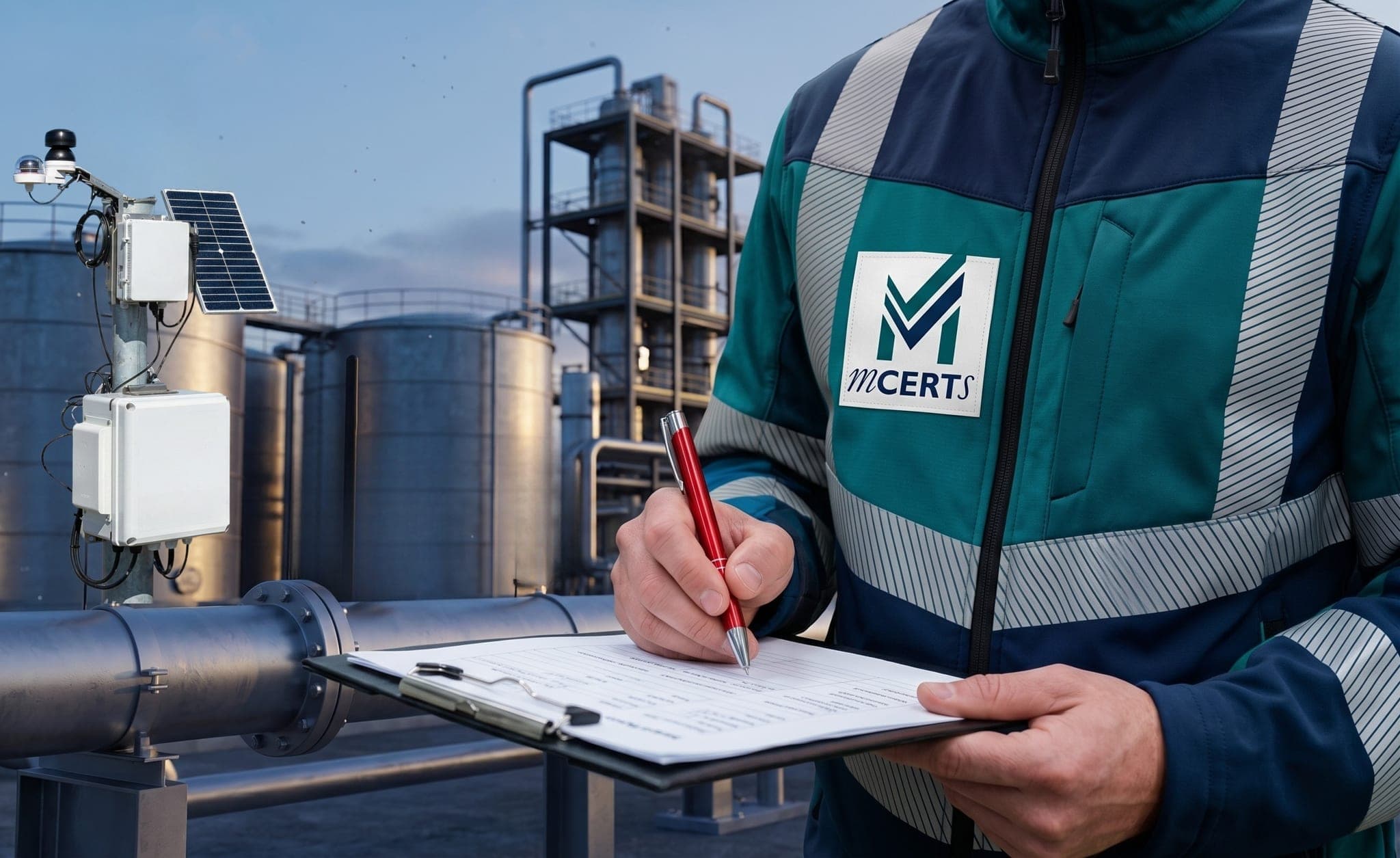
Paired with the Sensorbee Air Pro 2 (SB8202) base station, the PM module operates entirely on solar power with NB-IoT or LTE-M cellular connectivity. No mains power, no site Wi-Fi, no manual data retrieval. Deploy at a site boundary in under five minutes and receive real-time PM10 data on a cloud dashboard with configurable alert thresholds. For a detailed comparison of the Sensorbee SB4102 against the Aeroqual Dust Sentry — including heated inlet design, power options, and multi-parameter capability — see our Sensorbee vs Aeroqual comparison.
Why combined dust, noise, and vibration monitoring matters
Section 61 consents typically set conditions for dust, noise, and vibration simultaneously. With conventional equipment, that means three separate instruments at each boundary position — three power connections, three data platforms, and three maintenance schedules.
The Sensorbee Pro2 accepts the PM module alongside the Sound Level Metre (SB4652) for LAeq, LAFmax, and LN percentile measurement, and the Vibration Sensor (SB3641) for PPV and dominant frequency analysis. One solar-powered station provides all three parameters from a single installation point, with unified data on one dashboard.
For a project with four boundary monitoring positions, this replaces 12 separate instruments with four Pro2 stations — deployed in under 20 minutes total. Read more about this approach in our article on why dust, noise, and vibration need a single solution. To see how this works specifically on a UK site under Section 61, visit our construction dust monitoring page — or pair it with the construction noise and construction vibration sector pages for the full NDV picture.
Frequently Asked Questions
What dust monitoring is required on construction sites?
For medium and high-risk sites assessed under IAQM guidance, continuous real-time PM10 monitoring at site boundaries is the standard requirement. Section 61 consents and planning conditions typically specify MCERTS-certified instruments, automated alerts when trigger levels are exceeded, and real-time data access for site managers and regulators. Low-risk sites may require only visual inspections and reactive dust suppression.
What is the IAQM PM10 trigger level for construction?
The IAQM recommends a generic PM10 trigger level of 190 µg/m³ as a 15-minute or 1-hour mean concentration. This is an action level — when exceeded, dust suppression must be activated immediately. Site-specific triggers may be set lower, particularly near sensitive receptors. The UK Air Quality Regulations 24-hour mean limit of 50 µg/m³ for PM10 is also commonly referenced in Section 61 conditions.
Do I need MCERTS-certified dust monitoring equipment?
In England and Wales, regulators expect MCERTS-certified equipment for dust monitoring required under Section 61 consents, environmental permits, and planning conditions. While there is no absolute legal mandate in all situations, using non-certified equipment risks having your monitoring data challenged or rejected during enforcement proceedings. For any project where compliance data will be submitted to regulators, MCERTS certification is effectively essential.
Can one device monitor dust, noise, and vibration together?
Yes. Modular monitoring stations like the Sensorbee Air Pro 2 combine a MCERTS-certified PM module with noise and vibration sensors on a single solar-powered unit. This provides all three parameters required for Section 61 compliance from one device at each boundary position, with unified data on a single cloud dashboard. The alternative is deploying three separate instruments at each location, each with its own power supply and data platform.